My 2015 Vericon Schedule

March 19, 2015

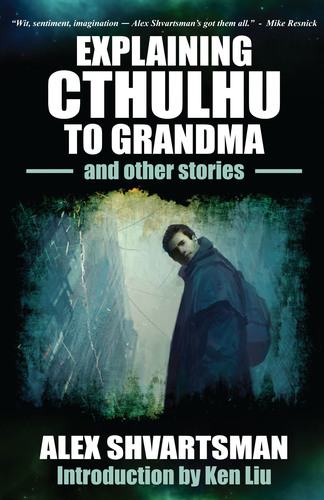
vericonThis weekend I’ll be attending Vericon — Harvard University’s annual science fiction convention.  This is a small affair with only a dozen or so guests and a handful of panels, but their other guests are top notch: this year’s roster includes Patrick and Teresa Nielsen-Hayden, Mary Robinette Kowal, Jo Walton, Will McIntosh and a plethora of other fine authors and editors. Ken Liu is the guest of honor (and also happens to be an alum).

I’m very excited to re-visit Boston, to visit Harvard for the first time, and to get to speak, participate on panels, and even do a reading there. I will stick around all weekend long, but these are the panels/functions I’m currently scheduled for, so come by and hear me (and people much smarter than me) speak, should you be so inclined:

Friday

7pm – Editing and Translating Genre Fiction (KL, AL, AS, PNH)  – Sever Hall 113

8pm – Diversity, Intersectionality, and Variety (DJO, KL, MRK, AS, JW) – Sever Hall 113

Saturday

7pm – Alex Shvartsman Reading – Sever Hall 102

8pm – Milk & Cookies – Story Reading & Snacks – Lowell Lecture Hall Basement

Sunday

11am – The Joys and Perils of Writing Short (MRK, KL, WM, GG, PNH, AS) – Sever Hall 111

#SFWAPro


Lots of cool news (with pictures)

March 17, 2015

YearsBest2013-195x300

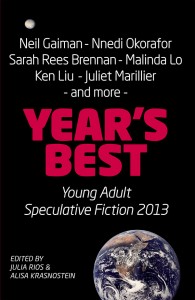
Twelfth Planet Press announced the Honorable Mention list for the 2013 Year’s Best Young Adult Speculative Fiction. I’m very honored to have my story “Things We Leave Behind” included on this list! Ken Liu’s story from UFO2, “The MSG Golem” has made the list as well.

You can read Things We Leave Behind at Daily Science Fiction, where it was originally published. You can also listen to the story podcasted at Cast of Wonders, and narrated by me!


Crains

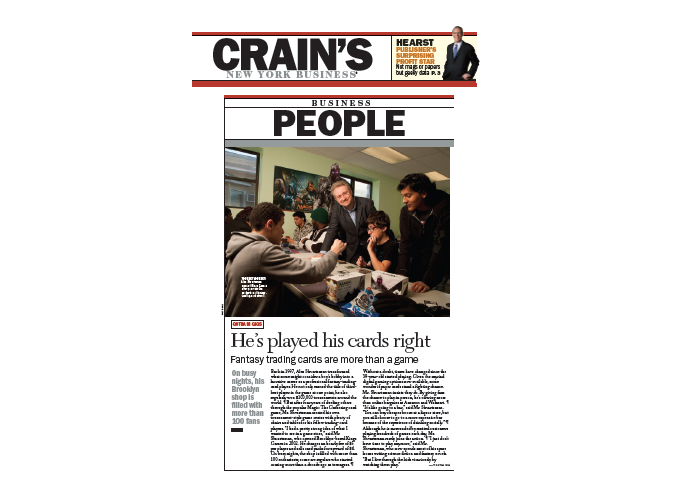
The May 16 issue of Crain’s New York Business Journal ran a profile on me in my capacity as owner and operator of Kings Games. All I have is this thumbnail for now, but I’m expecting some copies in the mail and am looking forward to reading the article.


Informator


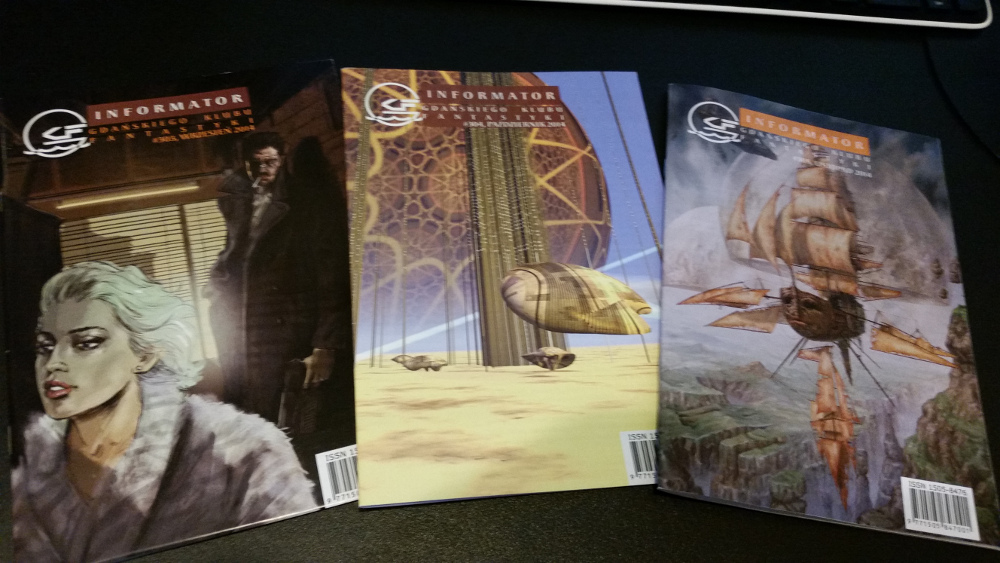
These are the contributor copies of Informator Gdanskiego Klubu Fantastyki, which has been publishing my Tales of the Elopus mini-stories translated into Polish, one per issue. You can also see the PDF issues online, here. (Click on the magazine cover at top right.)


missiontomorrow
Editor Bryan Thomas Schmidt shared the cover art of Mission: Tomorrow, his anthology forthcoming from Baen this November which includes my story “The Race for Arcadia.” This will be my second appearance in a Baen anthology, after this summer’s release of the latest Chicks in Chainmail volume.

#SFWAPro


The Hook: Death Marked by Leah Cypess

March 13, 2015

DeathMarked HC cThe Hook:

The mirror shattered into a hundred pieces, a sudden explosion followed by a cascade of jagged shards. Ileni whirled, throwing her hands up in front of her face, but nothing hit her: no sharp pieces of glass, no sting of cut flesh. After a moment, she lowered her arms and crossed them over her chest.

The broken fragments of glass hovered in the air, glimmering with rainbow colors. Then they faded back into the mirror, smoothing into a shiny, unbroken oval.

“Impressive,” Ileni said. She had no idea who she was talking to, but it wasn’t difficult to sound unafraid. After six weeks in the Assassins’ Caves and three days as a prisoner of imperial sorcerers, false courage was second nature to her. “But since I’m the only one here, it seems a waste of effort.”

Leah Cypess writes:

This is the sequel to Death Sworn, a novel in which a naive ex-sorceress is entombed in a cave full of assassins in training — and discovers that her entire life was built on a lie. In Death Marked, Ileni is determined to find the truth for herself. But the answers she is seeking lie in the Imperial Academy of Sorcery, a place where danger and temptation sit side by side. If her true purpose is discovered, she won’t escape alive. But once she discovers what the imperial sorcerers can offer her, she may not want to leave at all.

Except this place has its secrets, too.

The truth is never purely evil or purely good. And Ileni no longer knows whose side she is on.

Most of my critique partners expected me to start Death Marked right where Death Sworn ended. Instead, I jumped ahead 3 days so I could start with a bang (literally), and begin with Ileni situated exactly where her struggles and conflicts throughout the book would take place. She’s a prisoner in a strange new place, and discovering the secrets of this place will form the heart of the novel.

My decision made the beginning a bit less straightforward to write. I still had to explain what happened in those three days, not to mention what happened in the first book. This required me to violate the no-flashbacks-in-the-first-chapter rule, though fortunately that’s a rule I’ve never been that fond of. The trick was explaining the past in short bursts that wouldn’t slow down the forward action of the new story, while still making the sequence of events easy to understand. Beginnings are usually easy for me, but I reworked this one at least ten times. Maybe that’s typical for sequels — I guess I’ll find out when I find the fortitude to write another one!

Buy Death Marked on Amazon

About the author:

Leah Cypess is the author of several young adult fantasy novels published by HarperCollins. Her latest book, Death Marked, is the second in a duology about a sorceress forced to serve as magic tutor to a secret sect of assassins. She has also published several pieces of short fiction, including the Nebula-nominated “Nanny’s Day” (Asimov’s Science Fiction, March 2012). She lives in the D.C. area with her family. You can find out more about her at www.leahcypess.com, or connect with her on Facebook or Twitter (@LeahCypess).

###

#SFWAPro

If you’re an author with a book coming out soon and you wish to participate on The Hook, please read this.


RIP Terry Pratchett

March 12, 2015

This is not what I wanted to write about today.

Terry Pratchett, best known for his series of Discworld novels, was one of the most important voices in speculative humor.  His work had a profound influence on generations of writers, and brightened lives of millions of readers worldwide. I never personally met him or got an opportunity to work with him, and feel there is little I can say to add to the loud chorus of voices more eloquent and more relevant on this subject than my own, but I will say this: whether you are a long-time fan or are learning about him now, should you wish to honor his memory, the best way to do so is by reading (or re-reading) one of his books.

A few years ago I reached out to Mr. Pratchett to see if I might be able to acquire a reprint (or, who knows, even an original story!) for one of the UFO volumes. His agent got back to me and declined to sell me a reprint, because there would be a short story collection coming out soon and he wasn’t interested in shopping short story reprints around, at least not at the rates UFO could afford. And so I didn’t get to publish Terry, but although this collection took longer than expected, it is actually coming out in less than a week.

I’ll be picking up a copy of “A Blink of the Screen” and humbly suggest that you do so as well.

blink

There is a number of much happier news I’d like to share as well:

* The Unidentified Funny Objects 4 Kickstarter campaign is going well. After three days, we have nearly 120 backers and are only a few hundred dollars away from 50% of the funding. There’s always a slow-down in the middle (offset by lots of activity in the first few and last few days of the campaign), but momentum counts, so if you plan on backing this book, please don’t wait for the last day!

* I accepted a flash story by Brent C. Smith titled “The Transformation of Prince Humphrey” for UFO4. I read an earlier version of this story in a contest we both participated in, and out of 200+ stories I read for that contest it was my favorite. So I reached out to him and, after a few rounds of edits, accepted the updated variant of the story for the book. Don’t worry though: there’s plenty of room for stories that will come in during the open submission period next month!

* Two of my own stories found new homes (well, the same home, actually.)  Mike Resnick accepted both for publication in Galaxy’s Edge.

“Islands in the Sargasso” is an 8000-word space opera novelette in the shared world setting regular readers of Galaxy’s Edge are already familiar with. I had the pleasure of advancing the setting by 200 years and allowing humans to finally escape the confines of our solar system — but you’ll have to read the story to learn the details.

“Dreidel of Dread: The Very Cthulhu Channukah” is one of the silliest humor flash pieces I’ve ever written. It makes fun of saccharine Christmas specials, uses copious amounts of Jewish humor, quotes both Einstein and The Ghostbusters film… and, of course, there’s Cthulhu!

Both stories should be appearing in GE later this year.

#SFWAPro


UFO4 Kickstarter Campaign is Now Live

March 9, 2015

Today I launched the Kickstarter campaign for Unidentified Funny Objects 4 – the 4th annual collection of humorous science fiction and fantasy. This will be our first themed volume, and will feature stories by George R.R. Martin, Neil Gaiman, Piers Anthony, Esther Friesner, Mike Resnick, Karen Haber, Jody Lynn Nye, Gini Koch, Karen Haber and Tim Pratt.

There will be a submission window in April so that newer authors have a chance at sharing the table of contents with these established pros. All authors will be paid at pro rates.

And, of course, there’s a gorgeous and funny cover, by Tomasz Maronski:

image description

Please check out the campaign page, and help me spread the word of it to others? #SFWAPro

ufokickstarter


The Hook: Sing Me Your Scars by Damien Angelica Walters

March 9, 2015


SMYS_large

The Hook:

This is not my body.

Yes, there are the expected parts—arms, legs, hips, breasts—each in its proper place and of the proper shape.

Is he a monster, a madman, a misguided fool? I don’t know. I don’t want to know. But this is not my body.

#

The rot begins, as always, around the stitches. This time, the spots of greyish-green appear on the left wrist, and there is an accompanying ache, but not in the expected way. It feels as though there is a great disconnect between mind and flesh, a gap that yearns to close but cannot. I say nothing, but there is no need; Lillian’s weeping says it with more truth than words.

The hands are hers.

“Please don’t show him yet. Please,” she whispers. “I’m not ready.”

“I must,” I say. “You will be fine.”

“Please, please, wait until after the party.”

I ignore her. I have learned the hard way that hiding the rot is not acceptable, and while the flesh may be hers, the pain is mine and mine alone. I remember hearing him offer an explanation, but the words, the theories, were too complex for me to understand. I suspect that was his intention.

Lillian will still be with us; she is simply grasping for an excuse, any excuse at all. I understand her fear, but the rot could destroy us all.

Damien Angelica Walters writes:

With respect to openings, the same rules apply to both novels and short fiction. You want to grab a reader’s attention, draw them in, and give them reasons to care and to keep reading. In my short fiction collection, “Sing Me Your Scars” is both the title story and the first story to appear.

My goal for the opening was to offer a bit of mystery, a peek at the main character’s sense of physical dislocation, and a hint that this was not a result of her own doing.

From there, I move to the rot and the stitches, which hopefully ups the stakes and also gives the reader an indication that this story owes much to Mary Shelley. But the true hook to me is “the hands are hers.” That’s the sentence that provides the connection between the rot, the main character, and Lillian and makes it clear that this creation is not just a Shelley pastiche, but something new.

All told, it’s one hundred and twenty-two words. The next one hundred and nine up the stakes even more by revealing that the rot could destroy them all. So not only is the rot something the main character can’t take lightly, but it shows that she and Lillian are not the only occupants of this body. Also included in this section is another reference to the as yet unseen “him,” the true monster in the story.

All this information is conveyed on the first page.

It was a risk opening with a period piece, as most of the stories are set in contemporary times, but I think the story sets the tone well for the rest of the collection. A hint of darkness, a pinch of grim, and stories set a little off the expected path.

Buy Sing Me Your Scars on Amazon

About the author:

Damien Angelica Walters’ short fiction has appeared in various magazines and anthologies, including Year’s Best Weird Fiction Volume One, The Best of Electric Velocipede, Strange Horizons, Nightmare, Lightspeed, Shimmer, and Apex. “The Floating Girls: A Documentary,” originally published in Jamais Vu and reprinted in the Chinese literary journal ZUI Found, is on the 2014 Bram Stoker Award ballot for Superior Achievement in Short Fiction.

Sing Me Your Scars, a collection of her short fiction, is set for a March 10th release from Apex Publications, and Paper Tigers, a novel, is forthcoming later in the year from Dark House Press.

You can find her on Twitter @DamienAWalters or online at http://damienangelicawalters.com.

###

#SFWAPro

If you’re an author with a book coming out soon and you wish to participate on The Hook, please read this.


Seeking Two New Slush Readers for UFO4

March 7, 2015

On April 1 the floodgates will open and submissions to UFO4 will pour in. As with previous years, I hope to respond to most submissions in well under a week. To do this, I rely on a team of awesome associate editors/slush readers.

Those of you who’ve been submitting fiction to the UFO series already know how this works: I look at each incoming story. If it passes muster (aka I don’t find a reason to reject it in the first thirty seconds to a minute) it is then forwarded to three readers. Those readers are not aware of who the author is, so they judge the writing purely on its merit. Each reader is asked to provide a YES or NO vote as to whether the story should be seen by the entire team.

Stories thus advanced to the second round are read by all the associate editors who then proceed to comment on it for me and to provide their YES or NO vote as to whether they feel the story should be included in the book. I’m the final arbiter and the decision is mine, but I do take their votes and opinions into consideration. I’ve been talked into (and talked out of!) buying specific stories by my team.

This year, we are a little understaffed. for various reasons. As such, I’m looking to add two more slush readers.

The readers would need to be able to commit to 3 stories per day on average during the month of April, with a slightly lower work load in the few weeks leading up to it and the few weeks afterward. It’s perfectly okay to skip some days, but the assigned stories need to be turned around in 24 hours so we can maintain our response times as they were.

If this doesn’t sound too scary and is something you would like to try, feel free to reach out to me via e-mail: ufopublishing at gmail dot com. I will then send you a “sampler” of a dozen stories, asking you to share your opinion on them. This will probably take you 2-3 hours of reading/commenting time.

I look to select the readers on or shortly after March 15th, so you can apply at any point until then, so long as you feel you can turn around the slush sampler in time.

Couple of things to keep in mind:

* There are no “right” or “wrong” answers. It’s perfectly okay for you to love the story I hated, and vice versa.  Because I am ultimately going to be the one buying the stories, I want to find readers whose tastes match mine as close as possible, so that they don’t reject something I might like (and, optimally, don’t send me too many things to read I might not like.)

* I will only select two readers, so don’t feel bad if you are not picked. I hope this will be valuable to everyone, including those not selected, as it will given them a sense of how the slush process works.

* It goes without saying that familiarity with the Unidentified Funny Objects series and the kind of material we publish is a huge plus and very nearly a requirement.

So, if this sounds like something you would like to try, drop me an e-mail.

#SFWAPro


The Hook: Flex by Ferrett Steinmetz

March 5, 2015


Flex-144dpi

The Hook:

Julian knew the exact price of everyone’s pants in this nightclub. His own pants were a shabby APO Jeans knockoff ($17), purchased in a muddy alley from a toothless Chinese man, that Julian had hand-stitched with needle and thread ($2) until they’d pass casual inspection.

On any other night, Julian would feel like a fraud in this glamorous world of $275 jackets and $180 jeans – fake it ’til you make it – but he’d smile like he was a rich businessman’s kid, not the son of an $18,000-a-year drycleaner who was dealing coke to pay his tuition ($38,439 per semester). Any other night, he’d be discreetly swapping out his water ($6 a bottle, plus a splashy-generous tip) with a smuggled flask of Popov vodka ($16.99 per gallon), drinking to muffle this horrid idea that maybe – just maybe – being rich was something in the blood, and you could never ever buy success no matter how many deals you cut.

But tonight, he’d snorted Flex. And Julian saw numbers everywhere.

Hot lights flickered over bodybuilders draped in velvet, each flexing into new hypermasculine poses at set intervals – an experimental art exhibit he and Anathema had stumbled into, lured by tumbling streams of statistics. The gallery patrons plucked toothpicked pieces of brie ($1.50 apiece) off of silver trays ($49.95 from Williams-Sonoma). Each tray had wasplike blurs of probabilities hovering over them – the secret knots that tied the future together.

Magic. He had snorted crystallized magic.

Ferrett Steinmetz writes:

The truth is, I hate prologues.

But the structure of my book demanded one, alas. The magic system in Flex is a fairly complex one, and the whole thing that drives the first half of the book is that my protagonist Paul doesn’t understand magic very well. Alas, I needed an introductory sequence that showed how magic works, and more importantly how magical drugs work, to some ordinary schmuck who – spoilers! – does not survive his encounter with them.

Yet if I had to make a prologue, I reasoned, then I would make it the hookiest damn opening I could. You can’t see it here on this web page, but I rigged the manuscript I sent out to agents so that “Magic. He had snorted crystallized magic” was the last line on the first page.

The last line? Aren’t hooks supposed to come up-front?

Well, up-front-ish.

Trick is, like any good fisherman, you have to set the hook deep so they don’t wriggle away.

See, when I started writing, I would have thought a starter sentence like “Magic. He had snorted crystallized magic” would have been a strong start. But it isn’t. It grabs your attention, sure, but it’s a candy attention, a quick rush of sugar that fades too fast. The nourishing meat and vegetables of any novel consists of a heaping tray of who is snorting this crystallized magic, why they’re doing it, and what unwise decisions they are about to make as a result of this inciting incident.

But a fatal prologue makes that introduction more complicated, giving you an intrinsic struggle: You want to make the first person your reader meets sympathetic, but so obviously flawed that there’s a subliminal undertone of don’t stick around too long. The danger here is in getting your reader so attached to the first person they see that they lose interest once you kill them off, and hence put the book down.

So what I needed was to convey the desperation of a kid who was in a fix, and out of his depth. I knew he was in a fancy nightclub. I knew he was miserable. So what would make you experience this club as Julian saw it?

When I’m trying to get into character, I put a character in a situation and then ask: what thing about this setting is something nobody else but this character could possibly notice? That detail is not only a significant window into how a character thinks, but it’s also often a good initial hook – as when a character fixates on an odd detail, the reader tends to go along with them.

In this case, I realized that a poor kid fronting his ass off in a rich nightclub would know money. Nobody knows costs better than poor people trying to pass above their paygrade. And so the opening sentence of “Julian knew the exact price of everybody’s pants in this nightclub” was born.

The trick of putting the prices in was a really low-weight way of adding detail. It’s almost subliminal, as your eyes tend to skip over prices, but it’s also a way of mirroring Julian’s thoughts. Early readers (particularly E. Catherine Tobler, a fine writer in her own right) wanted me to emphasize the dollars, adding more of them for every proper noun, which worked.

So that was, uh, the first paragraph.

The second paragraph was where I had to build sympathy quickly. One of the things any fiction writer has to answer, and answer quickly, is “Why should I care?” Sure, Julian sees prices in everything, but unless we root that in some good reason for people to have sympathy for him, then that becomes a meaningless quirk. So I churned out some backstory quickly, to establish why he’s poor and desperate, and a pretty poor coke dealer. And right at the end of the second paragraph comes that cue that little Julian isn’t going to end so well – he’s convinced that maybe he’ll never be happy, and in fact he’s absolutely correct.

And from there, I could do a bit of descriptive scenework as the bridge to that more important punch.

Five paragraphs. The hook’s at the end of the fifth, and every good writing book will tell you to start off with the strongest start you can.

But the trick is not getting the reader’s attention. It’s getting them to care, as quickly as possible. And once you’ve maneuvered your poor reader into place long enough that they have stakes in who this person is and what they’re doing…

then you reel them in.

Buy Flex on Amazon

About the author:

Ferrett Steinmetz’s debut urban fantasy FLEX, described as “A desperate father will do anything to heal his daughter in a novel where Breaking Bad meets Jim Butcher’s The Dresden Files,” is out in bookstores. It features a bureaucracy-obsessed magician who is in love with the DMV, a goth videogamemancer who tries not to go all Grand Theft Auto on people, and one of the weirder magic systems yet devised. Ferrett, a prolific short story writer, has been as nominated for the Nebula and the WSFA, Tweeters at @ferretthimself, and blogs entirely too much about puns, politics, and polyamory at www.theferrett.com.

###

#SFWAPro

If you’re an author with a book coming out soon and you wish to participate on The Hook, please read this.


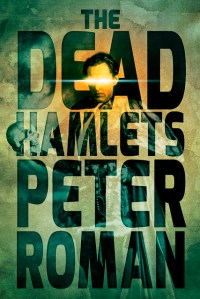
The Hook: The Dead Hamlets by Peter Roman

February 25, 2015
 
The Dead Hamlets
The Hook:

I lost the angel Baal in Berlin during a rainstorm of biblical scale. Some might say the weather was a sign of things to come, or maybe a sign of things past. But if there was one thing I’d learned over the ages, it was that the weather was usually just the weather. Usually. So instead of killing Baal and getting drunk on his heavenly grace, I found a bar on a quiet street and got drunk on regular spirits instead. It wasn’t the same, but I’d learned to make do. 

Make that drunker. I hadn’t been sober in months, not since the Barcelona Incident. The less said about that, the better. Let’s just say if I didn’t have a reason to kill angels before, I had one now.

Peter Roman writes:
The first few paragraphs of a novel are always the most important ones to me as a reader. They’re what’ll hook me or lose me. They tell me what I need to know about the style of the book, the writing level of the author, the genre coordinates — basically the whole works.
That means the first few paragraphs of a novel are also the most important ones to me as a writer. So how did I begin my new novel, The Dead Hamlets? By using the ol’ dark and stormy night intro.

It’s a dangerous game opening a book like that. But it’s the perfect start for a tale that is so strongly connected to the theatre world. The Dead Hamlets is a ghost story of sorts, where the immortal Cross must solve the mystery of who or what is killing the members of the faerie queen’s court. As it turns out, Cross’s search leads him to an ancient and startling secret about the Shakespeare play Hamlet. There’s a long tradition of dark and stormy nights in the theatre — lots of blackouts and thunder sound effects. The first stage directions of Macbeth, for instance, are “Thunder and lightning.” So I was hinting at the subject matter of my book in its opening lines. Shortly after that initial scene, I have Cross stumble into a theatre full of the dead — at which point things really get dark and stormy!

There’s a bit of the noir to this opening, too. Cross often treads the same moral ground as Raymond Chandler’s Philip Marlowe, and he operates in the shadows just as many hard-boiled detective characters do. Cross has seen it all and done it all, thanks to his immortality.

Then there’s the angel Baal, who is mentioned in that first line. Opening with Cross hunting the angel immediately sets the tone for the book and tells us a bit about his character. This is a dark and gritty urban fantasy, populated with dangerous and sometimes unpleasant people. Readers of the first book in the series, The Mona Lisa Sacrifice, will see immediately that Cross is in a grim place mentally as he’s back to hunting angels for their heavenly grace, which he needs to power his supernatural abilities. He loses Baal and then gets drunk (and later beat up), which tells us that he’s still making a mess of his life. Some things never change for Cross.

Plus, there’s that word “Baal.” The very sound of it is dark and foreboding. This is a book where nothing good is going to happen if characters have names like that.Introducing an angel in the very first sentence of the novel also sets up the supernatural nature of this book. Readers won’t be surprised when other crazy creatures show up, such as the real Witches of Macbeth, the eerie Alice from the Alice in Wonderland tales, a demon, a god of the dead — and a very supernatural and very nasty Shakespeare. If you’re down with the angel, then you’ll be fine with everybody else that arrives with weapons drawn.

As for Berlin? It sets the international scope of this book and reinforces the moodiness of the story. Berlin’s not exactly a place with a lot of happy memories and pleasant associations, after all. And I admit it’s a very subtle nod to the Wim Wenders film Wings of Desire, which featured angels hiding out in Berlin. Nick Cave, who has a cameo in the film, would probably feel at home in The Dead Hamlets.The last hook I put in the opening of The Dead Hamlets was the mention of The Barcelona Incident. This kind of lets readers know Cross has a back story and sets up where the book is in the series overall — The Mona Lisa Sacrifice opens and ends on two very different Barcelona incidents, so it’s a rich reference.

There you have it. In a couple of paragraphs I tried to set up the mood and plot of The Dead Hamlets, give an insight into Cross’s state of mind, and describe how the book relates to the first one in the series. Did all these hooks succeed? I suppose the true test of that is if you keep on reading the story. I certainly hope you do, as I’ve got a lot of tales to tell about Cross and his crazy group of friends.
About the author:
Peter Roman is the alter ego of Peter Darbyshire, a Canadian writer. Roman is the author of The Mona Lisa Sacrifice and The Dead Hamlets, while Darbyshire has written the novels The Warhol Gang and Please, which won Canada’s national ReLit Award for best novel. Both of them share an office in Vancouver, where there are no angels. You can follow their adventures at peterdarbyshire.com
#SFWAPro
###
If you’re an author with a book coming out soon and you wish to participate on The Hook, please read this.

Introducing: The Hook

February 25, 2015

The Hook is a guest post feature on this blog that will help promote other authors’ latest science fiction and fantasy books. Optimally each of these will be posted on the book’s release date.

Each post will open with a very short (up to 200 words) quote form the opening of the novel, followed by the author’s brief post consisting of two parts:

1) Elevator pitch — A paragraph or so talking about the book; what is it about, why is it awesome, etc.

2) The Hook — The author will explain why you they chose that specific scene/those specific lines as the opener. What makes it a great hook that will stick with the readers, and what makes it the right place to begin their story?

It is my belief that such posts will be both interesting to the readers and instructive to fellow writers.

I already have a number of authors lined up and will reach out directly to others on my radar whose books I’d like to bring to attention of this blog’s readers.  If you are an author who would like to participate, please have your publicist contact me. Self-published books will occasionally be featured, but those slots will be available by invitation only.

#SFWAPro