Cover and TOC reveal: Funny Science Fiction

July 23, 2015

FunnySciFi_cover

Funny Science Fiction is a spin-off anthology from the Unidentified Funny Objects (UFO) annual anthology series of humorous SF/F. While UFO attempts to collect some of the best speculative humor being written today, Funny SF gathers seventeen from among the best funny science fiction stories published in the last decade.

Whereas UFO covers both genres, Funny SF collected science fiction stories specifically. There are tentative plans for a Funny Fantasy reprint anthology to follow in 2016.

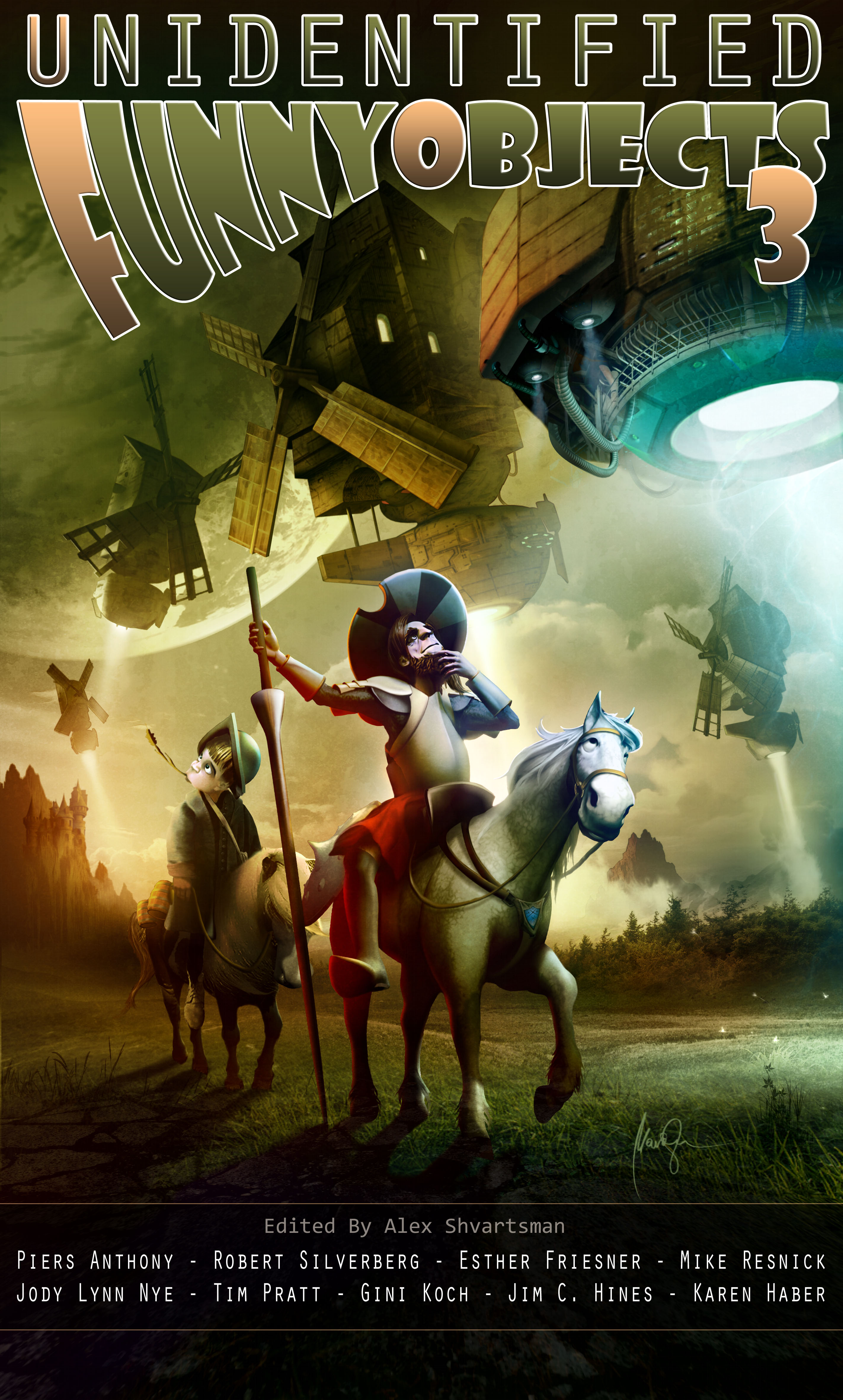
Cover art is by the talented Flavio Greco Paglia. Cover design is by UFO’s amazing graphics specialist-in-residence and game designer Emerson Matsuuchi.

I’m indebted to the original publishers of these stories, who have done their share to publish and promote humor in SF/F. Special thanks to the editors and publishers of Crossed Genres and Galaxy’s Edge magazines who allowed me to include stories that are still under contract with them, because I wanted badly to make sure current short fiction is well-represented in this book.

Funny SF will be published on Amazon on September 1, 2015. It will become available on other e-book platforms in 2016.

Table of Contents:

Foreword by Alex Shvartsman

“Observation Post” by Mike Resnick (Beyond the Sun, Fairwood Press, 2013)

“Flying on My Hatred of My Neighbor’s Dog” by Shaenon Garrity (Drabblecast, 2013)

“Wikihistory” by Desmond Warzel (Abyss & Apex, 2007)

“Distant Gates of Eden Gleam” by Brian Trent (Crossed Genres, 2015)

“Half a Conversation, Overheard While Inside an Enormous Sentient Slug” by Oliver Buckram (F&SF, 2013)

“Hark! Listen to the Animals” by Ken Liu and Lisa Tang Liu (Galaxy’s Edge, 2014)

“Whaliens” by Lavie Tidhar (Analog, 2014)

“See Dangerous Earth-Possibles!” by Tina Connolly (Lightspeed Women Destroy Science Fiction, 2014)

“Kallakak’s Cousins” by Cat Rambo (Asimov’s, 2008)

“Kulturkampf” by Anatoly Belilovsky (Immersion Book of Steampunk, Immersion Press, 2011)

“Let Us Now Praise Awesome Dinosaurs” by Leonard Richardson (Strange Horizons, 2009)

“Miss Darcy’s First Intergalactic Ballet Class” by Dantzel Cherry (Galaxy’s Edge, 2015)

“Pidgin” by Lawrence M. Schoen (Aliens and A.I., Eggplant Literary Productions, 2005)

“Nothing, Ventured” by James Beamon (AE: The Canadian Science Fiction Review, 2013)

“Last Thursday at Supervillain Supply Depot” by Sarah Pinsker (Daily Science Fiction, 2015)

“Chicka-Chicka-Bow-Wow” by Mike Rimar (Cucurbital 2, Paper Golem Press, 2011)

“Troublesolver” by Tim Pratt (Subterranean Press, 2009)

#SFWAPro


Die, Miles Cornbloom – Sherlock Holmes Mystery Magazine 17

July 15, 2015

shmm17

Die Miles Cornbloom, which I believe is my only full-length (non-flash) short story that is not science fiction or fantasy, was published in the Sherlock Holmes Mystery Magazine volume 17.

No, I don’t plan on writing a lot more suspense/mystery type stories. That one … just happened. The idea came to me and I wrote it. But generally I stay away from writing n0n-genre. In fact, I once wrote a literary story and added some magic to it just so I could sell it to a speculative magazine!

On a related note, this is as good a time as any to mention a pair of recent sales:

“Board Meeting, As Seen By the Spam Filter” will appear in Nature sometime in the next few months.

“The Hourglass Brigade” will be reprinted in the Broken Worlds anthology from A Murder of Storytellers. I really like the cover!

#SFWAPro


brokenworlds


John H. Costello Documents

July 13, 2015

readercon

The following scans are from the books and letters that were a part of the personal collection of John Costello, translator and science fiction fan who passed away earlier this year.  John had worked closely with Kir Bulychev, one of Russia’s best-known and beloved science fiction authors, and was actively involved in promoting Russian science fiction in the US.

I felt the following documents might especially be of interest to Russian fandom, and am sharing them with permission from ReaderCon. Click on any of the images to see the full version, and feel free to download/share/post them as you see fit.

Bulychev sig Poselok

There is a number of books in the collection autographed by Kir Bulychev and signed to John Costello. Most of them are merely signed with a brief note of well wishes, as the one above, but there are several with interesting notes that I am posting below. If there’s interest in the other “basic” signatures/dedications, I can scan those upon request.

Bulychev sketch

A self-portrait sketch by Kir Bulychev. He writes “from Igor and the Mouse” though that definitely looks like a cat to me. May have been some inside joke between Kir and John. This is from the flap of “Коралловый Замок” (The Coral Castle).


Bulychev sig Comic Book

The only dedication in English. From the flap of “Андрей Брюс, Агент Космофлота” (Andrei Bruce, Spacefleet Agent) hardcover comic book, circa 1993. Comic books were not a well-known media form in Russia; this must have been one of the earlier such publications, and it was based on Bulychev’s writing.

Bulychev sig Who Needs This

A “best of” collection “Кому Ето Надо?” (Who Needs This?). Bulychev writes: This is what’s called “The Best Of…” over there. I think it turned out to be a very pretty book.”

Lukin signature

A signature by Lubov and Evgeny Lukin on the cover page of their “Когда Отступяют Ангелы” (When Angels Retreat). It reads: “With hope that you like it. –Co-authors of this book and friends of Boris Zavgorodniy.”

Dushenko letter

The letter from Konstantin Dushenko to John Costello, granting permission to reprint the translation of Dushenko’s interview with Stanislaw Lem and requesting a copy of the publication. Dushenko goes on to ask how Costello found out about the interview, published int he Review of Books, and goes on to comment on Lem’s assent to the Russian-language publication of the novel “Memoirs Found in a Bathtub” without the foreword he was originally forced to write so the book would be able to get past the censors. Dushenko notes that all previous editions of “Memoirs” in the original Polish and in translation were published with this foreword.

Note: The scan intentionally cuts off the final line of the letter, which includes Dushenko’s address (in case he or his family still reside there.)


Kovshun letter 1Kovshun letter 2Front and back of the letter from Igor Nikolaevich Kovshun, a noted UFOlogist and head of “Proteus,” the SF fan club in Odessa, Ukraine.

Kovshun sig

A copy of “The Stars detached from the Sky and Fell to Earth…” autographed by Kovshun.

#SFWAPro


My Readercon 2015 Schedule

July 8, 2015

readercon#SFWAPro

I will be at Readercon over the course of the next four days. If you see me, don’t hesitate to say hello! Here’s my schedule:

Thursday July 09

8:00 PM    CR    The Games We Play. Erik Amundsen, Yoon Ha Lee, Alex Shvartsman, Romie Stott (leader), Gregory Wilson. Video games and tabletop games are an influential part of our imaginative lives. Are there times when you’re reading a book and feel the game mechanics too clearly beneath the prose? Or do you enjoy imagining what a character’s stats might look like? We’ll look at tie-in books (like R.A. Salvatore’s Chronicles of Drizzt and David Gaider’s Dragon Age prequels), book-based games (like The Black Cauldron, Lord of the Rings, and the Mists of Avalon–influenced Conquests of Camelot), and the pleasure of reading gaming sourcebooks.

Friday July 10

3:00 PM    E    Autographs. Alex Shvartsman, Allen Steele.
4:30 PM    ENV    Reading. Alex Shvartsman. Alex Shvartsman reads an excerpt from “H. G. Wells, Secret Agent”.

Saturday July 11

1:00 PM    F    Making SF/F Careers Viable. Sandra Kasturi, Matt Kressel, Bart Leib, A. J. Odasso, Alex Shvartsman (leader). Writing, editing anthologies or magazines, running small presses, creating artwork… these pursuits demand a great deal of investment, and returns are unreliable. Few people can spend weeks writing a story on spec, wait months for a contract and longer for a check, or absorb financial losses for years while trying to make a business profitable. Let’s talk frankly about how low pay rates on all fronts affect the demographics of professional SF/F, and what we can do to make SF/F careers more accessible to people with limited tangible and intangible resources.

The Hook: The Floating City by Craig Cormick

July 8, 2015

TheFloatingCity

The Hook:

The story starts with a murder.

It is a warm autumn night in the Floating City, and the waterways are still between the turning of the tides, and a little fetid. A dark gondola moves across the grand canal with a tall man and woman seated together in the boat. They wear ornate masks of birds, beset with tawny orange feathers and jewelry, and hold hands gently. Were there not such a large blood moon this evening it would be possible to see a soft glow emanating from where they touch.

The gondolier also wears a mask – but his is a plain white face, as if all the features have been erased from it, except an enigmatic smile. Ahead of them is a large golden palace, that seems to float on top of the water. It is ablaze with light as if there were a party for a hundred guests going on inside. But in fact it is empty except for servants. The master and mistress of the house are on their way back from a troubling meeting of the city’s Seers.

They will have need to discuss it with each other until late into the night, but for now they sit in silence, the only sound the soft splash, splash, splash of the gondolier’s oar, moving them forward.

Craig Cormick writes:

And the murder happens just a few paragraphs later. Two murders in fact, as a fearsome monster rises out of the canal, fights with the two Seers and slays them. And as they die their splendid palace sinks beneath the waters – letting you know it was only their magic that kept it afloat.

The Floating City is the second novel in my Shadow Master series, set in a world very much like Renaissance Italy, and this city is very much like Venice, but where magic and demons abound.

There are four pairs of magic Seers, protecting the city – one pair for each season, and they are slowly being killed off. As are the City’s Council of Ten. Monster and masked assassins and spies everywhere, all battling for control of the city. And just when things get desperate – the mysterious Shadow Master appears. He is armed with lightning fast swords, advanced gadgets and a sarcasticwit. He also has a scribe follow him around the city, while he dispatches his form of justice, and has him write the city’s history anew.

But that’s only half the story. The other half revolves around three very strong female characters, the Montecchi sisters: Giuliette, Disdemona and Isabella, who are each struggling to write their own destinies.

You might have picked them as being similar in name to Shakespeare’s characters: Juliet, Desdemona and Isabella from Romeo and Juliet, Othello and the Merchant of Venice – which is only half right. For I’ve gone back to the original Italian stories that Shakespeare adapted his plays from, and used those “origin” characters and plot structures within the novel. The original stories are worth checking out if you’re interested in seeing the way that Shakespeare built upon them and changed them: Luigi da Porto’s Giulietta e Romeo of 1530, Ser Giovanni’s Il Pecorone (the Dunce) of 1558, and Giraldi Cinthio’s Hecatommithi of 1565.

As for the starting point, or hook, I wanted to start the story at a major plot point, and then fill in the back story afterwards as we romp along – much as Shakespeare did in plays such as Hamlet. I think action is a great driver of plot and characterisation.

I also think the Shadow Master books are a fast-pace and fun read. And what I enjoy about them as the author, is when readers ask me, ‘So when are you going to explain a bit more about just who that Shadow Master character actually is?’ – I keep saying, ‘Well – maybe in the next book.’

After all, where is the fun in giving away all the mystery?

Buy The Floating City on Amazon.

About the author:

Craig Cormick is an award-winning Australian author and science communicator. He has published over 20 works of fiction and non-fiction, ranging over several genres. He has also published over 100 short stories.

The Shadow Master was published to widespread critical acclaim by his wife and mother in 2014, and they have great expectations for the Floating City!

You can find Craig online at his website craigcormick.com

###

#SFWAPro
If you’re an author with a book coming out soon and you wish to participate on The Hook, please read this.

Win a Signed Copy of H. G. WELLS, SECRET AGENT paperback

July 7, 2015

HGWellsCover

You can win a signed copy of the book at GoodReads. Of course, you can also pick up a copy from Amazon for only $7.99 (or $2.99 ebook) and I hope to have them available at Readercon this weekend (I’ll post my event schedule tomorrow and will know for sure if I’ll have the books in time by then.)

Also, Mike Ventrella interviewed me on his blog today.

#SFWAPro


Burying Treasure – Chicks and Balances anthology

July 7, 2015

chicksandbalances

My humorous fantasy story “Burying Treasure” is in this latest installment of the Chicks in Chainmail anthology series, edited by Esther Friesner. “Burying Treasure” attempts to explain why there are piles of treasure and gold always lying around, in the unlikeliest of places, for the heroes of traditional fantasy stories and Dungeons and Dragons campaigns to find. The short answer, or course, is Keynesian economics. The long answer … you’ll just have to read the story to find out!

Buy Chicks and Balances here.

#SFWAPro


The Art and Science of Anthology Editing

July 5, 2015

This post originally appeared at Locus Online, on February 1, 2015.

Now that I have five completed anthologies under my belt, the number of questions I get–from friends and strangers alike–about various aspects of anthology editing has turned from an occasional drip to a steady trickle. And while I would love to presume it’s because I’m such an awesome anthologist, the truth is, there’s fairly little information on the web regarding this niche topic. I thought it might be a good idea to collect some basic suggestions in one handy blog post. (Also, I’m incredibly lazy, and pointing people to a link is easier than cut/pasting chunks of this between e-mails!)

So, here goes:

Develop a Unique Concept

The optimal place to start is to develop a theme that is narrow yet appealing to a sizable readership, which your professional or life experience can somehow contribute to.

There are three primary reasons for a reader to pick up an anthology:

1)      It contains a story or stories by some of their favorite authors.

2)      They’re interested in the concept of the anthology.

3)      They trust the editor’s selections.

Unless you’re Gardner Dozois, Ellen Datlow, or anyone else who knows a lot more than I do about this subject (and therefore wouldn’t be reading this post), you probably won’t be able to capitalize on #3. And while we’ll cover headliners later, anthology concept is what you have the most control over.

There are plenty of space opera, zombie, steampunk, and Lovecraftian horror volumes edited by well-established anthologists. And while it’s possible to produce another quality entry into any of these sub-genres, you’re much better off exploring a narrow topic that will appeal to a large enough number of readers for the project to succeed.

My inaugural project as editor was Unidentified Funny Objects, an anthology of humorous science fiction and fantasy. I felt that there weren’t enough pro-paying venues that seek out humorous and lighthearted stories. I did some digging and discovered that no similar volumes exist or had existed in recent memory; most humor anthologies cover a specific theme (Deals with the Devil, Chicks in Chainmail, etc). As a reader, I would gladly buy an annual volume that collected wide-ranging humor stories. Happily, other readers agreed: I’m at work on the fourth annual volume. Similarly, Coffee: 14 Caffeinated Tales of the Fantastic tapped into a large, unexplored demographic; there haven’t been any coffee-themed speculative anthologies before. The book is easy to market as a present for anyone who enjoys both reading and coffee.

4books

When Neil Clarke, award-winning editor of Clarkesworld magazine, decided to launch his first anthology, he found a subject that was near and dear to his heart. Literally. A year before he announced Upgraded, an anthology of short stories about cyborgs, he survived a heart attack and had a defibrillator installed, effectively making him a self-proclaimed cyborg. Clarke wrote:

As I began looking into the possibility of a cyborg anthology, I quickly noticed that the cyborgs most people think of are villains (Cybermen, Darth Vader, the Borg, etc.). My people make excellent villains, but that only represents the tip of the iceberg. The more I thought about it, the more certain I became that this was the anthology project I had been looking for…  a cyborg-edited cyborg anthology. I don’t think that’s been done before. Besides, cyborgs are cool.

So, what unique idea do you have, and how can your life experience contribute to the project? An architect might collect tales of fantastic cities and structures. A real estate agent could gather urban fantasy and ghost stories involving houses for sale. (Plus, they’d be able to market these books to other architects and real estate agents, in addition to SF/F fans.)

Have a Plan, Have a Budget

What’s your strategy for producing an anthology? While it’s possible for a first-time anthologist to sell their project to an established publisher, this is perhaps even more difficult than selling a first novel.

Your agent could contact publishers and pitch them your idea. You will need a brief write-up of the concept and a list of headliners who are tentatively willing to contribute stories. The more appealing your headliners, the more likely you are to land a deal. There are a number of (mostly much smaller) publishers whom you can approach without an agent. Even so, it’s a long shot unless you have some sort of a pre-existing relationship or a resumé.

If a publisher accepts your proposal, they’ll pay you an advance against royalties (usually upon delivery of the manuscript) which you can use to pay your authors and cover some of your time and effort. The amount can vary greatly and is extremely unlikely to exceed $10,000.

Crowdfunding sites like Kickstarter are perhaps the best solution for such fledgling niche projects. Not only can you raise some or all of the funds needed to produce the book, but the level of interest during your funding period will be a good indicator of how well the book might sell upon release.

In recent years I’ve seen more and more “hybrid” projects, where an anthology would raise its initial funds on Kickstarter, then become picked up by a publisher who would handle subsequent sales and print distribution. For example, Bryan Thomas-Schmidt’s space exploration anthology Beyond the Sun was crowd-funded, then published by Fairwood Press.

Whatever your strategy, please be sure you are able to fairly reimburse your writers, cover artist, and everyone else involved in the project. Your contributors should be paid at least $0.05-0.06 per word, perhaps more for your headliners (some won’t write for that little). If you plan on including reprints, you can pay $0.01-0.02 per word for those. Always provide at least one contributor copy to each author.

“I can’t afford to pay much” is not only a common excuse I hear from token-market publishers, but also a terrible business strategy. Most of the accomplished authors will not submit their work to penny-pinching projects. In the end, you will have a much weaker pool of stories to select from, and the project will be far less likely to get noticed by readers and critics alike.

cover-hi-res#SFWAPro

Headliners

As I mentioned above, headliners are the top reason a reader might buy your anthology. Established authors will each have sizable fan bases who will gladly cough up a few bucks for their story alone; they might discover new authors as a bonus, which is an excellent reason to combine works from well-known authors and talented new writers alike.

Once you’ve established your anthology’s concept, think of popular authors who are especially good at writing the sort of stories you seek. Reach out to them directly. Send a polite query, including your pay rate, desired word count, and deadline.

If you plan to crowd-fund your project, be sure to mention that. Don’t ask them to begin working on the story until you’re certain you can afford to pay for it, but it’s okay to ask for tentative commitments. The same applies to anthologies you are shopping to publishers: so long as you don’t ask the author to begin the work, soliciting tentative interest so you can present your list of authors who are “on board” to the publisher is fine.

Keep in mind that popular authors are incredibly busy. Many won’t be able to commit to the project. Some will never respond to your e-mail. That’s okay–there are lots of great authors to approach, and some of them will say yes. If you’re having a hard time coming up with potential headliners for your project, you may not be quite well-read enough yet to edit an anthology.

Your e-mail should be brief, personal, and professional. Here’s a sample:

Dear Mr. Melville,

I’m in the process of putting together an anthology of short stories about whales. I greatly enjoyed Moby Dick and was hoping you might consider writing a short story for this project.

I’m seeking original stories of 2000-6000 words for Whales, Whales, Whales, and am able to offer $0.10/word for First Print and Electronic English language rights exclusive for 6 months after publication and non-exclusive rights afterward. Each contributor will also receive two paperback copies of the book and a lifetime supply of whale oil.

The submission deadline is December 31, 2015 and the publication date is August 1, 2016.

Thank you very much in advance for your consideration.

Sincerely,

Hopeful Editor

Other Contributors

Once you have a few solid headliners lined up, it’s time to fill out the rest of the book. There are two ways to go about this: you can open to submissions from the general public, or you can invite a bunch of authors directly. There are advantages and disadvantages to each approach.

Opening to submissions will likely allow you to find gems by little-known authors. Who knows, you could be the editor who discovers the next Octavia Butler or Robert Heinlein. Nothing about this process is more satisfying than nurturing and promoting brilliant new authors. However, this approach is extremely time-consuming. By posting the submission call on sites like The Grinder, Ralan, and Duotrope, you’ll likely receive hundreds of submissions. By the time you’re finished, you might sink enough hours into the project to earn less than minimum wage, but your anthology will be stronger for it.

The second approach is to identify and invite a number of authors whose work you’ve enjoyed to contribute directly. (Shameless Hint: I very much like getting invited to projects). These would mostly be neo-pros, not established best-selling authors.

The trick here is to catch people who are on their way up. Two years ago, any decent anthology could’ve gotten a story out of Ken Liu, who is one of the most brilliant short story authors writing today. By now, he’s too busy with bigger projects and has to turn down most anthology invitations. Be sure to approach authors whose work you already know and enjoy: they’re much more likely to write stories you’ll want to accept.

Cast your net wide: it’s important to solicit stories from a diverse group of authors. Let your potential contributors know that you welcome material from authors of all backgrounds, and actively seek out promising authors from traditionally disadvantaged groups. There is a ton of talent there, but even if you do an open submissions call, don’t just assume that you will get enough diverse submissions; be proactive about encouraging them. Also, I’m partial to encouraging the submission of translated stories, so English-speaking readers may be exposed to works from other countries and cultures.

Finally, it’s important to note that an invitation to submit is not a guarantee of acceptance. In fact, closed anthologies will generally invite more authors than they have room for, so that the editor can select and buy only the best of the available stories.

Selecting & Editing the Stories

If you do your job right, you will end up with more great stories than you can use. This is a good thing. An anthology isn’t just a random collection of tales united by theme: it is a work of art. The interplay of voices, styles, and plots should fit together like a symphony performed by an orchestra with you as the conductor.

To this end, most editors will whittle the submissions down slowly and only send out acceptances at the end of the process. They’re looking for material that isn’t just good, but fits well with the rest of the accepted stories.

Once the stories are in, don’t just spell-check them and throw the ones you like into the book. A good editor will work with an author to polish their story like a gemstone. In many ways, this process is similar to beta-reading and critiquing stories for fellow authors, except your opinion has more weight and you must be more careful to help rather than hinder the story. In addition to selecting the best stories, this is where your own skill and talent will matter most to the quality of the project.

Finally, there’s the devilishly difficult task of assembling the table of contents (TOC). There are many schools of thought on the subject. Some editors subscribe to “open strong, close long”–they place their one or two strongest stories at the beginning and close with a longer piece. Others prefer to mix up lengths and close on a light note, with their one humorous story at the end of the book.

This process is more art than science and no two editors will build the TOC in exactly the same way. Ultimately, it will come down to the interplay between stories, as described above.

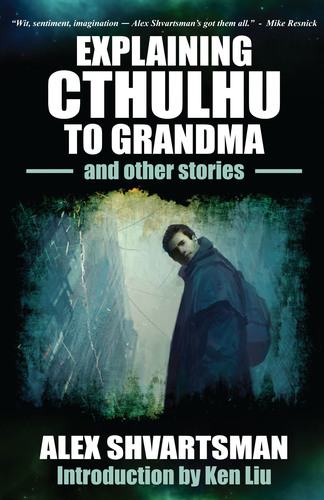
I recently had the pleasure of designing the TOC for my own short story collection, Explaining Cthulhu to Grandma and Other Stories. This is generally a bad idea, because authors are famously poor at judging the quality of their own work. Fortunately, most of the stories in this collection are reprints from pro venues, which means they were vetted by other editors. For this TOC, I took a rollercoaster approach: hopping from humorous to dark, from space opera to urban fantasy, in an effort to emphasize fun and enhance the sense of wonder for the reader. Did I succeed? Can you deduce my reasons for story placement? In a shameless act of self-promotion, I invite you to pick up a copy and find out.


H. G. Wells, Secret Agent e-book now available!

July 4, 2015

If you’ve been waiting to pick up a copy of H. G. Wells, Secret Agent novella, it is now available in e-book format! I’m not sure how long it will take for the paperback to show up on Amazon, but it should be soon, and available through the same link. Meanwhile, here it is:

HGWellsCover

H. G. Wells is a Victorian-era James Bond who must defend England and the world against time travelers, alien incursions and interdimensional threats (if he can learn quickly on the job, and survive the human foes he encounters, that is!)

During his missions, Wells will team up with Anton Chekhov to foil an assassination plot against Prince Nicholas Romanov of Russia, oversee the construction of the giant antenna designed to detect alien invasion fleets (or, as we know it, the Eiffel Tower), rub shoulders with the likes of Arthur Conan Doyle, Marie Curie, Jules Verne and Annie Oakley, and risk everything to encourage cooperation among the world’s most powerful intelligence agencies.

This humorous steampunk novella is filled with Easter eggs and British pop-culture references, from The Beatles and Ian Fleming to Douglas Adams and Dr. Who.

#SFWAPro


H. G. Wells, Secret Agent Novella Update

July 3, 2015

HGWellsCover

I have the proofs of the physical book in hand and they sure look good! The e-book and paperback versions will be up on Amazon next week. I will post the link as soon as it’s up. If you really don’t want to wait, you can order your copy of the paperback from the CreateSpace store already:

https://www.createspace.com/5567651

If I’m very lucky, I might receive print copies in time for Readercon next week, but more likely they will show up the week after that. Also, those who backed the Explaining Cthulhu to Grandma kickstarter last year will get their e-copies today!

#SFWAPro