New Publication: Seven Conversations in Locked Rooms

April 18, 2014

fscroll

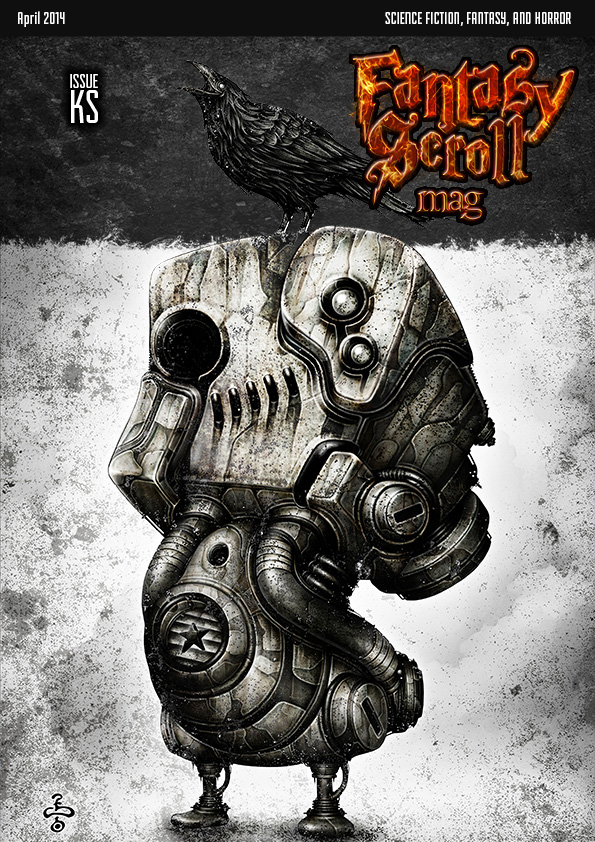
The premier issue of Fantasy Scroll is out, featuring stories by Ken Liu, KJ Kabza and others. It includes my short story “Seven Conversations in Locked Rooms” which was originally published in the Memory Eater anthology, but never before made available online. You can read the story here.

Fantasy Scroll is currently in it’s final week on Kickstarter, so if you like the content of the magazine, consider supporting them there.

And since I’ve been a little negligent about reporting recent acceptances, here are a few stories of mine you can expect to read in coming months:

“Notes on the Game in Progress, Played Almost to a Draw” – a Roger Zelazny homage flash story, was accepted at Daily Science Fiction

“One-Sided Argument” was accepted at Nature

“Icarus Falls,” a longer story, was accepted at Daily Science Fiction just yesterday.

#SFWAPro


Market Report: Fantasy Scroll Magazine

April 5, 2014

fantasyscroll

#SFWAPro

Click here for detailed guidelines

Genres: Speculative Fiction

Length: 1 – 5000 words

Reprints: Yes

Pay rate: $0.01 per word ($5 min for microfiction, $10 min for flash fiction)

Fantasy Scroll Magazine is a new semi-pro market launching later this month. My story “Seven Conversations in Locked Rooms” is in the first issue line-up, along with many other authors. I interviewed the zine’s editor-in-chief Iulian Ionescu.

###

When does the first issue of Fantasy Scroll Magazine launch? What sort of publishing schedule will you adhere to?

In our first year we aim to publish four quarterly issues, with the first one scheduled for mid-April. As a fledgling publication we didn’t want to stretch ourselves too thin in the first year; we want to establish a good process, a steady readership, and grow our presence in the social media. We want to analyze the data from year one and use that to tweak our efforts in the years to come.

During the following years, we will focus on growing the number of issues, hoping to get to a monthly publication by year three. This is a conscientious decision that works hand-in-hand with our other goal, which is to become a pro-market who can pay writers what they deserve.

I am also planning to issue an annual anthology containing the best stories from that year, and the proceeds from those publications will be used to achieve the goals above.

What niche do you expect Fantasy Scroll to fill among the speculative markets? What will make a Fantasy Scroll story different from what’s being published elsewhere?

I actually don’t want this magazine to be labeled into a very narrow niche, and that’s not to say that we won’t be focused at all. I gave a lot of thought to the magazine’s mission statement, and it came to me after many nights of staring at the blank ceiling at night. The mission statement says that the magazine will publish high-quality, entertaining, and thought-provoking speculative fiction.

The high-quality aspect of it leads the sentence because we are going to constantly look for those diamonds in the rough, those gems that rarely come through the slush pile. And when we find one, we’ll work closely with the author to make sure we bring that story to its best possible shape. So far, I have to say, the experience of working with writers one-on-one has been extremely positive, and a definite win-win. Being a writer myself, I knew this to be true, but now I can confirm it from the dark side (read editor’s desk): writers are awesome (and very modest.)

Second of all, we want these stories to be entertaining. I want to publish something that can drive lovers of speculative fiction to turn off their TV, shut down their Facebook, and sit down to read just because they enjoy it. And when they’re done, I want them to call their friends and tell them how much they loved it. If I can accomplish that, then I’ll call this magazine a success.

Lastly, we are looking for thought-provoking stories, the kind of stories that linger in your brain long after you’ve done reading them. I want people to feel the same way as ten-year old me felt when I first read “The Invisible Man,” and for days and nights I kept thinking what if?, is it possible?, can it be?

If I could turn this upside-down, I’d say that my goal is to publish stories that entertain, make you think, and touch the soul on an emotional level – and that is what I call a quality read.

During our Kickstarter Campaign, in order to entice the readers and let them know about the kind of stories they would see in our magazine, we launched a teaser issue that includes two sample stories. I invite you to read them.

Despite the magazine’s name, you are open to science fiction. What about horror, slipstream, any other stories that can’t be strictly defined as SF or fantasy?

In the magazine’s description I declare that we accept fantasy, science fiction, horror, and paranormal stories. This really opens it up to a very wide area of speculative fiction. I think the most important aspect here is the speculative element. I want that to permeate the story – I don’t want to have a regular story where an alien pokes his head at the end and says hello. The unusual must ooze from the story.

This, of course, puts a hold on some of the horror stories, because I am definitely not looking for the next Texas Chainsaw Massacre story. What’s funny is that I LOVE and enjoy watching gory, slasher movies, partly to annoy my wife, but I truly HATE reading those stories.

Just to show the confusion that exists among writers as well: I’ve seen a lot of stories in our slush that were qualified by the writers as horror, but I considered them dark fantasy, and stories that were qualified as fantasy, but I considered them pure horror.

I definitely accept slipstream; I actually like to see stories that nicely break the genre boundaries and take me to an unexpected place. The weirder the better.

We recently accepted some stories that border literary fiction, but the speculative element was strong enough that we felt they were appropriate.

Will you publish lighter or outright humorous stories? What sort of humor works or doesn’t work for your tastes?

I definitely don’t want the magazine to be totally dark; there will be some humor sprinkled here and there. I enjoy humorous stories, like the kind included in your UFO anthologies. The problem I find with humor, and verified statistically through the magazine’s slush pile, is that good speculative humor is hard to write, especially when it starts to be stretched out. As a successful writer who published a lot of funny stories, you probably know this better than me, but here are my thoughts about it.

Some of the funny stories we’ve accepted are very short—they made the point, made us laugh, and moved on. Those that started out nicely, but lingered on, trying too hard to be funny for a long time, eventually got nowhere. The problem is I like a story with a plot. What I’ve seen in some funny stories is writers mistaking being funny for plot. To have a truly funny story the writer has to do double-duty – the author not only has to create convincing characters that play in a good plot, but humor must also pervade through that somehow.

At the end of the day, we are looking for high-quality speculative stories, and if they happen to be funny too, we’ll never say no.

What’s your slush process? Will you read all the submissions yourself, or rely on slush readers? What is your estimated response time?

I think any publication is as good as its team, and I am working with a nice group of professionals who read slush, provide feedback, edit, and proofread. I read a lot of the stories, and definitely all of those that pass the initial slush process. At the end of that process we have editors that work directly with the authors to make sure the stories are in the best possible shape for publication.

Being a writer myself, I know how important it is to get a quick response from a magazine, and therefore I try to send all rejections as soon as possible. Our general rejection period has been about 10 days, and my goal is to shorten that even more.

For acceptances the timing might be a little longer, especially if the stories require work, but I am doing my best to notify the writers that their story is in a shortlist. We aim to notify writers of their acceptance or shortlist within 30 days.

How many stories or words of fiction do you anticipate publishing per issue?

We started boldly with twelve stories per issue, or approximately 25,000 words (we accept lengths from 100 through 5000 words). The first year will be a market test for us as well. We’ll run reader surveys and polls, we’ll analyze the traffic and reading patterns of our magazine readers, and take the pulse of the social media.

Based on these results, in the years to come, we will probably alter the content to match the market demand. One of our goals is to become a pro-market, so that analysis will also come into play when deciding how many words to include in future issues.

You are offering a combination of original stories and reprints from established authors. This is a model several new publications have adopted, most notably Galaxy’s Edge. Is this a long-term plan for FS, or is it just the way to fill the early issues, with more and more original fiction in future volumes?

We do accept reprints, but most recently we have restricted the reprints only to those that are not still currently available online for free. One of our core goals is to become a platform for new, unpublished authors, looking to launch their writing careers. From that perspective, our magazine will always include a majority of new, original content. But, being a reader and a fan of the genre myself, I see it as an homage to my favorite writers to be able to include their works in my magazine. I take pride and joy in sharing their work with our readers, resurfacing old works in front of new eyes.

I think one of the hardest parts of editing a magazine is putting the pieces together, matching the stories inside an issue for the best overall experience. Grouping reprints and originals under one roof is a part of that process. Whereas we will continue to accept reprints, our emphasis will always be on original works.

There’s lots of non-fiction scheduled for the first issue, such as interviews and reviews. Are you looking for non-fiction submissions too, or will that be handled internally?

For the time being the interviews are conducted by me personally, and I intend to continue doing that for one reason only: I really enjoy it. However, I will open the gates to interview requests from writers and agents, and an acceptance will depend on our schedule and the nature of the interviewee’s work—it needs to somehow be related to speculative short fiction.

As a last minute thing, I introduced one movie review and one book review per issue, and I’d like to continue doing that. So far, I am reaching out and requesting permissions to reprint, but in the future, I will probably open the submissions up to some of these non-fiction categories. This will not be our main focus, obviously, but I do see it as nice added bonus.

###

Fantasy Scroll Magazine is currently on Kickstarter. Please check out their crowdfunding campaign!

###

If you’re an editor of a new speculative magazine or anthology paying semi-pro or professional rates and wish to be interviewed for the Market Report column, please contact me.


LI-Con 2013

March 29, 2014

licon

I’m a guest at the fledgling LI-Con this year. All of my panels and the reading are tomorrow, but I stopped in today to check out the con and visit with friends. The convention is very compact but friendly, and all the panels I visited were well-attended. I look forward to speaking rather than just listening tomorrow. To that end, here’s my schedule:

Sunday, March 30:

10am – Salon D – My Inspirations – A. Shvartsman, K. DeCandido, R. Mauritsen, J. Nye, B. Fawcett
11am – Room 469 – Reading and signing
3pm – Salon E – An Alien Abducted My Homework – A. Belilovsky, A. Shvartsman
4pm – Salon C – Translator, Traitor: Translating Fiction – A. Belilovsky, A. Shvartsman, B. Fawcett

Details and directions to LI-Con can be found here.

#SFWAPro


Slush Pile Update – UFO3

March 23, 2014

image description

There’s approximately a week left to submit a story for consideration for UFO3, and I thought I’d write up a slush pile update.

Every submission received through March 22 has been responded to with either a rejection or a bump up to the second round.

We have read a total of 245 submissions so far this month (which sounds like a lot, but is actually a lighter volume than last year. There’s always a huge swell of subs in the last couple of days, though).

There are currently 8 accepted stories from headliners and I’m waiting on two more headliners to turn in stories.  Additionally, there are seven stories being held in the “final consideration” pile, and 6 more are currently in the second round.

As ever, things the associate editors and I are seeing too many of include: zombies, alien invasions and probing, stories that we don’t find to be at all humorous, zombies, vampires, puns, and did I mention zombies?

Things we want to see more of are stories with more than a humorous line or two placed somewhere within 6000 words, strong voices, and unique situations or characters. Some of the associate editors would also like a pony, but I realize that you can’t have everything and will settle for more quality submissions.

#SFWAPro


An Awesome Way To Say No

March 22, 2014

deareditor

It isn’t often that a rejection makes my day, but today one did.

I submitted a humor flash story to a brand-new market called Ruthless People’s Magazine (which you should all check out, since they’re offering an extremely competitive $100 per flash story pay rate). The story is about a hapless writer who can’t get his work published, and contained the following bit of dialog:

“They bounced ‘No Quarter’ without so much as a personal comment,” he said.

I racked my brain. “Is that the epic fantasy retelling the War of the Ring story from the point of view of the Ents?”

“No. I sent that one to Colossal Fiction just the other week. ‘No Quarter’ is an existential literary prose poem about the narrator’s inability to pay at a parking meter.”

Although RPM didn’t want this story, not only did they respond within hours, but the editor included the following at the bottom of his reply:

NO QUARTER

Canto the First

Cannot park here. Cannot be here. Pockets empty. Property—now beholden to the hexing, vexing State. No quarter. No quarters. No place in this world. I stand beside this parking meter. Pockets empty. This Grey Maypole, phallic intrusion into God’s own space. I want to grip it. Shake it! Strangle it! Choke the chicken livered authority. But who am I? Am I am, at all. Rage, empty! Impotence of steel! My vehicle is carried off and I am all – up ended. Inverted! Pockets empty. The Quarter Master mocks and pins a ticket to my brow. Am I here, circular, boundaried—no. I am quarterlessly quartered and rendered/dismembered non-Euclidian. My parallels? Parked. In this Pocket Universe I HAVE CEASED TO BE.

Heh. Damned thing writes itself.

So there you go — in case you ever wondered what an existential literary prose poem might be like.

I shall have to submit more material there, and soon!

#SFWAPro


Dark Expanse: Surviving the Collapse is out today

March 20, 2014

Dark Expanse cover

The anthology of space opera stories set in the universe of the Dark Expanse video game is out on Amazon today.

Here’s the table of contents:

DARK EXPANSE: Surviving the Collapse

Edited by Alex Shvartsman and William Snee

Castles in the Sky by Nancy Fulda
Dominoes Falling by Alex Shvartsman
The Ten Suns by Ken Liu
Betrayal, Clear as Kanzai Glass by Deborah Walker
The Price of Escape by David Walton
Hellfire Unleashed by Simon Kewin
Breaking Down by Michael Haynes
They Cannot Scare Me With Their Empty Spaces by Deborah Walker
A Small and Secret Freedom by Matt Mikalatos
Lightspeed Back to You by David Wayne
Escape from Planet Error by Michael Greenhut
Jump by Deborah Walker
Loud for All the Stars to Hear by Alex Kane
To Soar on Winds of War by David Wayne
Fires of Night by Alvaro Zinos-Amaro
Gorlack the Destroyer’s All You Can Eat Adventure by Robert L. Russell
Ghost Ship by Nancy Fulda
The Shadow Conspiracy by Nancy Fulda

Pick up a copy. It costs less than a Subway foot-long!

#SFWAPro


Coffee in End Times at the Nature Podcast

March 14, 2014

CoffeeInEndTimes

On the heels of the news of “Coffee in End Times” getting picked up by the Toasted Cake Podcast, Alvaro and I were very excited to learn that the story was also selected to be produced to be run on the Nature Podcast. They only select one story from several published in the magazine each month, so it’s quite an honor. What’s more, the story was read by Nature Future’s own editor Colin Sullivan, and he did an awesome job at it.

It will be really fun to compare how Tina Connolly produces the story. The voice actor adds a lot of their own touches to the story when they read it, and so her version will undoubtedly be different from Colin’s. And I, for one, am geeking out at the opportunity to hear both.

Listen to the Nature Podcast of “Coffee in End Times” here.
#SFWAPro


My LunaCon 2014 Schedule

March 13, 2014

lunacon

I’ll be attending LunaCon this Saturday and Sunday. I have a reading, a signing, and a bunch of panels. Please say hello if you see me at the con!

Saturday, 10amThe Real Cost and Problems of Self-Publishing
How do you plan, budget, publish, promote, and budget your time, all while trying to survive and have a real life?
Elijah Budd
Panelists: David Walton, Bianca D’Arc, Mikaela Barreee, Alex Shvartsman, April Grey, Marc Abbott

Saturday, 5pm
Help the Writers of the Weird Finish This Story
“I knew the dame was trouble when she slithered into my office” was the opening of a Round Robin story started several years ago on the private Google Group of the Writers of the Weird. See what happened next and help wrap things up.
Poplar
Panelists: Philip de Parto, David Sklar, Alex Shvartsman, Sarah Avery

Saturday, 6:30pm
Reading – Alex Shvartsman
Seymore Boton

Sunday, 10am
That’s really funny!
What’s the difference between a humorous story and a standard action-adventure tale? Are there differences in tone and structure between the two?
Port Chester
Panelists: Carol Pinchefsky, William Freedman, Dan Kimmel, Alex Shvartsman, Steven Savicki

Sunday, 11am
The Resurgence of Short(er) Story
So many collections, print and online magazines and other outlets — Is this a fad? Or, do readers really like short fiction again?Poplar
Panelists: Barbara Krasnoff, Neil Clarke, Sheila Williams, Alex Shvartsman, James Chambers, Ken Altabef

Sunday, 12pm
Autographing
Westchester Assembly
April Grey, Sarah Avery, Alex Shvartsman

Sunday, 1pm
Writing Groups and Professional Association
Writing groups? Professional Associations? Secret Society? SFWA, HWA, MWA, the Garden State Speculative Fiction Writers and ____. All are writing organizations, either local or international. Do they really serve a purpose in our writing lives or are they another distraction from writing? Writers discuss their experiences.
William Odelle
Panelists: Matthew Kressel, Alex Shvartsman, Neil Levine, David Mercurio Rivera,  Bianca D’Arc,  Sarah Avery.


Three podcast sales!

March 11, 2014

evp

This has been a good week for my podcast sales.

I signed a contract for a brand-new dark fantasy/horror flash story “The Lekar’s Fortune” to appear at the new pro-paying podcast, Electronic Voice Phenomenon.

Two more stories (both previously published in the journal of Nature) have been accepted by Tina Connolly to run on her Parsec-award winning podcast, Toasted Cake.

The first is “The Tell-Tale Ear” — a humorous near-future take on the Edgar Allan Poe classic.

The second is “Coffee in End Times,” a darker tale co-written by Alvaro Zinos-Amaro and I.

“Coffee” sold to Nature on its first outing, and was picked up by Tina at Toasted Cake on its third-ever submission. Clearly, Alvaro and I are doing something right, and should collaborate more!

#SFWAPro


CoffeeInEndTimes


Moving Forward

March 9, 2014

paypal-here

The trope of a Faceless Evil Corporation oppressing an everyman is all too common these days. It is perpetuated by movies and television. News of such an event can spread like wildfire online, as was the case with my own recent debacle. It is, in fact, so entrenched in our cultural psyche that any experience contrary to this trope might be met with suspicion and outright disbelief.

We tend to forget that corporations are often comprised of smart, motivated people who almost never own sharks with lasers attached to their heads, and are far more likely to go an extra mile to do something good than to twirl their mustaches while thinking of ways to frack for oil under your house.

I was recently a recipient of an act of kindness by a group of employees from three different companies, and I want to share that story.

If you aren’t already familiar with my e-commerce adventures, you might want to start by reading these posts:

1) Screwed By Square
2) Fair and Square

It has now been almost a month since the Square fiasco.  A few days after that second post I did finally get to speak to several folks from Square on a teleconference call. They wanted to hear my side of the story and figure out how to avoid similar calamities in the future.

Recently they reached out to let me know that, partially due to what happened in my case, they rolled out a Seller Protection Program.

Unfortunately, this program is rather toothless at this point. There is a long list of items that aren’t covered under the High Risk Goods section. It includes “electronics, collectibles, pre-ordered goods,” and much more. I wouldn’t have been covered under this program. Neither would most merchants selling the sort of items that might appeal to credit card thieves. Still, I’m glad that Square is beginning to move in the right direction on this, and hope they won’t stop at a half-measure.

Much of the attention has been focused on the chargebacks, but the greater issue to me has always been the fact that my account was dropped without notice, despite an otherwise-exemplary record. My web store, built and hosted with Square, went dark with no immediate substitute available.

This is where PayPal stepped in. They reached out to me, after hearing my story, and asked what they could do to help. I explained that I’ve been a PayPal user since almost Day 1, but didn’t have the skills necessary to install a PayPal-based shopping cart. The advantage of Square was that they offered a way for someone like me to sell products online without spending a lot of time or money to develop a sophisticated e-commerce site. I asked if they might be working on a solution similar to Square’s that I could adopt? Alternatively, I was prepared to have someone do a professional install of a shopping cart on my web site (a service for which I was quoted a price of $500).

pph

I was blown away by their generosity. PayPal offered to have their developers install the shopping cart for me, free of charge *and* to provide my store with a physical PayPal Here terminal to handle the in-person transactions. But they ended up doing even more than that!

PayPal teamed up with Wix and Ecwid to help my store completely rebuild and re-launch its web site. What’s more, they proved that even a very casual user with limited or non-existent programming skills can do the same.

Our original web site hasn’t changed in twelve years. Designed by a friend way back when we first opened the store, it was long past its prime, a PHP dinosaur held together with duct tape and stubbornness.

wixEnter Wix.com. These guys created a web design platform that allows their users to build very sophisticated web sites–with things like scrolling image galleries, app plug-ins, and blog tools–while knowing absolutely nothing about HTML.

The site building tool looks and feels more like Microsoft Publisher. You drag and drop different elements (which range from simple text boxes and contact forms to sophisticated blog and database elements. Everything is highly customizable, down to colors and shapes of the boxes.

A Wix expert helped us port the look and feel of the site, allowing us to keep our logos and color scheme while making the design way slicker.

When I was first shown the interface, I was very excited to play with it and have made numerous site changes on my own. This is definitely something a casual user can learn in only a few days, and there are lots of templates to help a newbie get started even faster. I’m still tinkering with the elements of it whenever I have a free minute, and learning more about its nifty features. I haven’t even gotten into the SEO features yet, but I fully intend to!

Thanks to Wix, my store’s web site went from this:

oldkg

To this:

newkgYou can also visit the live site, to see what I’m rambling about.

Another really important feature of a Wix site is that it’s very easy to integrate an Ecwid shopping cart into it. Which brings us to the second point:

ecwid1

An Ecwid shopping cart is another tool that can be set up by someone with zero programming experience.

There are many similarities between Wix and Ecwid in that both platforms are very customizable and offer an expert user great flexibility, but they are also simple and intuitive enough to allow a casual or new user to muddle through.

It’s very simple to create categories and add in products, and even link the same storefront through your Facebook page. Setting up shipping and tax tables is only slightly more complicated, but very doable. And if you want to adjust the look and feel of the site that’s a little bit more sophisticated, but still very achievable by a layperson.

One of my favorite features of the cart is coupon creation. You can set up very specific coupons and discounts, both by % of sale and a set $ value. You can have coupons be single-use or multiple use, and apply to specific items or categories. For example, right now I’m running a 20% off sale for all the UFO Publishing books listed on the site. The sale will last for only 48 hours, until end of day Tuesday, March 11. All you have to do is enter the coupon code UFO20 at checkout. (See how I snuck in an ad for my books there?)

And, of course, hooking in your PayPal account and setting up PayPal Express Checkout (which lets customers avoid the annoying process of creating Yet Another Account) is super easy!

paypal

Which brings us back to PayPal. After doing my research, I found them to be the only company to offer sufficient protection against chargebacks. As long as I follow a few simple instructions (ship the item to the address they provide via trackable means and with signature confirmation for orders over $250) they essentially insure the transaction, greatly reducing the risk for small businesses like mine.

Not to mention the fact that they masterminded this entire alliance to help me. You better believe I’ll be waving the PayPal card reader around at the upcoming conventions!

I’m enormously grateful to everyone at PayPal, Wix, and Ecwid who helped me. These very busy people took the time out of their schedules and worked together on this project. Representatives from three international corporations came together to help the little guy.

This update probably won’t get the kind of traction my original post did. It’s much easier to spread a story of being wronged by a company than a story of being helped by one (or three.) But I hope it does, because an act of kindness deserves at least as much recognition and praise as the attention given to an instance of poor customer service.