This story originally appeared in Asimov’s May-June 2024 issue and is posted here with permission. Now that the award season is upon us, I’d greatly appreciate if those voting for various short fiction and translation categories would read this and consider it for nomination. First, it’s a great story. And while I’m biased as a translator, others have said so as well. But it is also an act of courage, as is explained here better than I could by Michael Swanwick. (Be sure to read the translator note at the end.)
This story is 9000 words and is eligible in the novelette category.
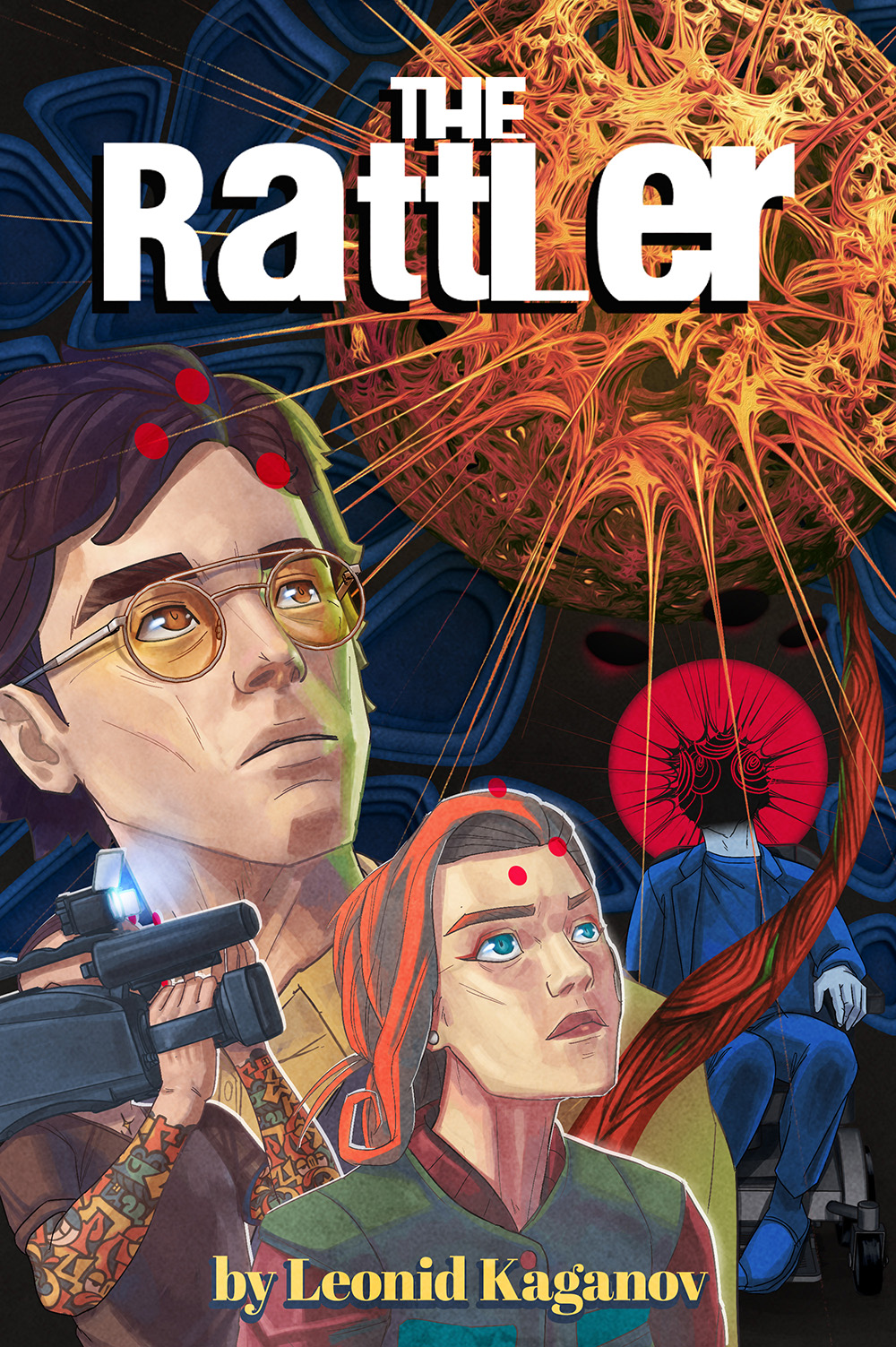
The Rattler
Leonid Kaganov
Translated by Alex Shvartsman
Got to hurry; we were rapidly losing the light.
Lots of people strolled along the boulevard, rode scooters, rushed to their destinations.
Only none of them were willing to be interviewed.
Rather than stop, they shrank away from Verba’s microphone as though she were handing out leaflets.
Yes, I was only the driver, but I felt equally invested in the outcome.
This was our crew. We were a team, meant to succeed or fail together.
Our cameraman, Nariman, shifted from foot to foot.
Undeterred, Verba kept trying to get someone, anyone, to stop and talk to her.
Kapeldiner wouldn’t be happy if we returned to the studio empty-handed.
Right next to Nariman, our producer Mark was frowning.
A spider web of wrinkles was spread across Mark’s forehead. His moustache drooped sadly.
I was beginning to realize that we weren’t going to record our segment today.
Nariman looked at his watch.
Evening was upon us. We had less than ten minutes of good light remaining.
#
I disliked the passerby immediately. He was a short, unshaven little man wearing a bright-red shirt and an angry expression on his face. He was clearly drunk, careening forward as if he were blind, awkwardly waving his arms. A sizable ring with a white stone glinted on a finger of his right hand; the stone was probably just glass.
Verba took a decisive step toward him.
“What do you think about the Rattler?”
“What did you say?” The drunk stopped abruptly.
“The alien conquering Earth,” Verba clarified. “How did the Rattler’s appearance change your life?”
“What’s this nonsense?” He stepped forward, invading her space. “Who do you work for?”
“First Regional TV channel. We’re conducting interviews—”
Before she could finish, the man backhanded her on the cheek with all of his strength. Verba crashed to the ground, her glasses and microphone clattering across the pavement. The man traced their trajectory and then turned toward us.
“Who else wants some? Come on!”
Nariman lowered the video camera from his shoulder and set it down slowly, trying not to make any sudden movements. Then he stared at the sidewalk.
Our rotund producer Mark took a small step backward and hugged his notebook to his chest, holding it like a shield.
I was sitting in our van, its doors ajar. I remained where I was.
“You bastards are getting paid for your fucking interviews, while my brother was blown up yesterday,” the drunk said, addressing no one in particular. He staggered away.
Nariman was the first to regain his senses. He rushed toward Verba and helped her up. Her face was covered with blood. She wasn’t crying, but she was shuddering and gasping for air.
“What a phenomenal asshole,” Mark said passionately. “With people like that, you don’t need an alien invader. Let’s call the police!”
“Let’s go to the hospital,” I said, and started the van.
#
Back at the station we were immediately ushered into the general manager’s office; he must’ve issued an order in advance. Kapeldiner sat behind a massive desk. A shiny bald head covered in liver spots towered over a pair of monitors.
“Well?” he asked. “How are you?”
“Fine,” said Verba. “I was dizzy at first, but it’s all right now.”
“What did the doctors say?”
“He cut up her cheek with a ring,” Mark blurted out. “They applied stitches but said she’ll need cosmetic surgery, and that there will be a scar either way.”
“Damn it,” Kapeldiner cursed, and nervously massaged his bald head with both his palms. “Where am I going to find another anchor?”
“We—” Nariman began to say, but Kapeldiner interrupted him.
“You!” The manager pointed a finger at him. “Where were you?”
“It happened so suddenly,” Nariman managed. “I recorded a close-up of his face, if anything—”
“If—what?” Kapeldiner shouted. “There were three of you, and he was alone! You didn’t even detain him!”
“I had the camera. It’s expensive, and you would’ve made me pay for any damages. I have a mortgage. Mark has a family.”
“What, me?” Mark chimed in. “I’m not a young man. I’m a producer, not a boxer. We need a security guard!”
And he nodded toward me, for some reason.
“I was in the van,” I said. “The tire iron is in the trunk. Was I supposed to run him over? The van was facing the opposite way….”
Kapeldiner cursed again and scratched at his head.
“What am I supposed to air tomorrow morning? We’re the premier regional channel! And because of this accursed thing, we’re being watched across the globe!” He quickly glanced at Verba. “Can you talk, or does it hurt?”
“I can talk.”
“In that case, we’ll broadcast live tomorrow. Mark will write copy. Head over to the park in the morning, I’ll get passes for you from the feds. Set up there, and we’ll go on the air.”
“Lord, not again.” Mark frowned.
“There’s been a million hours of footage recorded there without us,” said Nariman. “It’s always exactly the same. We could film Verba in the studio in front of the green screen and add the park background in post.”
“We’re the First Regional channel, not some bloggers,” Kapeldiner reminded him sternly. “We need an exclusive.”
“How am I going to go on camera with this bandage?” Verba spoke up.
“You’ll be out of frame. Read the text behind the scenes and point with your hand. To, I don’t know, indicate scale. Mark will think of something. Except, Mark, cut down on the negativity. Not like that other time! In the end, I want you to focus on the positive. So we won’t get another call from …” Kapeldiner nodded meaningfully upward.
#
Nothing had changed since we’d filmed the Rattler last week. A discordant row of plastic barriers that looked like orange suitcases remained in place. This was a purely symbolic barrier; everything was guarded by security cameras. Also the same were the gray cubes of cabins towering over the barrier, hastily erected by some scientists in the early days and then quickly converted into a security post. But the guards were different—one redhead and another with a stylish beard. A silent man in civilian clothing sat in the corner.
“What’s with your face?” the redhead asked Verba right away.
“A bandage. I cut myself shaving,” Verba replied dryly.
The redhead squinted in disbelief, as though uncertain whether she was joking or not.
“Instructions,” he declared once he finished checking our documents.
“This is our third time here,” said Mark.
“You have to listen, anyway.” The redhead shook his head. “Under no circumstances will you cross the guardrail. Make no sudden movements. Do not throw absolutely anything in its direction. Not chewing gum, not a match, not a lens cap. The Rattler reacts instantly. First, it destroys the attacker, and then the one who ordered the attack, and so on, until it reaches the one who came up with the idea to launch an attack in the first place.”
“How does it know who thought of attacking it?” I asked.
“That’s not my department,” countered the redhead. “Scientists from all over the world still haven’t figured that out.”
“There was this corpse yesterday,” added his bearded colleague, grimacing. “Some eco-activist. Whatever he wanted, he didn’t make it across. And we were the ones who had to remove a headless body from the clearing.”
The redhead stared at me with sudden suspicion. “You’re not on the list.”
“I’m the crew’s driver. I’ll wait for them here.”
“This is not a waiting room.” The redhead glowered.
“Let him come with them,” commanded the soft voice from the corner, where the man in civilian clothing sat.
“Go.” The redhead immediately nodded and opened the cabin’s backdoor. “Straight down the path until you reach the red warning tape, you see it? And not a step farther.”
“You won’t come along?” asked Mark, surprised.
“We’ll watch you on camera.” The bearded guard pointed at his display. “You have your cameras, we have ours.”
“We’re not afraid to go there,” the redhead explained for some reason. “It’s just a bad omen. We had this one guy who’s been going there for days, always looking. And then he got hit. He must’ve been plotting something. It can sense that.”
“Just a second.” Nariman turned back after glancing outside. “We need to film from the opposite end of the clearing. Not from here.”
“There’s only one observation area,” said the redhead. “Be thankful you’re being allowed in.”
“But I can’t work there in the morning, the lens will be staring right at the sun. We need another vantage point.”
“Not permitted,” the man in civilian clothing said quietly from his corner.
And we headed toward the observation point.
#
This was my first time in this part of the park. Until the Rattler had appeared, it wouldn’t have occurred to me to venture into this remote corner overgrown with trees, more forest than park. I must’ve crossed the park on a bicycle a thousand times back when I worked in food delivery. I’d spent hours here with a stroller when Maya was born. If I’m being honest, a couple of times I’d ventured into the park to relieve myself in the bushes. That was before the cameras, before the municipal restroom was built by the central gates. Once, when I was young, I’d spent all night making out on a bench after a prom. But all of that had taken place near the main throughways. I’d never been to this corner. Even though it was only about fifty meters of bushes and trees between me and the buses driving down the nearest boulevard.
Nowadays the park was devoid of people. Even the birds didn’t chirp here anymore. I wondered whether the Rattler shot down birds on the fly. A makeshift dirt road paved by hundreds of feet and marked with bright plastic tape on both sides lay ahead of us. At one point it even crossed an official bike path.
Soon we reached our destination: a small clearing opening up behind the trees and containing a hastily erected observation point. Metal racks stood in a semicircle, like at the airport, with tape stretched across them. I surreptitiously felt the tape with my fingers. It was dusty and somewhat damp with the morning dew. Street sounds and the honking of car horns emanated from somewhere up ahead.
“Six minutes to air.” The voice of a studio assistant came from the pair of headphones that hung around Mark’s neck. “How’s the connection?”
“We’re in position,” Nariman replied into the microphone of his camera. “Tuning up.”
The Rattler stood right in front of us in the clearing. This was the first time I’d seen it in person, and I was shocked at how truly small it was. I’d swear it was no taller than a floor lamp. It looked like a floor lamp, too. Or perhaps like a giant dandelion, or an air balloon tied to the ground with a thick cable so it wouldn’t fly away. A gleaming stalk as thick as an arm stuck out from the soil and terminated in a cloudy silver globe the width of a bicycle wheel. Sparse off-white cords grew like hairs across its surface, swaying gently as though caressed by the wind. They were perfectly illuminated by the morning sun that shone through the tree branches.
Three black round spots skipped across the surface of the globe, as if funnels were constantly opening in different spots, always three of them. They disappeared every second, but could be immediately found elsewhere on the globe. Except, of course, when they decided to reappear on the side of it we couldn’t see. As if on cue, the funnels ejected three short sparks which faded into the air, never flying away. But, of course, we knew very well how far they actually traveled, and how their imaginary trajectories would ultimately converge on a single point. The funnels mostly appeared on the lower half of the sphere. I heard they’d appeared at the top of the sphere once, to kill a pilot. Currently they were spinning at the very bottom, nearly at the stem. They were burning someone in the southern hemisphere.
Also, the Rattler made a sound. Many would say that it emitted an occasional rattling noise when it fired, which earned it its name. Others heard a low pinging, like the sound a streetlight would emit to assist the visually challenged. To me it always sounded like the quiet clicking of an electric clock, like the pinch of rice grains being tossed into a can. The most unpleasant sound in the world that wouldn’t let me fall asleep when I’d been a child. My mother would complain, claim I was making it up. She couldn’t believe that I could hear the clock located in the kitchen through closed doors: tick, tick, tick.
“Three minutes to air,” rustled the headphones.
“I’m tuned,” reported Nariman.
“We’re ready,” confirmed Mark and turned to Nariman. “How’s the Sun?”
“It causes significant interference. I’m barely adjusting for it. If it weren’t a live broadcast, we could have fixed it in post.”
“But you can make it work?”
“Yes.”
“What’s that green screen next to it?” Verba suddenly pointed into the distance.
I followed her gaze. About three meters away from the Rattler stood a large steel frame covered in green tent fabric. Definitely a green screen. It blended into the clearing and it seemed strange that we hadn’t noticed it sooner.
“Looks just like the shower curtain in my bathroom,” I joked.
“Probably a billboard.” Mark frowned. “People will monetize anything.”
“Should I reframe to keep it out of the shot?” asked Nariman.
“Whatever you think is best.” Mark waved him off. “There’s no advertisement on the billboard yet anyway.”
“One minute to air,” squeaked the headphones. “Thirty seconds. Rolling!”
Verba’s demeanor instantly changed, even though she wasn’t in the frame.
“A regular morning, in a regular central park of a regular city,” Verba recited in a well-projected voice, barely glancing at her tablet. “The only unusual thing is the object that’s been standing here for the past three weeks, which we call the Rattler—a name adopted by the international community which, I will remind our viewers, was originally suggested by the First Regional channel. Over the course of these three weeks, which have irrevocably changed the fate of our planet, the scientists have continued to argue as they attempt to answer the question: what has come into our world? Is it a robot or a living being? A plant or an electron gun? A visitor from distant stars, or a monster from the Earth’s core? A killer machine built by a mad scientist, or an Antichrist who has appeared in the form of a deadly flower? And while the scientists argue, the Rattler kills one citizen of our planet every second. We already know that, day and night, three spots on its surface like three antennae aim at a random victim and instantly destroy them with an invisible discharge. It doesn’t matter whether that person is located nearby or on the other side of the world. It’s no wonder that an honored citizen of our city our national poet, Sheron, wrote a blog post yesterday calling the Rattler a doomsday clock, and our city the earthly gates of Hell. But there’s no room for negativity. Life goes on!
“This fine morning I stand here, next to the Rattler, unafraid, because the risk of dying standing next to it is no greater than for a resident of Adelaide, or Hong Kong, Vancouver or—“
“Stop,” said Mark suddenly.
Verba ceased talking and turned around, confused.
“Kapeldiner dropped the connection,” Mark explained. “Our video must be flawed.”
“The video is fine!” said Nariman. “I adjusted for the lighting.”
“He said to come back to the studio, there will be another assignment.”
Nariman reluctantly lowered his camera and retrieved another lens from the bag.
“All right, give me a minute. Let me shoot some close-ups since we’re already here.”
We waited patiently as he took his time aiming the camera.
“Get down!” Nariman shouted hysterically. He let go of the camera, and the rest of us dropped to the ground.
After several torturous seconds, nothing happened.
“False alarm,” Nariman said hoarsely as he got up.
“What was it?” Verba asked coldly as she tried and failed to rub dirt off the sleeve of her white blouse.
“The Rattler suddenly looked right at me,” Nariman explained. “It was terrifying. I thought it was the end. All three of its eyes bunched up and aimed right at me. Right at us!”
“It doesn’t care about you,” I said.
“Well maybe it aimed somewhere behind our backs, plus or minus a hundred meters, I swear!”
“The entire city is behind our backs. With suburbs all the way to the horizon.”
“I swear, it was shooting somewhere nearby. I should have the recording!” Nariman wouldn’t give up, though it was clear to the rest of us that he felt embarrassed by his behavior.
We turned and walked quietly toward the guard post. Even before we reached it, we realized that something had happened.
“Faster!” The redhead guard waved to us from the door, his face pale, his uniform covered in crimson dew. “Faster, come through and go away, don’t turn around!”
I couldn’t help stealing a surreptitious glance.
Instead of the man in civilian clothing, a headless body lay limp in the armchair. The chair, the floor, and the walls were all painted, as if an inexperienced graffiti artist had attempted to recreate a sunrise using a red spray can.
#
Traffic on Heroes Boulevard was at a standstill—there was likely an accident up ahead.
“How much longer?” asked Nariman from the back seat.
“Two hours,” I replied. “Three if the traffic doesn’t ease up.”
“If he’s such a big-deal professor, why doesn’t he live closer to the city center?” muttered Nariman.
“Perhaps he loves fresh air,” said Verba.
“And what, lectures remotely?”
“Nariman,” I said in a conciliatory manner. “You seem really stressed. Is it because of the corpse in the guardhouse?”
“I’m stressed because I got up at five in the morning to record a live broadcast, only to be forced to film facing the sun and then to be told that my recording is flawed, and have it cut off!”
“No one is blaming you,” said Mark. “I spoke to Kapeldiner. He told me he cut the feed right away, that something wrong was in the frame.”
“The wrong Rattler? The wrong park?” Nariman seethed. “What, is there another city on this planet where another Rattler has sprouted? What could’ve possible been wrong in our frame?”
“Ask him yourself if you like,” countered Mark.
“No, thanks.”
I watched in my rear view mirror as Nariman took out his notebook, unpacked the camera, and connected them via a cable, muttering “Wrong this, wrong that.”
The traffic jam ended suddenly and I saw its cause: a small sedan stood perpendicular to the boulevard, slammed into the divider. A headless woman sat in the driver seat. Two police cruisers and an ambulance were parked nearby. No one else on our crew noticed, which was for the best; it was not a pleasant sight. I didn’t tell them anything.
We got out of the city and drove past fields and warehouses.
“Oh, wow!” Nariman shouted from the back seat. “Verba, look!”
“Did you draw that on?” Verba asked, incredulous.
“Sunlight shone through! Do you see why they cut our broadcast?”
“What is it?” Mark struggled to loosen his seat belt and turn around. Nariman handed him the notebook. Mark stared at it for a while and then whistled. “A little one…. So that’s why they erected—”
“Would someone please use their words and tell me what’s there?” I said, irritated. “Or should I turn around instead of watching the road?”
“There’s a second Rattler growing next to the original one,” Verba explained. “They shielded it so it couldn’t be seen from the observation post. But the sun shone through the cloth. Like a shadow play. And its outline was visible in the frame.”
“A second Rattler?” I was astounded. “Who shielded it?”
“The guards. Or the national security people,” said Mark. “There must’ve been an order, to avoid panic. Kapeldiner must’ve known since he reacted so quickly.”
I shook my head. “So they’re lying to us? Lying to the media?”
“Well, not lying. Withholding information.”
“Why didn’t Kapeldiner just warn us not to show the second Rattler?”
“It’s probably top secret.”
“But we have the right to know, we’re journalists!”
“Especially you,” said Nariman.
I really dislike that man.
#
Professor Johann came out to meet us in front of his mansion in an electric wheelchair. He was old, his yellowish face framed by a gray beard. His jaundiced eyes sparkled with cheer.
He asked us how our trip had been, if we’d like some tea, and invited us into his study. The wheelchair buzzed and entered the house via a ramp. We followed. Every wall in Professor Johann’s study was covered with bookshelves—I’d never seen so many books.
The professor kept coughing while we set up our equipment and lighting.
“You don’t look well,” Verba said cautiously. “Will you be able to speak to me for half an hour?”
“Don’t you worry,” said the professor cheerfully. “As soon as we begin conversing the coughing will cease, I promise. But you also don’t look well, my dear. What’s wrong with your face? Were you in an accident?”
“It’s nothing. A cat scratched me,” said Verba. “You’ll be the only one on camera.”
“Is it possible not to show the wheelchair?” he asked. “Such an unpleasant thing, this chair. I don’t like it.”
“The absence of the superfluous in the frame is our specialty,” said Nariman. “Especially today.”
“Cut it out,” Mark warned him quietly.
“I’ll be quiet. Also, I’m ready.”
“Rolling!” said Mark.
Verba spoke.
“We’re visiting with Professor of Mathematics Taavi Johann, whose name went viral on the internet yesterday. Professor Johann, could you briefly summarize your hypothesis?”
“In brief,” said Johann, “I’ve studied game theory my entire life.”
“Game theory?”
“It’s a branch of mathematics. Let’s play a game. Suppose you’re a medieval pirate who is shipwrecked on an island of cannibals. Your goal is to kill them all. You have one musket, and an infinite supply of bullets and gunpowder. The only problem is that it takes a long time to reload the musket. If they attack you en masse, you’re dead. What strategy will you pursue?”
Verba didn’t reply. She seemed bewildered.
“The most effective strategy in such a scenario is the strategy of terror. You must keep the cannibals terrified, so they’d be afraid to approach you, while simultaneously shooting them one at a time, constantly and methodically. This is exactly what the Rattler is doing.”
“But why?” asked Verba.
“This question is irrelevant to us.” Johann flashed a sad smile. “Its strategy is perfectly clear, which allows me to extrapolate the game’s win condition. How will you play at a pirate with a musket? First you would find a comfortable spot from where you can aim at any place on the island, and then begin a secret culling. Remember that the epidemic of mysterious deaths began long before the Rattler was discovered in the park. Then, once your presence on the island is finally discovered, you must kill anyone who finds you in order to keep your secret a little longer. That’s also what the Rattler did. When your activity is no longer a secret to the cannibals, it’s time to let them know that you are the source of the deaths, and that approaching you indeed means certain and immediate death. Otherwise the cannibals might not differentiate between the bullet and sudden illness, won’t understand what’s happening and might kill you in a panic. Again, that’s what the Rattler has done. Afterward, the cannibals will begin making plans against you and you must destroy their command structures—the chieftain, the shaman. And so we have our infamous Bloody Thursday when thirty-seven countries lost their presidents and prime ministers.
“In the ensuing chaos you must simply keep shooting the panicking cannibals, but also demonstrate to them that the far ends of the island are just as dangerous as the nearby bushes. That there’s no logic to what’s happening: the best way to coerce their cooperation is if they don’t see a solution. Their reflex for self-preservation will take over, causing them to hide and hope that death will pass them by. As a result, we see the Rattler strike at faraway continents more often than here in the city where it has appeared and taken root. And the primary focus must be on the cannibals who dared jump at you from the bushes with ill intent. That’s the entire strategy.”
Johann stopped talking and struggled with another coughing fit.
Verba glanced at Mark. The interview clearly wasn’t going in the direction where she could use the prepared questions.
“What will ultimately happen to humanity?” she asked.
Professor Johann considered his answer.
“Everyone must decide for themselves,” he finally said. “We already know that the Rattler’s so-called musket fires once per second around the clock. To be precise, once every 967 milliseconds. The Rattler uses its own, otherworldly unit of time. In that same second, three or four people die on Earth due to unrelated causes. There are eight billion of us. Given the average life expectancy of sixty-seven years, 120 million people die every year. Whereas the Rattler kills thirty million per year. The odds of being killed by the Rattler in any given year are 0.3 percent. Is that a lot, or a little? For me it’s already irrelevant. But you’re young.”
“I’m more concerned for humanity as a whole,” said Verba. “What will happen to us?”
“Like I said, everyone must decide for themselves.” Professor Johann grinned. “Some pick up a calculator and say, there are eight billion of us, and given this rate of culling there will be no one left in 250 years! They’re absolutely right. But others use the same calculator to counter: there are eight billion of us now, but that number is not constant. Our population has been growing at a rate of one percent per year, so in 250 years there will be 67 billion of us, despite the Rattler. They’re also right! Others still point out that the Rattler has caused such incredible levels of depression and uncertainty in the future that we can’t expect any sort of population growth, but rather an increase in suicide rates and a demographic crisis. They, too, are correct. A fourth group might say: what’s 250 years? I won’t be alive then. What do I care? It’s better to live peacefully for however long my fate and the Rattler will permit, and keep away from the infernal thing. And, damn it, they’re also right!”
“Fine.” Verba shook her bangs decisively. “Can humanity defeat the Rattler?”
“Easily.” Johann grinned. “All it would take is for the cannibals to take up their sticks together and quickly terminate the lone pirate with his musket. He will only have time to shoot one or two cannibals, and it’ll be over.”
“Are you sure the Rattler could be destroyed with … sticks?”
“I’m absolutely certain. Otherwise it wouldn’t have shot the children who were throwing pinecones at it. I’m a materialist. I’m not among those shouting about the Rattler being the instrument of God’s wrath, and how it only kills sinners, and is invincible. It’s merely a small, fragile structure made of atoms.”
“But even a nuclear missile—”
“No one has tried a missile,” Johann interrupted her. “They tried to press the button and the Rattler killed those who reached for that button. They tried to drop a bomb but the Rattler killed the pilot first.”
“How does the Rattler do that?”
Professor Johann frowned. “That’s a question for physicists; I’m a mathematician. What does it matter how it accomplishes this? Somehow it figures things out, somehow it tracks aggressive intent from across the globe.”
“It matters!” said Verba.
“It absolutely does not. It doesn’t alter anything about our problem.” He suddenly smiled. “Among all the theories, I rather enjoy the one about a time jump. Have you heard it? Check the internet, it was proposed by a mathematician from Canada. The crux of it is that when the Rattler is in danger it pauses the world and rolls back in time, checking all the past frames in all parts of the world that it’s able to access. This should be familiar to you, as television people. So it takes its time to conduct an investigation and determine the source of the attack. And then simply kills the source, which is always a specific individual. And then we wonder about the Rattler destroying the pilot who reaches for the button rather than the missile. Do you see?”
“This seems like a foolish theory.” Verba sighed.
“Foolish.” Johann laughed softly. “I don’t believe it. On the contrary, I believe the Rattler is mortal if one can get past its defenses. But it’s an amusing theory. Again, it’s completely irrelevant how the pirate knows which cannibal decided to sneak up on him in the dark. The cannibals might come up with some wild theories: mysticism, magic, the meddling of evil spirits. In reality there’s no magic or time jumps. There’s something practical and understandable but as of yet unknowable to the islanders. Imagine that our pirate has a night vision scope which allows him to aim in the dark. Simple?”
“Simple.”
“How does it help the cannibals if they learn the concept of night vision and understand how it works?”
“Hmm….”
“It won’t matter. The scope will continue to work, and it won’t be possible to hide from it. Therefore the problem is not in the fantastical weapon of the Rattler but in the structure of our society, in our psychology. We could come together, attack, and crush it. But we will never band together, never attack, because we aren’t together. The bees would be able to do it in our place. But we can’t. Everyone thinks: but what if it fails? What if we don’t gather sufficient numbers? I’ll be the one who’s killed! The individual is not ready to sacrifice themselves. That’s why they won’t unite. The Rattler understands this well. Perhaps we’re not its first planet.”
“Wait!” Verba perked up. “But humanity knows how to cooperate, there’s an army—”
“And where is this army of yours?” Johann grinned. “Young soldiers can be trained to attack and to die, but there must be a commander who sends them into battle. And above him there must be a general who comes up with a plan. And above him there’s Parliament which decides to declare war, a prime minister, a president…. These are old, timid people used to fancy meals and expensive clothes. None of them are prepared to die, that’s for sure. Whereas the Rattler has demonstrated that it will kill them first. One second, and your head explodes, no matter where you hide. That’s it. You see, it has found a flaw in our civilization. There are eight billion of us and we all want to be rid of the monster that’s killing us. But no one is prepared to perish first. Everyone wants victory. Or, at least, a personal chance to live to see it. Which means that the optimal strategy for any individual is the exact opposite of the best strategy for the planet as a whole. The winning strategy for an individual is to live quietly and to hope they won’t be among the 0.3% that will be killed that year. That’s why the Rattler has managed to take root here. It lived, it lives, and it will live forever. Assuming it’s a living organism in the first place.”
“So you’re saying the Rattler pauses the world, investigates who wants to kill it, and punishes everyone involved,” said Verba. “Does that mean the Rattler is invincible?”
Johann winced. “That’s not what I said at all! Forget that fantasy, I shouldn’t have used it as an example. That’s not my theory. My theory is the strategy of a pirate on Cannibal Island. Everything the Rattler does fits perfectly into this game. The Rattler is very vulnerable. It’s cowardly. It fears us terribly because if all of us natives attack the pirate together there will be nothing left of him, he simply won’t have time to reload his musket. Do you understand? There’s a certain threshold but it’ll only work if a crowd of cannibals surges toward the pirate all at once. The pirate won’t have time to determine who the instigator was—he will fire at the nearest attacker and maybe at another if he has enough time to reload. But, if the crowd won’t stop, they will trample him, ending the shootings and the game. But it’ll be a completely different scenario if one cannibal starts running around the island, waving his hands, persuading his fellow tribesmen. The pirate will notice this and kill him first, ending the threat. That’s why the Rattler’s task is to keep us afraid by shooting the most active and the most suspicious. And if there are no such individuals at the moment, then shooting anyone at random.”
“May I ask a question?” I surprised myself by calling out.
“Verba askes the questions. Even I remain silent,” said Mark, irate.
“I merely wanted to ask if there’s a way to motivate all the people to attack together….”
Mark was about to say something indignant again, but Verba spoke first.
“Professor, you’re saying the only way to defeat the Rattler is to unite many people. But how is it possible to motivate them?”
“An excellent question,” said Johann. “First, the people have to be informed. That’s why I published my article online yesterday. That’s why I’m doing interviews now—in person, by phone, whatever. You’re my seventh today. As to motivation … this is more complicated. I’m a mathematician, not a psychologist or a sociologist. I think the main hurdle is the fear for one’s life. But people have even greater fears. The fear for their children’s future, for example. Could that be sufficient motivation? Perhaps, yes.”
“Aren’t you afraid for yourself?”
“I am.” He nodded. “But even fear of death can be dulled when one’s life is ending soon anyway—as it is in my case. You see, that’s also an option, but unfortunately there aren’t many of us. Besides that, people are social animals, they have many social fears. I don’t know, perhaps the fear of … fear!” He contemplated something and his face brightened. “Listen, I think I understand! I just came up with an idea: cowardice can be defeated by cowardice!”
“How do you mean?”
“Let me explain. People are afraid to be seen as cowards, right? Therefore it’s enough to set up a situation…. Except, how to do that? Enough to set up a social situation where cowardice automatically becomes—”
I didn’t understand what happened—it was as though a soft pop sounded and someone sprayed warm water onto my face. When I could see again, there was blood everywhere, and Professor Johann’s body in the wheelchair was headless.
We spent a long time waiting for the police. A long time writing our statements. Vara—Professor Johann’s young assistant and nurse—wept bitterly for a long time. It was from the police officers that we learned the news of the day: a group of young people who had read Johann’s article communicated online and armed themselves with baseball bats. They’d attempted to storm the clearing in the park, and all died there never reaching their target—all eighteen of them.
“He set himself up, and got a bunch of innocents killed,” an officer summarized gloomily.
#
It was still light outside when I dropped everyone off and made it home, but I felt completely exhausted. Maya ran out to greet me and I tossed her into the air a couple of times.
“More! More!” shouted Maya.
“Maya, dear, Daddy is tired,” Ada told her sternly. “Go gather your toys. It’s nearly bedtime.”
“I don’t wanna sleep!” Maya whined, but Ada looked at her in such a way that Maya turned around and shuffled toward her room.
I hugged Ada, held her tight, and felt her shivering.
“I was so worried.” Ada sobbed softly. “This isn’t right!”
“What happened?” I asked.
“You told me you were going to film the Rattler again, and on the internet they say a lot of people died there today, one of our translators, too. I kept calling, but your phone was turned off!”
“We have to—we were recording an interview all day. Forgive me, please.”
“Are you hungry?” Ada asked.
“Nah….” The memory of book spines covered in blood resurfaced and I felt sick again. “I want some water.”
We went to the kitchen. Ada sat on a stool in front of me, hugging her knees, and watched me drink water.
“Did something happen?” she asked again.
“Nothing.” I waved her off. “A difficult day is all. We drove around a lot, and all for nothing.”
“Why nothing?”
“Because we can’t get any of our footage on air. Kapeldiner has gone insane, he’s afraid of everything. We can’t air this, shouldn’t air that, airing the other thing will cause problems…. Worst of all is how all of them are lying to us. They’re afraid of everything, and they lie.” I looked at her, not knowing whether to tell her. “You know, between us, everybody thinks there’s only one of them. But there’s a second one, growing!”
But Ada wasn’t listening to me. “I’m beginning to fear everything, too. Imagine, I went to read the news today and thought, what if it sees everything? What I read, what I think. What if it understands how much I hate it? It already took everything from us! No one can live, work, anything! I wanted to kill it, to strange it with my own hands for everything it’s done.”
“With your own hands?” I gasped.
“This…” She glanced around and whispered, “Diminutive tyrant ruining countless lives from afar. You know, I almost went there today.”
“You?” I was in shock. “Weren’t you afraid?”
“Well, yes. There was this one professor, he proved that this … little tyrant can’t do a thing if everyone marches against it. Our folks from the translator society put up a notice, organized for noon. And I thought, you’ll be there too! And then I looked at Maya; who would take care of her? And I didn’t go. I feel ashamed, if I went maybe we’d all have made it…. And there’s no word about them, not on TV, not anywhere. What happened to them in the end? I never told anyone that I saw their notice. Only you. This way people might think I didn’t go because I didn’t see it. Do you understand?” She looked up at me with her big brown eyes. “Do you?”
“I do,” I said. “So that means, if everyone goes, even you will go?”
Ada shook her head slowly. “No. That was it. No one will go anymore. Tomorrow they’ll begin building the wall.”
“What wall? Where did you hear that?”
“The mayor spoke at City Hall today. He said we must improve security to avoid acts of terror and excess casualties.”
“Excess?”
“He said we need a wall and more guards. Do you understand? They’re on its side! They fear it so terribly that they defend it with all their might!”
“When did he say they’ll begin building this wall?”
“He said, starting tomorrow.”
I looked at my watch. It was only 8 p.m.
“What are …” Ada was taken aback. “Where are you going?”
“I won’t be long,” I shouted on my way out the door. “I understand. Understand what must be done!”
#
I figured things out and had a plan, but I needed Nariman. I didn’t have his number—we were never friends. I called via the video conference line the four of us used for work.
“Hey!” Nariman answered immediately. He was weirdly excited. “Listen, you’ve got to see how the head exploded! I’m watching the interview frame by frame right now, and what a gory train wreck! It’s enough to make one sick. But it’s impossible to look away. First, the eyeballs swell—that’s the first three frames. I’ll turn the notebook around, can you see the screen?”
“Quit your corpse dancing,” I cut him off. “You spend your whole life sitting on the couch and savoring trash.”
“Are you crazy?” Nariman said. “I’m the world’s first cameraman to record this professionally. This is huge! It’s priceless footage. For posterity, for our descendants!”
“We have no more history. And you won’t have any descendants.”
“What are you saying?” Nariman was getting angry.
So I explained it to him.
At first, Nariman didn’t understand, so I explained it again.
Nariman grabbed his hair with both hands and began to scratch his head fiercely, just like Kapeldiner. Except that one had a bald head while both of Nariman’s arms were covered in tattoos up to the shoulder, multi-colored like Mondrian paintings.
“What if I refuse?” he finally asked.
“You won’t.”
“Why?”
“Precisely because of this.”
“Because of what?”
“Because then everyone will know you turned out to be a coward.”
“It will kill me first.” Nariman sighed.
“It won’t care about you. You’re merely a cameraman. All that’s needed from you is to record.”
“But it will kill you for sure.”
“Well, if it hasn’t killed me yet than either it doesn’t yet understand what we’re planning and we have time, or it will work.”
“Fine, but what about calling the studio? Who’s going to be the correspondent? You?” Nariman snorted. “Have you ever done that? It’ll have to be me!”
“I’ll do it,” Verba’s voice cut in suddenly.
We’d never noticed, but she’d been connected to the video conference for a while.
“We don’t want to lose you,” Nariman objected.
“I’m the face of the channel. People will believe me.”
We couldn’t argue with that.
“Your face is bandaged,” Nariman reminded her.
“Perfect.” Verba nodded. “It’ll be more effective. My career is over, anyway. No one will put me in front of a camera with this scar. So it’ll be my final appearance. I’ll call a taxi and will be there in twenty minutes. Set up the green screen and the lighting. If we don’t have everything ready in time for the evening news, we won’t get on the air.”
“How are we going to get on the air?” Nariman asked.
To be honest, I hadn’t thought that through.
“I’ll put it on the air,” Mark chimed in. “I’ll say this is urgent footage from the mayor’s office, on Kapeldiner’s orders. I’m a producer, so techs will listen to me. And Kapeldiner will be gone for the day by then.”
#
Kapeldiner wasn’t gone. We saw the light in his office window as soon as we drove onto the parking lot. But by then, we didn’t care.
When Nariman and I walked into his office, Kapeldiner got up, surprised to see us there so late. He began to suspect something only when I walked up to him and Nariman approached from behind, but he didn’t have time to shout. Nariman clamped his mouth shut, we twisted his arms, and carefully pressed him against his desk, right in front of his monitors, which displayed some musical. We found sealing tape in his desk and used it to tie his hands and his mouth.
We heard Mark’s voice in the corridor. It was high-pitched yet somehow more convincing for it. “Kapeldiner said to air this immediately! It’s from the mayor’s office. What do you mean, where? It’s right here, on the flash drive I’m handing you.”
Several agonizing minutes passed. Kapeldiner twitched.
“Sorry, Herman,” Nariman told him.
“We had to,” I added.
The musical disappeared from the monitor, replaced by Verba.
“We bring you breaking news,” she declared solemnly. “Many of you have already heard through unofficial channels about Professor Johann’s hypothesis. About him falling victim to the Rattler, and the group of citizens who undertook an unsanctioned attempt to destroy it. Up until now, the First Regional channel couldn’t disclose these details so as not to undermine the professor’s plan, but now we can tell you the truth! Not only did Professor Johann mathematically prove that the Rattler fires once per second and is therefore helpless against a mass attack, he also discovered the principle the Rattler uses to determine who, and how, is attempting such an attack!”
“Even if the Rattler kills all of us now,” Nariman whispered into my ear, “the recording is already playing.”
“Yes,” I whispered back and we exchanged glances. “Do you think they’ll buy this nonsense?”
“They will.” Nariman nodded with assurance. “Our viewers have believed dumber things.”
Verba continued speaking on the screen.
“The principle is tied to the previously unknown phenomenon of an archival cloud. It contains a permanent holographic recording of all events that ever took place in the history of the universe! The Rattler is using access to this phenomenon to commit acts of murder and terror. That’s how it has identified people who have posed danger to its existence. But now its technology has been copied and is available to us. Humanity no longer needs street cameras and video recorders!” Verba’s voice hardened. “Our entire lives. All our words and deeds. Every moment of our fates will henceforth be available for anyone to view with the aid of a simple system using special lenses. You’re about to see a demonstration of how this works. Here’s our direct line, you can see the number at the bottom of your screen. The first caller will be shown the recording of any moment they choose from their life. And here’s our first call. Hello? Hello?”
“Hi!” The caller’s muffled voice sounded through the static.
“What’s your name?” asked Verba. “Please speak up, we have a poor connection.”
“My name is Mike.” The viewer spoke as if with his mouth full.
“Mike, which moment would you like to see?”
“Well,” Mike chuckled. “What am I doing now?”
“Right now? One moment….”
Verba clicked invisible keys and suddenly a smaller image popped up on the screen. Her interlocutor was sitting in a kitchen, with a cup of tea in front of him. His arms were covered up to the shoulders with tattoos. He stared into the camera holding a half-eaten sandwich. A sly grin slipped from his face, his eyes widened and his jaw slacked, bits of unchewed sandwich visible in his mouth.
“Holy crap!” Mike exclaimed and began looking about nervously in search of hidden cameras. Perhaps too nervously. “How?”
“Now, Mike,” said Verba. “Can you choose another date and place?”
“Well…. Twenty years ago. May 2nd. My grandma’s dacha.”
“Time?”
“Well, I don’t know. Six in the evening… Eighteen minutes and three seconds?”
Verba clicked the keyboard again and a cozy wooden house with an open veranda covered in blooming lilac bushes appeared on the screen. There was a table on a veranda where a serious-looking child sat surrounded by adults. A cake with four candles was placed in front of him. “Come on, you must put all of them out,” the adults encouraged him. The child took a deep breath and blew out all the candles, save one. He started crying. The adults all laughed.
“Holy crap!” the TV viewer shouted again. “That’s my birthday! It happened, just like that! Can I download this recording somewhere?”
“You can! From now on, any record of any life can be downloaded with the help of our new lenses. Thanks for your participation, Mike.” Verba ended the call. “This technology will be accessible to everyone, but first we must solve the Rattler problem and do what only we, the citizens of the city where the monster has made its lair, can do. Right this second, every one of you, everyone who is watching this report, must pick up a stick, a fork, a rock, and rush to City Park. The Rattler must be destroyed, there’s nothing it can do to all of you at once! We must remember—everyone’s heroic actions will be recorded in the archival cloud. Everyone’s cowardice will be recorded as well. No one will be able to claim tomorrow that they didn’t know, didn’t hear, didn’t see! All of you watching right now, what you do next will become the story of our victory tomorrow, or the permanent shame that can never be redeemed for anyone too cowardly to join in. Everyone! Remember: your actions in this moment are history being recorded for posterity, and it will become known to all tomorrow. No one will be able to claim ignorance. No one! Forward, friends, together we will save our planet! Go!”
Verba jumped up and the screen went dark.
I had never driven this fast—we made it from the studio to the boulevard in just seven minutes. But there was no way to get farther—the road was blocked with scores of abandoned cars, some with doors left ajar and engines still on. I didn’t waste any time either, but by the time we reached the clearing, it was all over.
There were so many jubilant people that it was impossible to break through to the center.
“Make way for the TV crew,” Nariman shouted as he lifted his camera above his head.
“Who needs TV anymore?” someone asked in the dark. “Give us lenses! Magical lenses!”
“Make way!” Nariman demanded.
“Hey, that’s Mike!” shouted someone triumphantly and grabbed Nariman’s hand. “Guys, Mike’s with us! Let Mike through—he needs to blow out the last candle!” He cackled.
“We blew them out already,” the crowd responded cheerfully. “The large one and the little one. Snuffed them both out!”
“Verba,” people shouted. “Verba is with us, too!”
“Verba, will they show each of us on TV?”
“Verba, give us lenses! Where do we get the lenses?”
“There were no lenses.” Verba waved them off. “We simply won!”
But no one heard her.
“Lift Verba up!” shouted the crowd. “Hurray!”
I was quickly squeezed aside. I stood among the cheering crowd, holding the tire iron that was no longer needed, and felt tears roll down my cheeks. No one paid me any attention. I stepped aside and called Ada, told her I was fine and that we won. But she already knew. She hadn’t seen our broadcast, but somehow everyone knew.
I hurried home. It was difficult to get through—more and more people ran across the park and toward the clearing. Suddenly I came across the redhead guard, who leaned against a tree and stared forward.
“Ah, the reporter.” He recognized me. “I can’t believe it’s finally over, bro.” And suddenly, he hugged me tight.
“How many?” I asked. “Do we know how many?”
“Only three! And one more accidentally had his arm broken with a baseball bat. Our heroes!” He nodded respectfully toward the guardhouse.
So many more had died in the failed attempt the day before. What had made this time different? Was the Rattler overwhelmed by the sheer number of attacking cannibals? Did it simply quit firing its musket once it realized it had no chance to survive? It was gone and we couldn’t know its mind. I hoped no other pirate would ever land on our island.
At the guardhouse, a row of three bodies lay on stretchers, fully covered in black polyethylene. One of them had an arm sticking out from under the cover. For a moment I thought the arm was covered in blood and I nearly turned away, but stopped when I realized it wasn’t blood but merely the sleeve of a bright-red shirt. On a crooked cold finger hung a gaudy ring inset with a large white stone. I never did understand whether he was a good man or a bastard, whether he was on our side or not. But I still felt sorry for him.
#
Got to hurry; we were rapidly losing the light.
Lots of people strolled along the boulevard, rode scooters, rushed to their destinations.
“Our channel’s general manager, Herman Kapeldiner is running for mayor. Will you be voting for him?” Verba thrust her microphone at an older woman.
“Really, young lady, why would I ever?”
“You know, it was his television crew that saved the city from the Rattler,” said Verba.
The woman grimaced. “Saved us? Bah! We would’ve managed on our own.”
Oh, how I wanted to laugh as I watched this scene unfold from the van.
“Herman Kapeldiner is a liar,” the old woman went on. “He promised us special lenses, and where are they? He’ll be lying to us as mayor, too.”
Easygoing Verba was growing annoyed. “Tell me, where were you that night? Did you march against the Rattler or hide out at home?”
“Rattler or not, they shouldn’t have lied to us!” the woman snapped.
“Oh, do tell the truth!” Verba insisted. Nariman turned off the camera at this point. This spat wouldn’t make it onto the broadcast.
Exasperated, the old woman declared, “You don’t need to know. I did whatever I wanted.” She turned around and proudly walked away.
So far, it remained unclear whether we’d manage to record the ten-minute segment we needed for the evening edition before we lost the light.
END
Translator’s note:
This story was published in 2022, after the war started, and was very popular with many Russian readers, partly for its anti-totalitarian message. So much so that it was nominated and eventually won the annual “Book of the Year” award sponsored by Fantlab.ru in the “best online publication” category. Shortly thereafter this award was withdrawn and the author was banned from future nominations because the fandom discovered that the first and last scenes of this story were written as an acrostic, spelling out “Slava Ukraine, Slava Geroyam” (Glory to Ukraine, Glory to the Heroes), a popular pro-Ukraine slogan.
The author, cognizant of how dangerous it is doing a thing like that in modern Russia, claims ignorance on his personal blog: “It was such a coincidence, I was surprised myself when I found out.”
By an even more incredible coincidence, my translation appears to have maintained the acrostic in the English text.