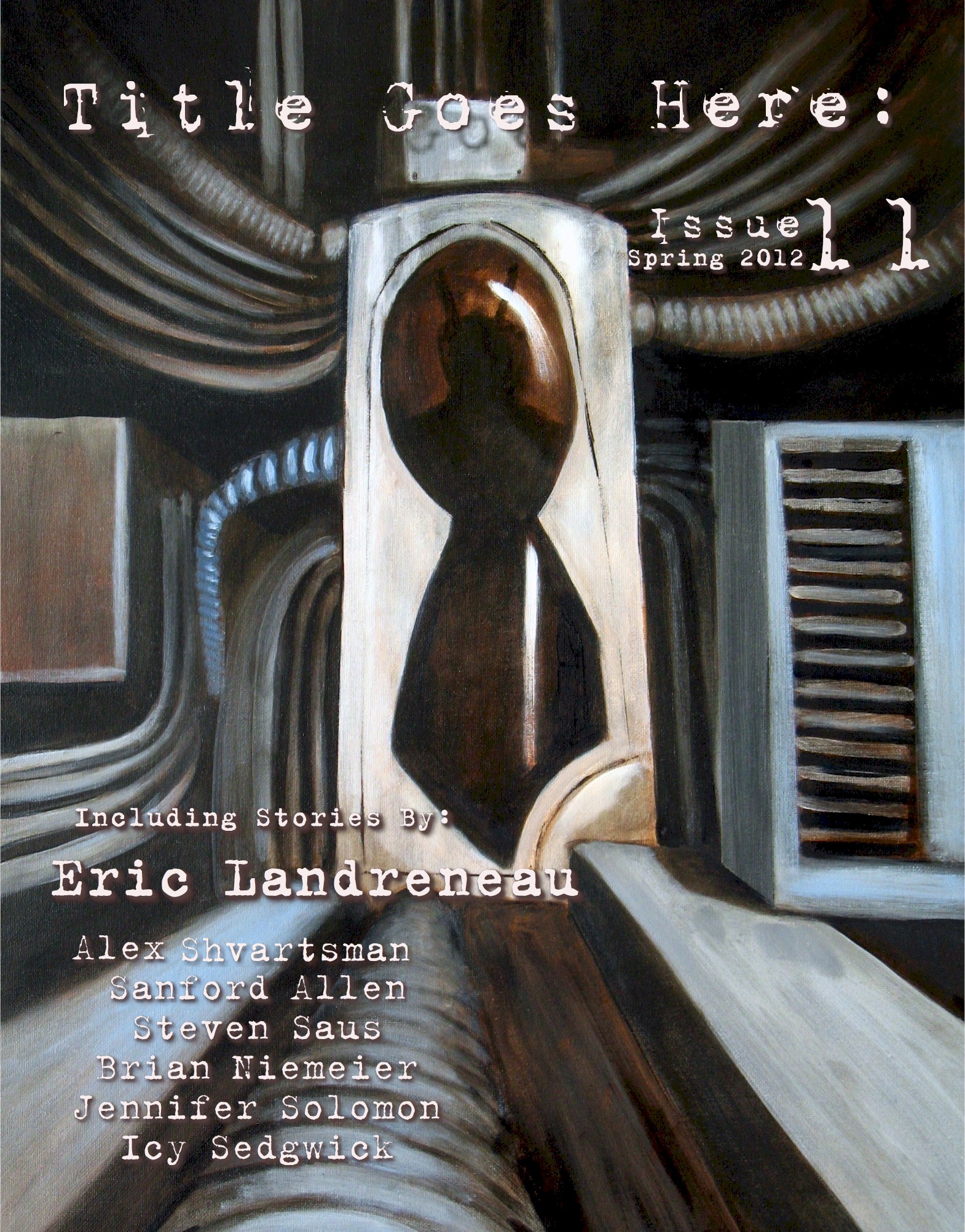
Publication: “Hunger” in Title Goes Here Magazine, Volume 11

April 21, 2012


“Hunger” is the story of the last yeti, being hunted by the humans for the unforgivable crime of being too different. This one isn’t available to read online for free, but you can buy a printed issue or an e-book.

And if you’re getting a bit tired of my constant publication updates this month, I’ve got bad news for you: there are MORE on the way, likely to hit before the month is out. Mwahaha!

Seriously though, if someone told me 2 years ago that I would have four short stories published in a single week, I would have laughed in their face. Life is good.


Publication: “A Shard Glows in Brooklyn” at Buzzy Magazine

April 19, 2012

Of all the stories I’ve had published so far, this is my favorite.

Conrad Brent is special. He is among the small group of people (one in thirty thousand) who can See the world for what it really is.  There are wizards, and monsters, and even a giant troll underneath the Verrazano Bridge — deadly threats that an average citizen knows nothing about. Threats that are kept in check by the Watch — an ancient society which protects regular people from being taken advantage of by those with magic.

Conrad Brent is the Watch’s representative in Brooklyn, NY. When a powerful magic-enhancing shard of Atlantean crystal shows up in the borough, it is up to Brent to keep it out of the wrong hands. By whatever means necessary.

OK, given a little time and a medium cup of French Vanilla coffee, I could probably write a better blurb. But you get the idea. “Shard” is  the kind of urban fantasy I love to read, and want to write.

Conrad Brent is a wise-cracking, irreverent, morally complicated character and I love telling his stories. I’ve already written a second Brent tale, titled “Requiem for a Druid,” where our protagonist butts heads with New York’s most prominent real estate mogul who has a penchant for firing people. That second story is currently looking for a home — sadly there aren’t a lot of pro markets interested in light urban fantasy short stories.

I’m also in the very early stages of planning out my first novel. It will be–you guessed it–a Conrad Brent story.

So please head over to Buzzy Magazine, a brand-new pro venue which was kind enough to accept this story, and read “A Shard Glows in Brooklyn.”


Publication: “The Traveling Fair” at Every Day Fiction

April 18, 2012

This story was written for one of the Shock Totem contests. Every few months the horror/dark fiction magazine sponsors a contest where a prompt is provided and each author submits their story anonymously, to be judged by fellow entrants. I enjoy the process and try to participate whenever I can, and it often results in pretty good stories. “Spidersong” — my first SFWA sale — was another ST contest story. For “The Traveling Fair” the prompt was to write a story under 1000 words featuring a giant monster and fireworks.

Click  here to read The Traveling Fair at Every Day Fiction, and don’t forget to rate it!


Night and Day

April 6, 2012

I’ve always been a night owl. From an early age I found myself to be at my most productive and creative in the evening hours. When I started writing, I fell into a routine where I got most of my new words output done at night, after my wife and son went to sleep and the house became quiet and distraction-free. Some nights I would be too tired to write–exhausted by the day job or various chores that needed doing. Writing being a hobby rather than a career for me, I accepted this loss of productivity and tried my best to make up for it on other evenings, when I had a bit more energy to spare.

Then my wife switched jobs.

She started at the new place two weeks ago. Her new office is very far away, and it takes her nearly two hours to commute there.  This means that she has to leave the house very early, before our son’s day care opens. So now I have to get up early every morning, get Josh ready and drive him to day care. No more sleeping in till 9-10am. And those late-night writing sessions? Forget about it. By midnight my brain feels like a squeezed out sponge.

So, driven by necessity, I fell into new routine. After dropping my son off at day care I get a bit of breakfast and have several uninterrupted, quiet hours in which to write. (I don’t have to be at work till noon). The difference has been night and day–pun very much intended. I am able to attack whatever story idea I’m working on while rested, fresh, and properly caffeinated.  Words are flowing more easily and quality of the output appears to have improved (says the guy who’s notoriously bad at evaluating his own writing).

In the last two weeks I wrote three complete stories from scratch. And although they’re relatively short, none of them are mere flash length, either. There’s a magical realism story I’m especially proud of called “Things We Left Behind” (2500 words) that draws heavily on my personal experiences of uprooting and moving from the Soviet Union to the United States. A 1350 word space opera-ish “The Miracle on Tau Prime” is about the Vatican miracle investigators. In space. And yesterday I wrote a 1500 word SF story “Seven Conversations in Locked Rooms,” completing the first draft in one sitting. One sitting! Normally I struggle to write 500 new words of fiction per day.

I’m liking this new productivity. Well, scratch that. I’m still a night owl at heart. I hate getting up early and going to bed on old people’s time. What I do like are the results.

Could something as simple as a routine change ultimately take me to the next level in terms of both quality and quantity on my writing? Only time will tell. But it’s certainly an intriguing possibility.


2011 Nebula Nominations Announced

February 20, 2012


SFWA announced the 2011 Nebula nominations this morning, and here they are:

Novel

  • Among Others, Jo Walton (Tor)
  • Embassytown, China Miéville (Macmillan UK; Del Rey; Subterranean Press)
  • Firebird, Jack McDevitt (Ace Books)
  • God’s War, Kameron Hurley (Night Shade Books)
  • Mechanique: A Taleof the Circus Tresaulti, Genevieve Valentine (Prime Books)
  • The Kingdom of Gods, N.K. Jemisin (Orbit US; Orbit UK)

Novella

  • “Kiss Me Twice,” Mary Robinette Kowal (Asimov’s Science Fiction, June 2011)
  • “Silently and Very Fast,” Catherynne M. Valente (WFSA Press; Clarkesworld Magazine, October 2011)
  • “The Ice Owl,” Carolyn Ives Gilman (The Magazine of Fantasy and Science Fiction, November/December 2011)
  • “The Man Who Bridged the Mist,” Kij Johnson (Asimov’s Science Fiction, October/November 2011)
  • “The Man Who Ended History: A Documentary,” Ken Liu (Panverse Three, Panverse Publishing)
  • “With Unclean Hands,” Adam-Troy Castro (Analog Science Fiction and Fact, November 2011)

Novelette

  • “Fields of Gold,” Rachel Swirsky (Eclipse 4, Night Shade Books)
  • “Ray of Light,” Brad R. Torgersen (Analog Science Fiction and Fact, December 2011)
  • “Sauerkraut Station,” Ferrett Steinmetz (Giganotosaurus, November 2011)
  • “Six Months, Three Days,” Charlie Jane Anders (Tor.com, June 2011)
  • “The Migratory Pattern of Dancers,” Katherine Sparrow (Giganotosaurus, July 2011)
  • “The Old Equations,” Jake Kerr (Lightspeed Magazine, July 2011)
  • “What We Found,” Geoff Ryman (The Magazine of Fantasy and Science Fiction, September/October 2011)

Short Story

  • “Her Husband’s Hands,” Adam-Troy Castro (Lightspeed Magazine, October 2011)
  • “Mama, We are Zhenya, Your Son,” Tom Crosshill (Lightspeed Magazine, April 2011)
  • “Movement,” Nancy Fulda (Asimov’s Science Fiction, March 2011)
  • “Shipbirth,” Aliette de Bodard (Asimov’s Science Fiction, February 2011)
  • “The Axiom of Choice,” David W. Goldman (New Haven Review, Winter 2011)
  • “The Cartographer Wasps and the Anarchist Bees,” E. Lily Yu (Clarkesworld Magazine, April 2011)
  • “The Paper Menagerie,” Ken Liu (The Magazine of Fantasy and Science Fiction, March/April 2011)

Ray Bradbury Award for Outstanding Dramatic Presentation

  • Attack the Block, Joe Cornish (writer/director) (Optimum Releasing; Screen Gems)
  • Captain America: The First Avenger, Christopher Markus, Stephen McFeely (writers), Joe Johnston (director) (Paramount)
  • Doctor Who: “The Doctor’s Wife,” Neil Gaiman (writer), Richard Clark (director) (BBC Wales)
  • Hugo, John Logan (writer), Martin Scorsese (director) (Paramount)
  • Midnight in Paris, Woody Allen (writer/director) (Sony)
  • Source Code, Ben Ripley (writer), Duncan Jones (director) (Summit)
  • The Adjustment Bureau, George Nolfi (writer/director) (Universal)

Andre Norton Award for Young Adult Science Fiction and Fantasy Book

  • AkataWitch, Nnedi Okorafor (Viking Juvenile)
  • Chime, Franny Billingsley (Dial Books; Bloomsbury)
  • DaughterofSmoke andBone, Laini Taylor (Little, Brown Books for Young Readers; Hodder & Stoughton)
  • EverybodySeesthe Ants, A.S. King (Little, Brown Books for Young Readers)
  • TheBoyat theEndofthe World, Greg van Eekhout (Bloomsbury Children’s Books)
  • TheFreedomMaze, Delia Sherman (Big Mouth House)
  • TheGirlof FireandThorns, Rae Carson (Greenwillow Books)
  • Ultraviolet, R.J. Anderson (Orchard Books; Carolrhoda Books)


Huge congratulations to all the nominees. There’s lots of reading for me to do. As hard as I tried to read up for the short fiction categories, two of the seven nominated stories are new to me, and I can’t wait to get my hands on them.

And, in case you wonder what it feels like to get nominated for science fiction’s most prestigious award, check out Ferrett Steinmetz’s blog entry on this very subject.


Publication: The Getaway in Sparks anthology (Earthbound Fiction)

February 14, 2012


Earthbound Fiction launched its first anthology with “Sparks: Exciting New Fantasy From Today’s Brightest Stars,” a collection of twelve fantasy stories.

My tiny flash story “The Getaway” isn’t, strictly speaking, fantasy. It’s a strange mix of humor, suspense and literary with speculative overtones. But it’s something I enjoyed writing and, I hope, you will enjoy reading–a nice palate cleanser between some excellent longer stories included in this book.


The PEST Method

February 3, 2012

Ask an experienced writer where you should submit your stories, and they’ll invariably tell you to “start at the top, and work your way down.”

The logic behind this is perfectly solid. Even if you suspect that your story isn’t amazing, you may well be suffering from a common writer affliction: underestimating the quality of your work. So why do an editor’s job and self-reject? Let them see the story and decide for themselves.

But where, exactly, is this “top” you should start at? Is it based purely on the amount of payment offered? If this were the case, TOR.com would get to see every story first. Yet I have never submitted there, and possibly never will, because I can’t imagine waiting a year or more, at any venue. Instead, I consider a combination of factors when trying to decide which publication should have the privilege of rejecting my next story:

Prestige – How reputable/popular is the venue
Exposure – How many people will read the story if published
Speed – What’s the likely turnaround time
Terms – Which rights are sought

Let’s examine the PEST method, keeping in mind that I’m discussing speculative fiction only, which is why The New Yorker and its ilk aren’t mentioned below.

PRESTIGE

What publishing credit would you be the most proud of? In terms of respect, nothing comes close to the big three: Fantasy & Science Fiction, Asimov’s and Analog. They’re the gold standard, and it’s hard to make the case for sending a story which might be appropriate for one or more of those magazines elsewhere first.

The big three all pay professional rates, but prestige isn’t necessarily tied in to payment. There are a number of magazines that pay only a penny per word that are highly respected. Lady Churchill’s Rosebud Wristlet, Shimmer and Andromeda Spaceways are a few notable examples. I often submit to ASIM and Shimmer before sending the same story to higher paying venues.

New publications don’t get completely ignored under this method. Instead of considering the magazine/anthology’s history, I consider instead who the editors are and what their track record is in the industry. I was interested in aggressively submitting to Stupefying Stories right from the start, because it’s edited by Bruce Bethke. If there’s ever an open call for one of Mike Resnick’s anthologies, I’ll be eagerly writing a new story from scratch just to have something I can send in.

EXPOSURE

I care about how many people will ultimately read my story. Every author does. So when the time comes to submit, I am more likely to send my work to a publication with a large readership than a higher-paying but obscure journal or anthology. Every Day Fiction pays token rates, but they provide more exposure than most online markets. I gladly submit to them, and will continue to do so.

On the other hand, be wary of non-paying markets that boast about how appearing on their web site will help promote your brand and advance your writing career. It won’t. Most of those markets are read by a few hundred people, at best. And you won’t be doing yourself any favors mentioning the fact that you’ve been published by such in your cover letter. Things are a bit different on the literary fiction front, but when it comes to science fiction and fantasy, there aren’t any non-paying markets I can think of where I’d be interested in submitting original work.

SPEED

How long does a market take to respond to your submission? Some of the very best markets are also the fastest—Clarkesworld, Lightspeed, Daily Science Fiction, F&SF are among publications where most submissions are handled within days rather than months. There are dozens of other great markets that manage a turnaround of 4-6 weeks. It’s logical to submit to all of those before sending your story to Dark Discoveries, GUD or TOR.com where your submission is likely to languish for a year.

TERMS

In their desire to get published, writers often ignore the finer details of their contracts. There are a number of important details you should consider, before signing on the dotted line.

First, never give up the ownership of your work. Very few publications ask for it, but stay as far away as you can from the ones that do. Maintaining ownership will allow you to eventually sell your story to reprint markets, Best Of anthologies, Podcast ‘zines, etc. You might even hit a jackpot and have your story optioned for a movie or a screenplay. Or, perhaps, you simply want to make the story available for free on your blog. If you aren’t careful, you could forfeit all of those opportunities with a stroke of a pen.

Most reputable publishers won’t attempt to grab full rights. But you should read the contract carefully to see exactly which rights they do want. They’ll typically ask for a certain period of exclusivity. Obviously, you can’t do anything with your story until they publish it. In some cases, the rights will revert to you immediately upon publication and you can begin to submit elsewhere. In most cases however, they’ll want a period of exclusivity that can range from anywhere between a few months and a few years. I think anything up to a year is pretty reasonable. My personal upper limit is 18 months.

It’s very important to note that this period of exclusivity (be it 0 days or 2 years) typically begins on the date of publication, not when the contract is signed. In these cases you must make sure there’s a reversion clause in your contract.  A reversion clause states that the publisher has a limited amount of time to print your story. Without such clause, a publisher could hang on to your story indefinitely and you won’t get it back – even if you didn’t sell full rights.

This sort of thing doesn’t happen often. Most publishers mean well and operate in good faith. However, it doesn’t hurt to make sure reasonable terms are spelled out in the contract. If there’s something there that doesn’t sound right to you, it’s perfectly OK to ask the publisher if they’d be willing to alter it. After all, agents negotiate novel contracts with publishers all the time.


So there you have it – my method for ranking short story markets. Nothing earth-shattering, but hopefully there will be some glimmers there to help you figure out which editors to PESTer with your own submissions next.

Two New Sales and a Reprint

January 16, 2012


A few months ago I found out about a new Kindle magazine called Stupefying Stories. It was launched and edited by Mr. Bruce Bethke, the man who coined the term “cyberpunk” back in the day, and has been an influential voice in the science fiction field. Naturally, I wanted to have a story of mine appear in this shiny new ‘zine.

I sent out a piece, and got a “close, but no cigar” rejection. Mr. Bethke did encourage me to send in more stuff, and to send more than one story. I obliged, sending two pieces of flash fiction.

“A Brief Respite from Eternity” is a love story set  in the final stages of the heat death of the universe. “Number Station” is a horror/dark fantasy piece which takes place in modern Russia. They’re two very different stories, in tone, subject and voice. I figured my best bet was to offer a range and hope that Mr. Bethke and other editors would like one or the other.

I was overjoyed to find out, late last night, that they liked and accepted both! I don’t have the publication details yet, but from what I gleaned from the e-mails it sounds like “Brief Respite” will appear first, with “Number Station” to be published sometime in the future.

Yesterday also marked the reappearance of the first story I ever wrote, “The Skeptic,” on the Internet. Its original publisher shut their virtual doors last year and took the site down. Bent Masses stepped in and accepted “The Skeptic” as a reprint. It has been published in their January issue and can be read here.


Writing What You Don’t Know or In the Footsteps of Jules Verne

December 5, 2011

Jules Verne, a science fiction pioneer

Some of the most basic writing advice out there is “show, don’t tell,” “avoid adverbs like the plague” and “write what you know.” While the former two adages are more or less universal, it’s a lot harder for a speculative fiction author to follow the third. After all, what writer could have the first-hand experience navigating a faster-than-light starship, traveling back in time, or casting magic spells?

In most cases a healthy amount of research will do the trick. Jules Verne, renowned for his lush descriptions of exotic and faraway places, hardly ever left his armchair. He learned about Africa, India and other settings outside of Europe by reading books and studying maps. One can only imagine what kind of adventures the grandmaster would have thought up if he had access to the Internet. Or perhaps his productivity would have been stunted by World of Warcraft and Words With Friends – just like the rest of us… Or is that just me? But I digress.

Research is how I cope with writing about stuff I don’t necessarily know much about. I don’t have to become an expert in every field — I just learn enough to fake sounding like one on paper. After all,  if I can’t fake a little knowledge, how can I write convincing accounts of telepathic alien spiders or bad-ass magic wielders on the streets of Brooklyn?

A good portion of my allotted writing time is spent on Wikipedia, looking up various subjects. And the subjects are only getting stranger. Recently some of the stuff I had to look up online for my stories included:

* Manhattan Municipal Building
* Mose the Fireboy
* Persimmons
* Variations of Shakespeare’s “To Be or not to Be” soliloquy in “Hamlet”
* Kaballah and Jewish mysticism
* Sunset Park waterfront
* Sumatra
* Year the JFK airport was renamed as such
* Common Greek names
* Volcanic eruption that destroyed Pompeii.

These aren’t all for the same story (although, if they were, it’d be a doozie!). On second thought, I looked at the list again and SIX of the ten examples I listed are all research for just one story – a sequel to “A Shard Glows in Brooklyn” titled “Requiem for a Druid.” I really doubt anyone would be able to figure out which six, but feel free to give it your best shot in the comments.


“The Candidate” published by Gary Games

February 23, 2011

“The Candidate” is the only sword and sorcery fantasy I’ve written so far. It is also the only story that is set in the world I did not imagine on my own. Instead I was working with the background created by Justin Gary and other fine folks over at Gary Games for their excellent board game “Ascension: Chronicle of the Godslayer.”

I was given a set of mythology/events they developed for the game, plus whatever hints I could pick up from artwork and flavor text printed on the game’s cards. However, I also had plenty of creative freedom. Kaer and his people were entirely my addition (though Ahrans already existed in the world of Ascension). All individual non-deity characters in the story I got to make up on my own. Justin and Co. even took some of my advice in changing parts of the fundamental mythology of Ascension in the process.

In writing this story, my goal was to introduce Ascension fans to the fundamentals of the imaginary world in which they are playing. For those who haven’t played it yet (and you should!), Ascension is a deck building game in which players race to collect the most powerful assortment of weapons and spells while defeating monsters on the board. Players are never in direct conflict with each other as they would be in a game like Risk. They are all working toward the common goal – defeating an evil god. However, there can be only one winner, so the game mechanics allow players to occasionally make moves that temporarily set back their opponents (much like moving a Robber in Settlers of Catan, or placing a tile to mess up a competitor’s city in Carcassonne).

In the end, there can be only one Godslayer – but there are many Candidates (players) in the game. What motivates them? Some are obviously in it for the Big Prize (this will be covered in the story, but the game’s title in itself is a pretty big hint). Others… not so much.

The end result was a rather long (5000+ words) story which will be published in four installments on the Gary Games web site. Today you can read the first part here. Stay tuned to the official Ascension web site, or to this blog, for the next chapter.