The latest issue for Fireside is live as of today and it includes my post-apocalyptic flash fiction story He Who Watches. Click on the link to read but be warned: it’s not the usual light and fluffy fare you’ve come to expect from me!
#SFWAPro
The latest issue for Fireside is live as of today and it includes my post-apocalyptic flash fiction story He Who Watches. Click on the link to read but be warned: it’s not the usual light and fluffy fare you’ve come to expect from me!
#SFWAPro
 Comments Off on He Who Watches – Fireside Magazine #26 |
  Uncategorized |
  Permalink
 Posted by Alex Shvartsman

The following scans are from the books and letters that were a part of the personal collection of John Costello, translator and science fiction fan who passed away earlier this year. John had worked closely with Kir Bulychev, one of Russia’s best-known and beloved science fiction authors, and was actively involved in promoting Russian science fiction in the US.
I felt the following documents might especially be of interest to Russian fandom, and am sharing them with permission from ReaderCon. Click on any of the images to see the full version, and feel free to download/share/post them as you see fit.
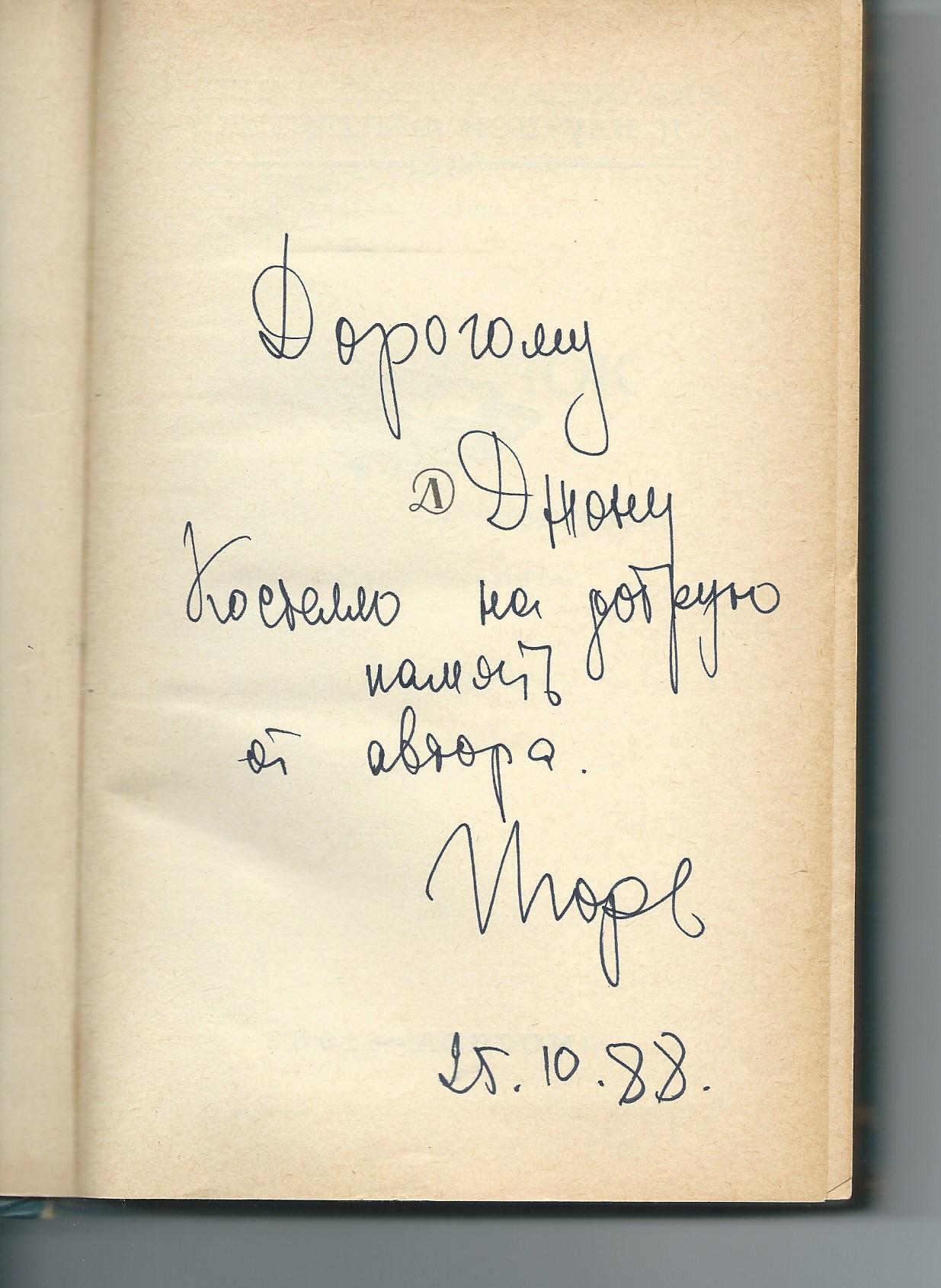
There is a number of books in the collection autographed by Kir Bulychev and signed to John Costello. Most of them are merely signed with a brief note of well wishes, as the one above, but there are several with interesting notes that I am posting below. If there’s interest in the other “basic” signatures/dedications, I can scan those upon request.
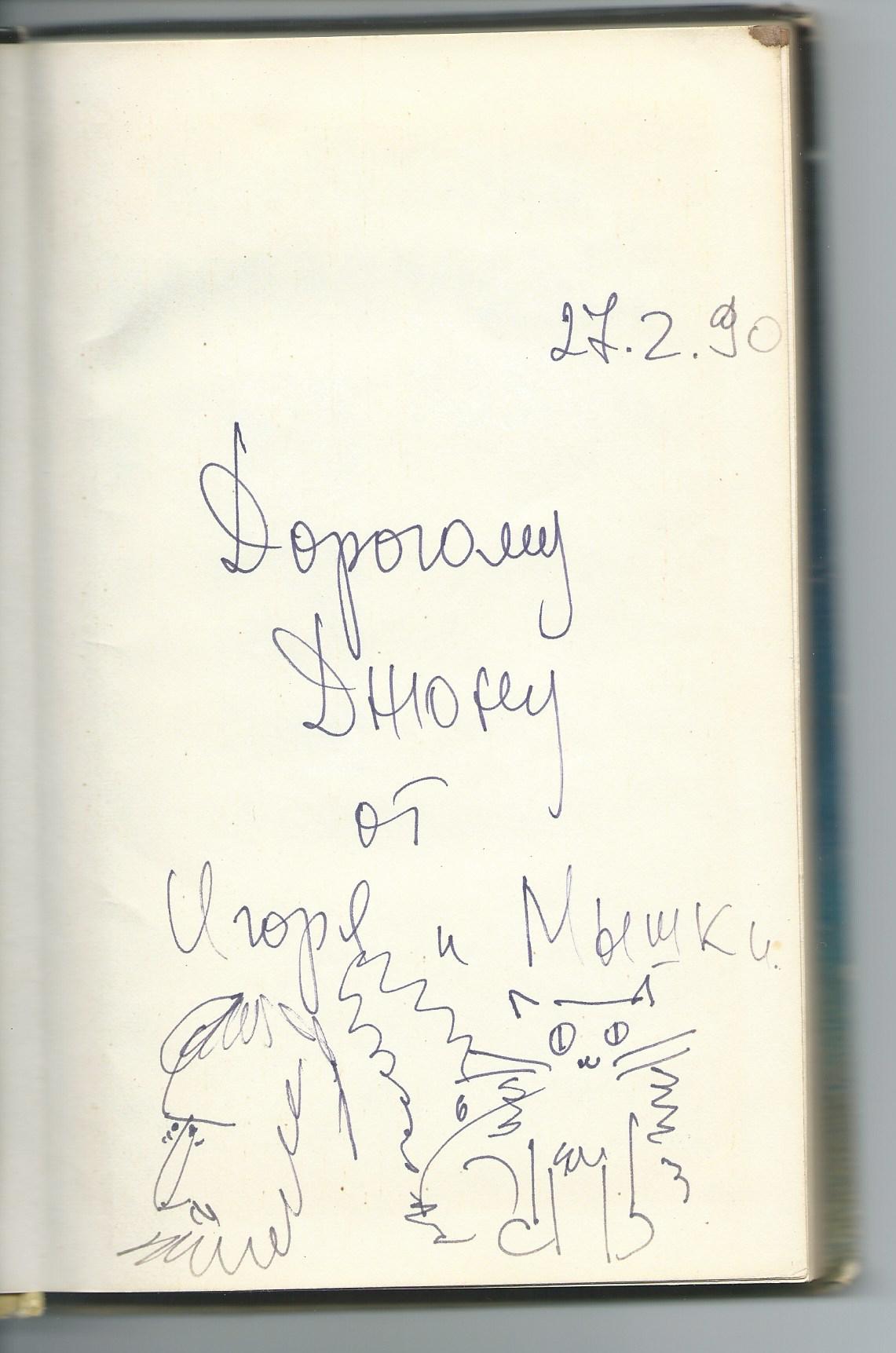
A self-portrait sketch by Kir Bulychev. He writes “from Igor and the Mouse” though that definitely looks like a cat to me. May have been some inside joke between Kir and John. This is from the flap of “Коралловый Замок” (The Coral Castle).
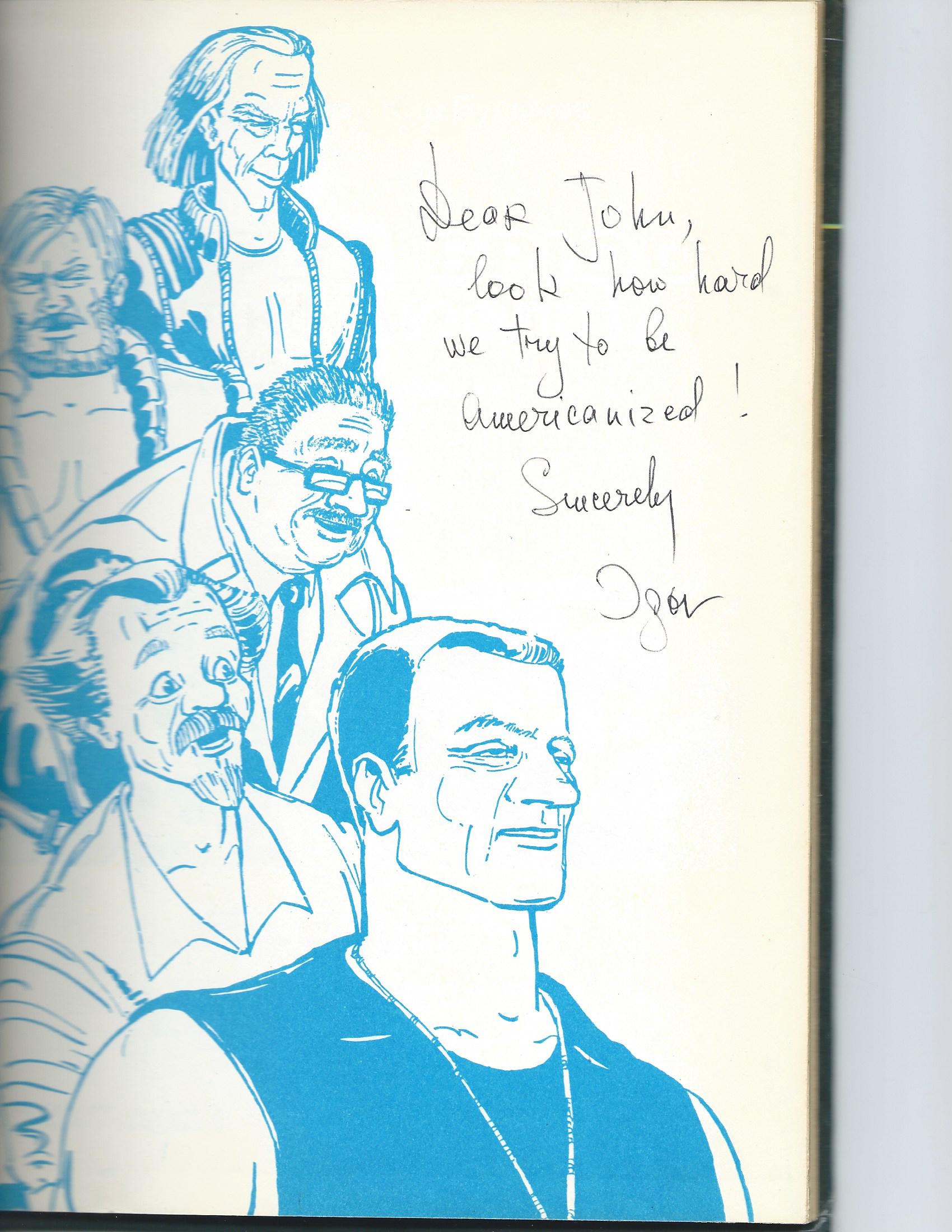
The only dedication in English. From the flap of “Андрей Брюс, Агент Космофлота” (Andrei Bruce, Spacefleet Agent) hardcover comic book, circa 1993. Comic books were not a well-known media form in Russia; this must have been one of the earlier such publications, and it was based on Bulychev’s writing.
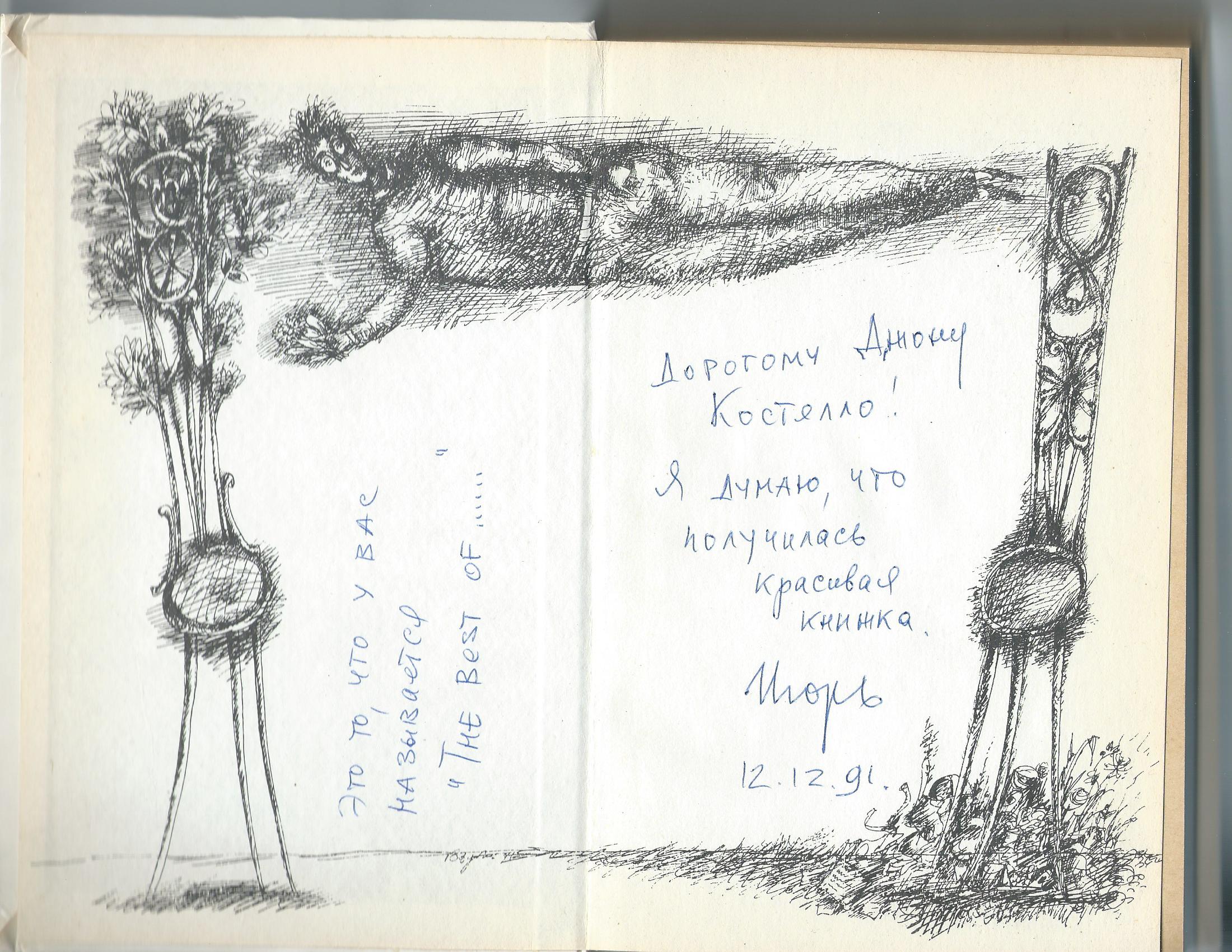
A “best of” collection “Кому Ето Надо?” (Who Needs This?). Bulychev writes: This is what’s called “The Best Of…” over there. I think it turned out to be a very pretty book.”
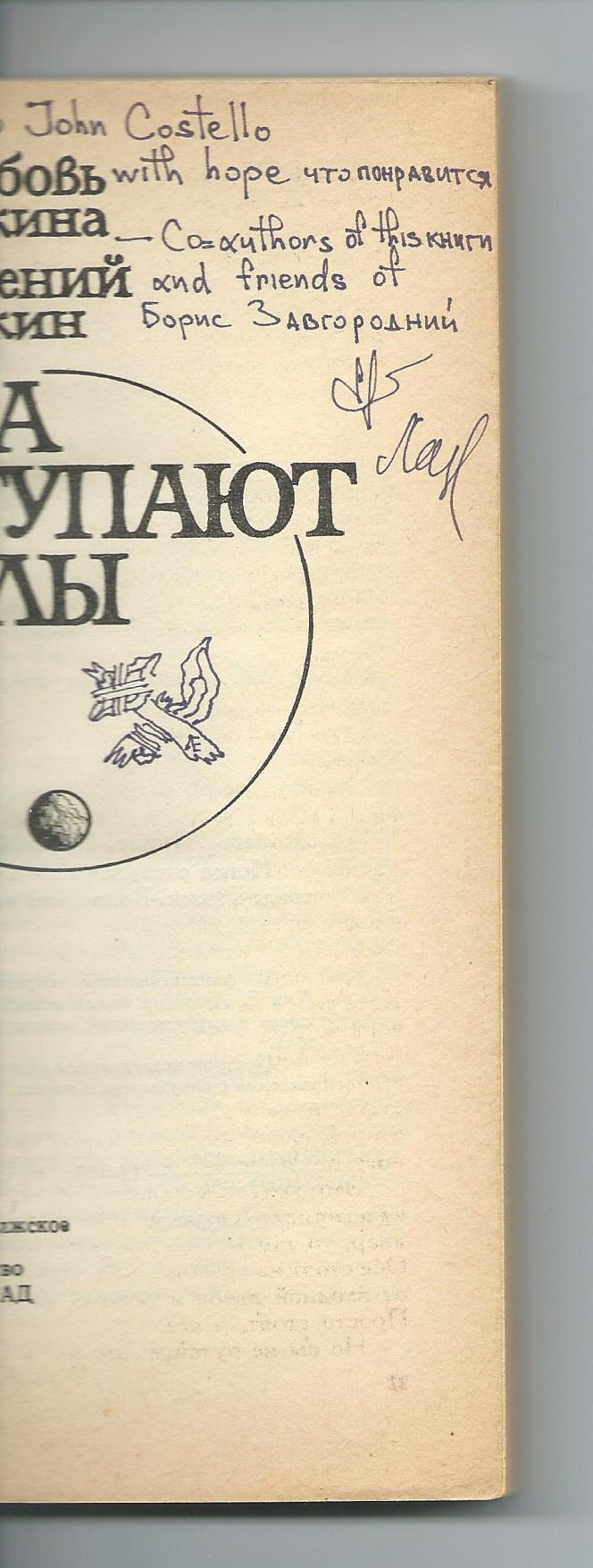
A signature by Lubov and Evgeny Lukin on the cover page of their “Когда Отступяют Ангелы” (When Angels Retreat). It reads: “With hope that you like it. –Co-authors of this book and friends of Boris Zavgorodniy.”
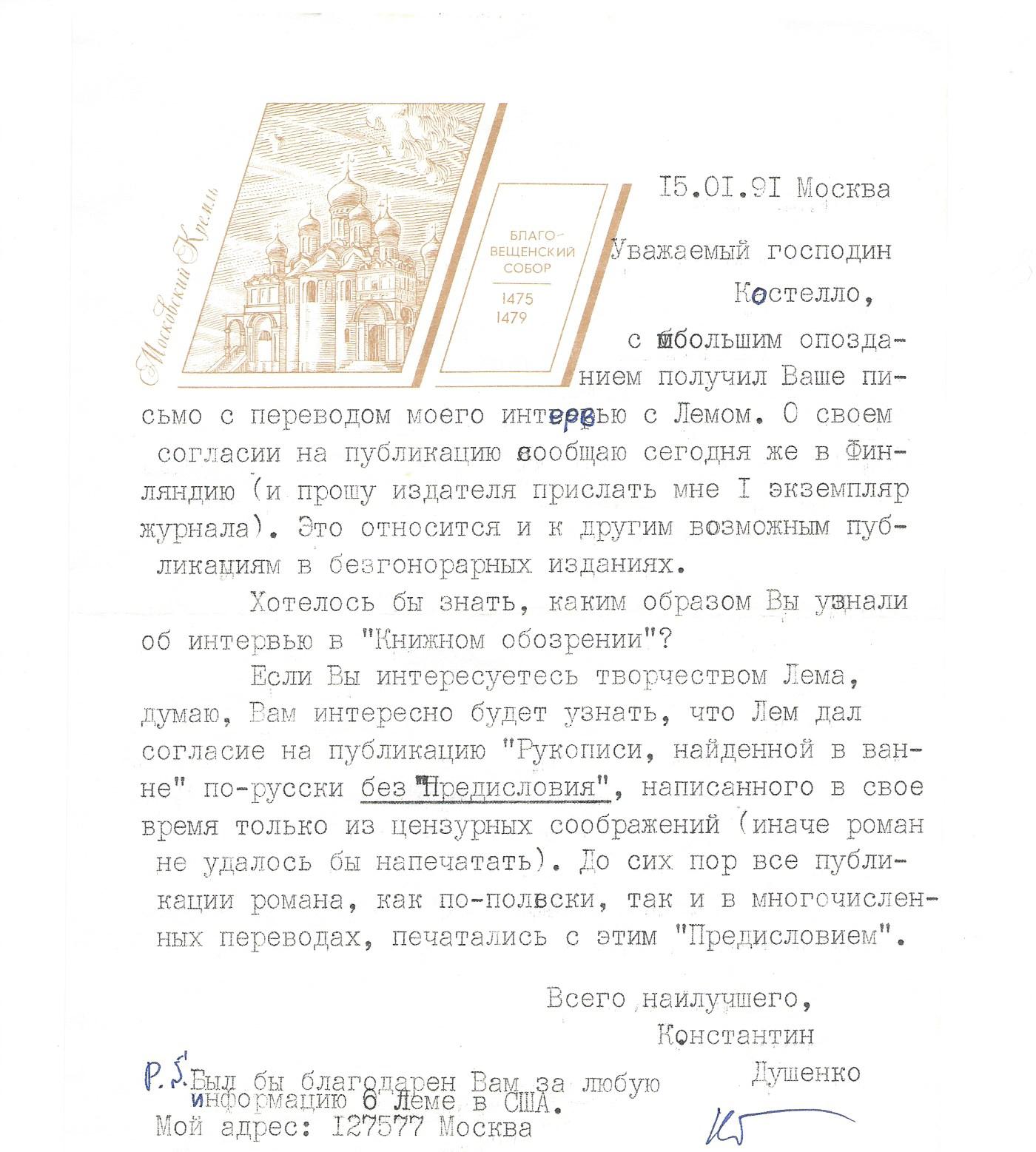
The letter from Konstantin Dushenko to John Costello, granting permission to reprint the translation of Dushenko’s interview with Stanislaw Lem and requesting a copy of the publication. Dushenko goes on to ask how Costello found out about the interview, published int he Review of Books, and goes on to comment on Lem’s assent to the Russian-language publication of the novel “Memoirs Found in a Bathtub” without the foreword he was originally forced to write so the book would be able to get past the censors. Dushenko notes that all previous editions of “Memoirs” in the original Polish and in translation were published with this foreword.
Note: The scan intentionally cuts off the final line of the letter, which includes Dushenko’s address (in case he or his family still reside there.)
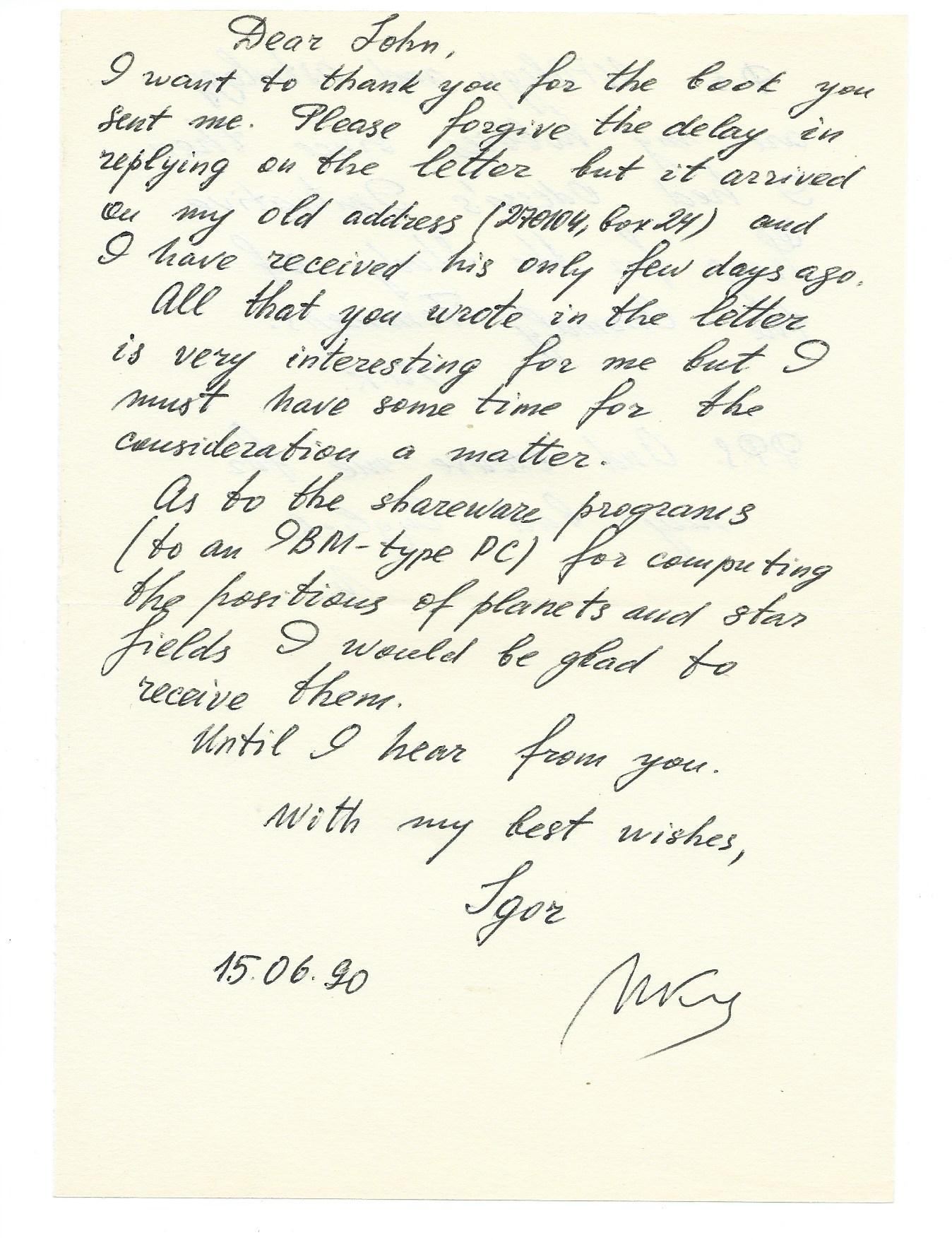
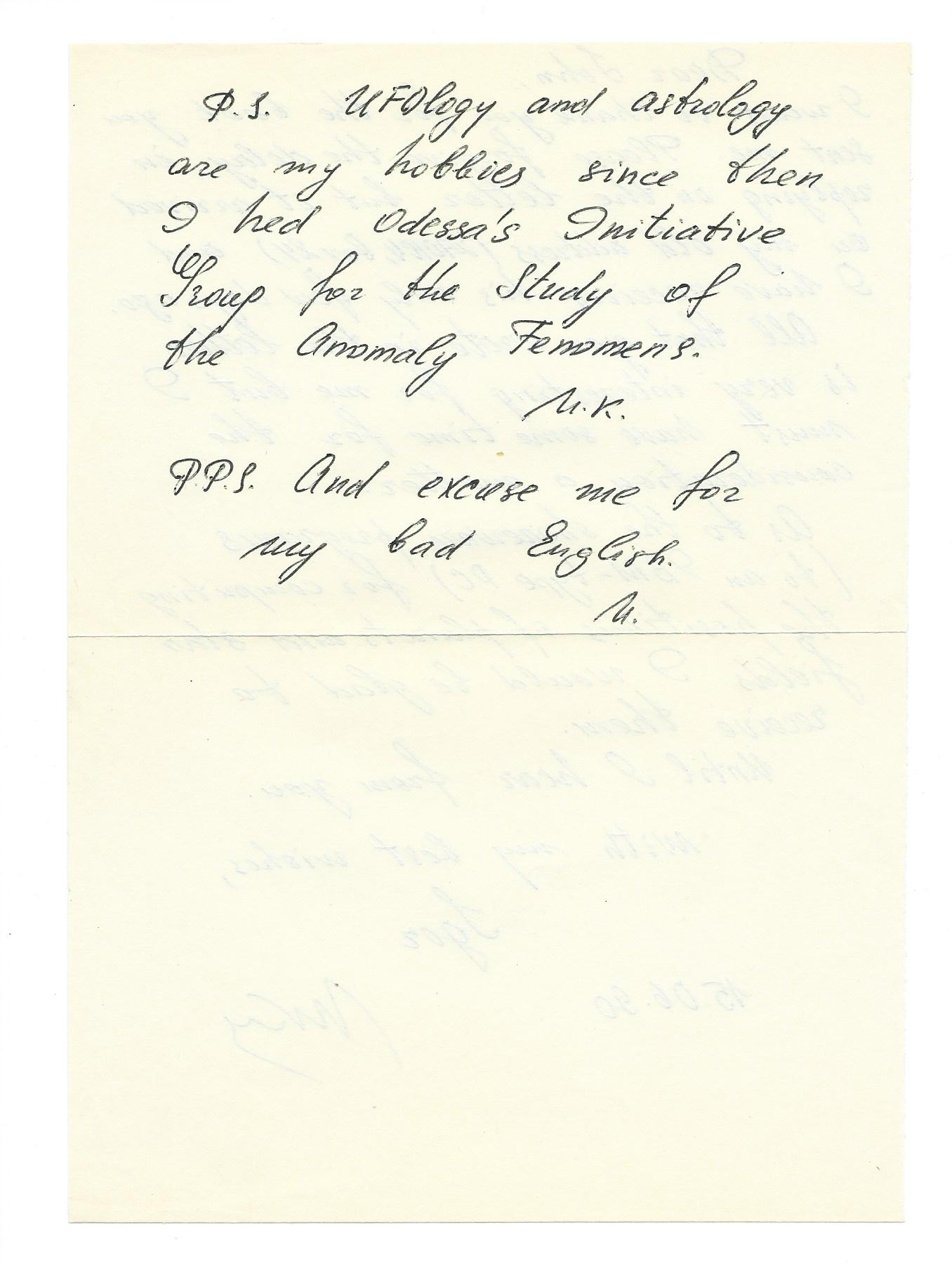 Front and back of the letter from Igor Nikolaevich Kovshun, a noted UFOlogist and head of “Proteus,” the SF fan club in Odessa, Ukraine.
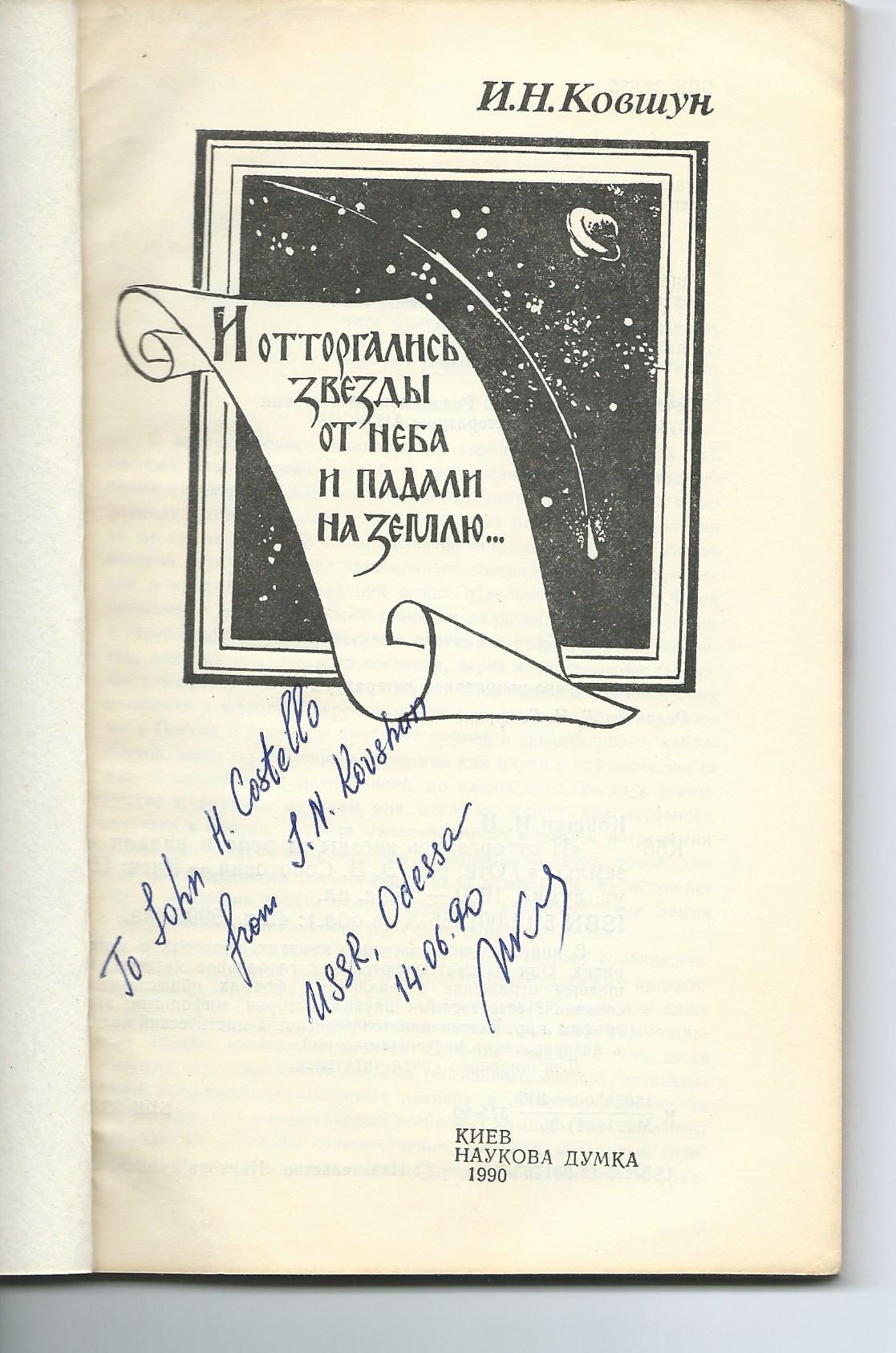
A copy of “The Stars detached from the Sky and Fell to Earth…” autographed by Kovshun.
#SFWAPro
2 Comments | Uncategorized | Tagged: Dushenko, John Costello, Kir Bulychev, Kovshun, Lukin, Russian science fiction | Permalink
Posted by Alex Shvartsman

Funny Science Fiction
I’ve read a LOT of funny science fiction stories so far, and have a good number in my “maybe” pile, but this is an update on the stories that have made it into the book already:
“Observation Post” by Mike Resnick (Beyond the Sun, Fairwood Press, 2013)
“Flying on My Hatred of My Neighbor’s Dog” by Shaenon Garrity (Drabblecast, 2013)
“Whaliens” by Lavie Tidhar (Analog, 2014)
“Half a Conversation, Overheard Inside an Enormous Sentient Slug” by Oliver Buckram (F&SF, 2013)
“Wikihistory” by Desmond Warzel (Abyss & Apex, 2007)
“See Dangerous Earth-Possibles!” by Tina Connolly (Lightspeed Women Destroy Science Fiction, 2014)
“Kulturkampf” by Anatoly Belilovsky (Immersion Book of Steampunk, Immersion Press, 2011)
“HARK! Listen to the Animals” by Ken Liu and Lisa Tang Liu (Galaxy’s Edge, 2014)
“Let Us Now Praise Awesome Dinosaurs” by Leonard Richardson (Strange Horizons, 2009)
“Miss Darcy’s First Intergalactic Ballet Class” by Dantzel Cherry (Galaxy’s Edge, 2015)
“Pidgin” by Lawrence M. Schoen (Aliens and A.I., Eggplant Literary Productions, 2005)
“Nothing, Ventured” by James Beamon (AE: The Canadian Science Fiction Review, 2013)
“Troublesolver” by Tim Pratt (Subterranean Press, 2009)
If you plan on sending a suggestion, please do so in the next day or two at the latest. I hope to finalize the TOC in the next week.
#SFWAPro
Comments Off on Funny Science Fiction Update #2 | Publishing, Uncategorized | Tagged: Funny Science Fiction, humor, short stories, Submissions | Permalink
Posted by Alex Shvartsman
I’m happy to share the cover of my upcoming humor novella, designed by the very talented Jay O’Connell:

Blurb:
H. G. Wells is a Victorian-era James Bond who must defend England and the world against time travelers, alien incursions and interdimensional threats (if he can learn quickly on the job, and survive the human foes he encounters, that is!)
During his missions, Wells will alternately team up with Anton Chekhov to foil an assassination plot against Prince Nicholas Romanov of Russia, oversee the construction of the giant antenna designed to detect alien invasion fleets (or, as we know it, the Eiffel Tower), rub shoulders with the likes of Arthur Conan Doyle, Marie Curie, Jules Verne and Annie Oakley, and risk everything to encourage cooperation amongst the world’s most powerful intelligence agencies.
This humorous steampunk novella is filled with Easter eggs and British pop-culture references, from The Beatles and Ian Fleming to Douglas Adams and Dr. Who.
What makes this story different:
Every single named character, from the titular Herbert Wells to the lowest gate guard, is based on a real historical personage who could have conceivably been found at the time and place of the story (which spans from 1887 to 1889.) Although the individuals the characters are based on happen to be real, the story is riddled with intentional anachronisms.
Wells, who is the newest agent of a Torchwood-like organization, wears a Babel Fish translator device, travels in the yellow submarine, and rubs shoulders with some of the most iconic individuals from the late nineteenth century.
Here’s a brief sample. Wells is at a party at the Hermitage Palace in St. Petersburg.
Sample:
Back in the Armorial Hall, Wells sought to soothe his bruised ego with strong spirits. He approached one of several bars set up for the guests. He waited for the bartender to finish serving a glass of sparkling wine to an attractive blonde.
“Have you got any gin?” Wells asked.
The bartender shook his head. “Vodka,” he said curtly. “Seven different flavors.”
“Obviously,” said Wells. “Very well. I’ll have a vodka mixed with a shot of the Kina Lillet you’ve got over there.” Out of the corner of his eye he noticed the blonde watching him with interest. Perhaps this day wasn’t entirely ruined yet. “This mixture is my own invention; I’m going to patent it when I think of a good name. Make sure it’s stirred, not shaken. Wouldn’t want the drink to be weak.”
He turned toward the blonde and flashed his best smile. “My name is Wells. Herbert Wells.”
The blonde giggled and walked off, carrying her glass. Wells sighed as he watched her go. Things really weren’t working out in the way he had imagined. He waited for his drink, composing excuses for Ministra MacLean in his head. His first mission for the Ministry was shaping up to be his last.
Wells took a swig of the proffered cocktail and coughed violently. The drink turned out to be far more potent than he had anticipated.
“You should have added lemon to that. I take a slice whenever I have to drink Cognac. Makes the vile stuff taste almost tolerable.”
Wells looked up at the man advising him, and swallowed the biting remark he was about to make. Standing in front of him was the heir to the Russian throne.
Annotations:
Readers familiar with Ian Fleming’s work may note that Wells is trying to pull a James Bond here. I couldn’t have him order a Martini because this drink hadn’t been invented yet in 1887, but Fleming was very helpful in that he wrote the line, which I steal wholesale, where Bond orders what becomes known as a Vesper Martini.
There are lots of Easter egg moments in the story where dialog or exposition are a nod to some pop culture or historical reference. For those interested in seeing if they caught them all, I’m providing a complete list of annotations after the story, which will also include some relevant images as well.
#SFWAPro
H. G. Wells, Secret Agent is slated for the release as an e-book in July.
2 Comments | Publishing, Uncategorized | Tagged: alternate history, humor, steampunk, Wells | Permalink
Posted by Alex Shvartsman

The Hook:
As she rode through the snowy wilderness of far southern Caskentia, Octavia Leander’s spirits were buoyed by three thoughts: that although she fled from assassination and capture, she was undoubtedly in one of the most beautiful places she had ever seen; that thus far they had survived a full week without any sign of pursuit by horse or buzzer; and that her companion in the hard journey was Alonzo Garret, a man who had forfeited his career as a Clockwork Dagger–and possibly his life–in order to keep her alive.
Considering the dire circumstances, he made for delightful company.
Alonzo rode ahead on a chestnut bay stallion, their gray pack horse following close behind. This far from civilization, the world was utterly quiet but for the jingling of tack, the horses’ breathing and the steady rhythm of their hooves, and the radiant life songs of the horses, Alonzo, and any wildlife within close range. In particular, she took comfort in the ever-present marching band brasses of Alonzo’s life essence; she would recognize his particular notes in any crowd.
Beth Cato writes:
This is the opening of my steampunk fantasy novel The Clockwork Crown, the sequel to The Clockwork Dagger. That book featured healer Octavia Leander caught in a vicious game of tug-of-war between her corrupt government of Caskentia and separatists in a desolate territory known as the Waste. It had a heavy dose of espionage, royal tragedy, airship travel, and cuteness in the form of little green gremlins.
Writing a sequel is intimidating. There’s immense pressure right away to establish the setting, characters, and the lingering plot issues from the previous book, and to do so without it being a boring info dump.
I opened the book with my heroine, Octavia, making three observations. This style of opening has now become a superstitious stand-by for me. I wrote an urban fantasy novel years ago that opened with three points like this; that book connected me with my agent, though it didn’t sell. I then had The Clockwork Dagger‘s first paragraph also start with three notes.
Yes, I continue this tradition with my next project, too. So far, each of these books has brought something awesome to my life and/or sold. Why mess with a good thing?
Here, I used that technique to introduce the stakes right away: Octavia and Alonzo are being hunted. Since a lot of world-building is necessary right away, I wanted to balance information with a high-tension action scene. You know that things have been uneventful for them for a week, but that’s going to change right away.
With the personal stakes established, I moved on to another important element of the books: Octavia’s magic. She’s a medician who draws her healing powers from a world tree known as the Lady. In the grand tradition of most leading characters, Octavia is abnormally powerful. When she is close to other people or animals, she hears their health in the form of song. Her magical talents are one reason why they are being hunted, and her abilities have gotten stronger over a very brief span of time. This is not a good thing.
Octavia’s insight also introduces Alonzo. I wanted to establish that there is chemistry between these characters and a potential romance, though that’s not the central point of the book. Survival is. In that, Octavia and Alonzo rely on each other and the unique skills they meld to form a solid team.
Until now, I didn’t realize how many plot threads I built into those first 180 words. Huh.
Really, these opening paragraphs are the last moments of peace Octavia and Alonzo will know for the next while. All hell is about to break loose, and I hope that readers enjoy the crazy ride.
Buy The Clockwork Crown on Amazon
About the author:
Beth Cato hails from Hanford, California, but currently writes and bakes cookies in a lair west of Phoenix, Arizona. She shares the household with a hockey-loving husband, a numbers-obsessed son, and a cat the size of a canned ham.
She’s the author of The Clockwork Dagger steampunk fantasy series from Harper Voyager. The newest book, The Clockwork Crown, comes out on June 9th, 2015.
Follow her at BethCato.com and on Twitter at @BethCato.
###
#SFWAPro
If you’re an author with a book coming out soon and you wish to participate on The Hook, please read this.
1 Comment | Uncategorized | Permalink
Posted by Alex Shvartsman

The Hook
I was mucking out the dragon’s garage when the witch’s text popped up on my phone.
BRING ME A BIRD
“Ugh,” I said to Moonfire. “Here we go again.”
Tina Connolly writes:
Seriously Wicked is a lighthearted YA novel about a girl who lives with a “seriously wicked” witch. Cam’s voice just popped into my head one day and the whole novel spilled out.
Now, there was lots of rewriting, of course! I wrote the first draft of this book before Ironskin. Seriously Wicked was my fifth completed novel, and the first what I thought of as a “really-truly” novel, a full-length novel I believed in and loved. Still, Seriously Wicked was my fifth novel, and Silverblind (my most recently-written novel, that came out Oct 2014) was my tenth. So, I like to think I’ve learned a little bit.
And one thing that happened with Seriously Wicked is that I rewrote the beginning. Again and again. Oh, right, and did I say again? Yes. Again. I kept coming back to this book between later novels and rewriting the whole novel, but particularly the beginning, because as we all know, your opening has to work very very hard to set the stage and tone and characters and hook the reader and everything else.
For fun, I thought I’d show you how much better the beginning got over time:
Draft 1. Book title: HOW I STOPPED THE WITCH WHO ATE MANHATTAN
Chapter One: Introduction To Me, aka CASH
Look. Say you’re a girl. And say someday you grow up and decide to be preggers. When you’re carrying around an innocent little baby with blue eyes and a kinda smooshed nose that everyone says someday she’ll grow into, then for the love of pete, do not under any circumstances say you just gotta have pickles dipped in chocolate.
Note: This is a terrible opening. I have no idea who CASH is. Also, as a reader, I don’t want to be accused of being A) a girl, B) preggers, and C) liking pickles and chocolate. The only thing good I can say about this opening is that putting these words down on the page made all the other words follow in a flood.
#
Draft 2. Book title: WITCH GIRL HEARTS DEMON BOY
Chapter One: Hot Seat
If you think your life stinks because you have to take out the recycling or vacuum your room or something normal like that, then listen up.
Every morning before school I got to start by collecting the dragon’s milk and mucking out her living quarters. There aren’t many dragons left, if any, but there’s one for sure living out back in the detached RV garage, big and warm and smelling of regret. The witch says one girl dragon doesn’t make any more noise than a chicken, and those are legal in the city, so so far she’s gotten away with it.
Note: Significantly better, but the opening sentence is still a bit aggressive (READER LET ME MAKE ASSUMPTIONS ABOUT YOU), and then we talk about dragons for awhile and I’m starting to wonder how long this is going on. (Note: It goes on for PAGES. Cam tells you about EVERY SINGLE ONE OF HER MORNING CHORES.)
#
Draft 78 (approximately). Book title: SERIOUSLY WICKED
Chapter One: Girl on Fire
If you think your life stinks because your musical mom makes you practice violin three hours a day even though you’re tone deaf, or your athletic dad makes you stay on the high school diving team even though your best dive is a bellyflop, then listen up.
Here’s what it’s like to live with a witch.
Every morning at 4:55 AM I drag my weary butt out of bed and head straight for the choreboard. The choreboard is a shiny list of magical tasks the witch wants me to do to “understand true witchery” or something, and if I haven’t done every one by the time I leave for school, it magically slices my thumbs with papercuts.
Note: Not really better. Going backwards, I think. Ever heard the advice not to start with your character waking up? Okay then.
#
Draft 233 (approximately). Book title: SERIOUSLY WICKED
Chapter One: Girl on Fire
4:55 in the horrible, horrible A.M., and once again I was staring at a whiteboard framed in gilded wood carved with toothy serpents. A peeling office label on the bottom proclaimed: Chores by Which One Must Understand True Witchery.
The toothbrush dangled from my mouth while I pressed the label back down, picked up the dry-erase marker, and marked off, “Werewolf pup—feed and take outside” with a big red X.
Then yelped as the choreboard gave me a papercut on my thumb.
Note: I rather like this setting, but it brings up weird questions (how does a choreboard give you a papercut? It’s magical, okay? GO WITH IT) and you don’t want the reader having weird papercut-related questions on the first page. Also, she’s still basically just waking up and going through her chores. I do like the juxtaposition between the whiteboard/office labels and witchy things.
#
And then finally (FINALLY!) we get to the real one. The final one.
SERIOUSLY WICKED
Chapter One: TRUE WITCHERY
I was mucking out the dragon’s garage when the witch’s text popped up on my phone.
BRING ME A BIRD
“Ugh,” I said to Moonfire. “Here we go again.”
Note: I kept the most important chore (mucking out the dragon’s RV garage) and then we jump RIGHT TO THE CONFLICT WITH THE WITCH. No detailed explanation of every single one of Cam’s magical chores. No weird musings about papercuts or pickles. It still establishes the humor in the story, which partly comes from the juxtaposition of magic and mundanity: dragons living in garages, a wicked witch who sends her demands by text (the witch is a big texter.) It still establishes that Cam has to work. A lot. And then: Cam brings the witch a bird and the witch tells her she’s planning to take over the world. Just a normal Tuesday.
Buy Seriously Wicked on Amazon
About the author:
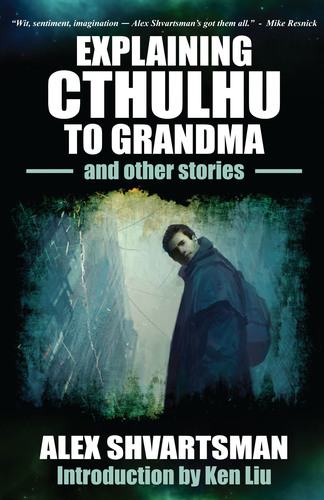
Tina Connolly is the Nebula-nominated author of the Ironskin trilogy from Tor Books. Her next book, Seriously Wicked, comes out May 5th from Tor Teen. Her stories have appeared in Women Destroy SF, Lightspeed, Tor.com, Strange Horizons, UFO 3, and many more. Her narrations have appeared in podcasts including Podcastle, Pseudopod, and Beneath Ceaseless Skies, and she recently recorded the audiobook for Alex Shvartsman’s Explaining Cthulhu to Grandma, which is available on Amazon. She runs the Parsec-winning flash fiction podcast Toasted Cake.
###
#SFWAPro
If you’re an author with a book coming out soon and you wish to participate on The Hook, please read this.
Comments Off on The Hook: Seriously Wicked by Tina Connolly | Uncategorized | Tagged: The Hook, tina connolly | Permalink
Posted by Alex Shvartsman
At long last, here’s the info about UFO4:

The cover is by Tomasz Marosnki (the same artist who drew the UFO3 cover.)
Unlike the previous volumes, UFO4 will be themed. The theme of this anthology is: dark humor.
As with previous UFO volumes, this book will feature 2 reprints and all-original material for the rest. The headliners are attached to the project are listed below:
George R.R. Martin – “The Monkey Treatment” reprint
Neil Gaiman – “We Can Get Them For You Wholesale” reprint
Esther Friesner – “The Match Game”
Piers Anthony – “Hello Hotel”
Other headliners that have agreed to write original stories for this volume include:
Mike Resnick – Gini Koch – Tim Pratt – Jody Lynn Nye – Karen Haber
Submission guidelines are now posted. We’ve raised our pay rate to $0.07 per word for original fiction.
There will be a Kickstarter campaign launched sometime in early March. As with previous volumes, the book will be published regardless of the crowdfunding campaign’s success. However, a successful campaign will allow us to purchase more stories, include interior illustrations and otherwise maintain and improve the annual series.
Some of the notable changes from previous volumes:
* Themed volume (see above)
* Maximum story length is 5000 words.
* One submission per author.
Hope to see many great stories from all of you!
#SFWAPro
Comments Off on UFO4 Cover Reveal, Submission Guidelines, Headliners | Publishing, Uncategorized | Tagged: humor, short stories, submissions call, UFO4 | Permalink
Posted by Alex Shvartsman

I will be attending the Baltimore Book Festival this weekend. There will be panels, a reading, and lots and lots of signing (or, at a minimum, sitting around hoping to sign something). Here’s my schedule:
Friday 2:00-3:00 Writing about social justice in science fiction and fantasy.
Join our panel to talk about science fiction that revolves around issues of social justice here on Earth–and elsewhere. From Ursula Le Guin’s tour de force novel The Dispossessed to the works of MacArthur Fellow Octavia Butler through a plethora of other writers, science fiction and fantasy authors have never shied away from stories that tackled issues of social justice. Talk with our panelists about their favorite examples and yours.
Panelists: Anne K. Gray, Alma Katsu, Sunny Moraine, Alex Shvartsman, Fran Wilde
Friday 3:00-4:00 Signing
Saturday 1:00-2:00 Signing
Saturday 3:00-4:00. Short stories: What’s trending and who are the hot new authors in science fiction and fantasy?
The title says it all! Join our panel of writers to hear about the field of short fiction in SF and fantasy. Science fiction and fantasy have a rich history of short fiction and more ways than ever for readers to find stories.
Panelists: Danielle Ackley-McPhail, Brenda Clough, Jim Johnson, John Maclay, Alex Shvartsman
Sunday 2:00-3:00 Signing
Sunday 4:00-6:00 Reading
(Note: I won’t be reading for 2 hours. There will be four authors, each reading for 30 minutes.)
Saturday 5:30 -7:00 Reception and Meet & Greet with authors, music, and food
Join the Science Fiction and Fantasy Writers of America at our reception, autographing session, and Meet and Greet with our program participants at the Baltimore Book Festival.
Danielle Ackley-McPhail, Jeanne Adams, Jill Archer, Catherine Asaro, Jack Clemons, Brenda Clough, Scott Edelman, Charles Gannon, Ronald Garner, Em Garner, Herb Gilliland, Anne K Gray, Elektra Hammond, Justina Ireland, Jim Johnson, Alma Katsu, Cheryl Klam, L. Jagi Lamplighter, John Maclay, Marrisa Meyer, Sunny Moraine, Christine Norris, Ellen Oh, Sarah Pinsker, Caroline Richmond, Don Sakers, Karen Sandler, Peggy Rae Sapienza, Rori Shay, Alex Shvartsman, Dawnyell Snyder, Bud Sparhawk, John Tilden, Mike Underwood, Jean Marie Ward, Fran Wilde, Ilene Wong, Karlo Yeager #SFWAPro
All of these events will be taking place in or near the SFWA tent. If you plan on attending the festival, please stop by and say hello!
Comments Off on Baltimore Book Festival | Event Appearances, Uncategorized | Tagged: Baltimore Book Festival | Permalink
Posted by Alex Shvartsman
The trope of a Faceless Evil Corporation oppressing an everyman is all too common these days. It is perpetuated by movies and television. News of such an event can spread like wildfire online, as was the case with my own recent debacle. It is, in fact, so entrenched in our cultural psyche that any experience contrary to this trope might be met with suspicion and outright disbelief.
We tend to forget that corporations are often comprised of smart, motivated people who almost never own sharks with lasers attached to their heads, and are far more likely to go an extra mile to do something good than to twirl their mustaches while thinking of ways to frack for oil under your house.
I was recently a recipient of an act of kindness by a group of employees from three different companies, and I want to share that story.
If you aren’t already familiar with my e-commerce adventures, you might want to start by reading these posts:
1) Screwed By Square
2) Fair and Square
It has now been almost a month since the Square fiasco. A few days after that second post I did finally get to speak to several folks from Square on a teleconference call. They wanted to hear my side of the story and figure out how to avoid similar calamities in the future.
Recently they reached out to let me know that, partially due to what happened in my case, they rolled out a Seller Protection Program.
Unfortunately, this program is rather toothless at this point. There is a long list of items that aren’t covered under the High Risk Goods section. It includes “electronics, collectibles, pre-ordered goods,” and much more. I wouldn’t have been covered under this program. Neither would most merchants selling the sort of items that might appeal to credit card thieves. Still, I’m glad that Square is beginning to move in the right direction on this, and hope they won’t stop at a half-measure.
Much of the attention has been focused on the chargebacks, but the greater issue to me has always been the fact that my account was dropped without notice, despite an otherwise-exemplary record. My web store, built and hosted with Square, went dark with no immediate substitute available.
This is where PayPal stepped in. They reached out to me, after hearing my story, and asked what they could do to help. I explained that I’ve been a PayPal user since almost Day 1, but didn’t have the skills necessary to install a PayPal-based shopping cart. The advantage of Square was that they offered a way for someone like me to sell products online without spending a lot of time or money to develop a sophisticated e-commerce site. I asked if they might be working on a solution similar to Square’s that I could adopt? Alternatively, I was prepared to have someone do a professional install of a shopping cart on my web site (a service for which I was quoted a price of $500).

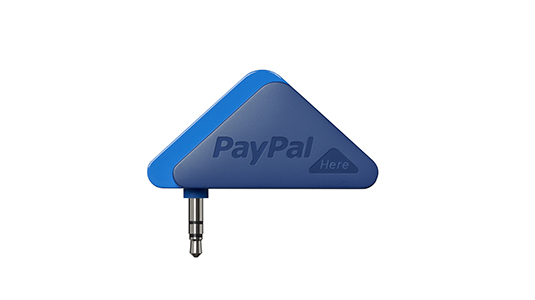
I was blown away by their generosity. PayPal offered to have their developers install the shopping cart for me, free of charge *and* to provide my store with a physical PayPal Here terminal to handle the in-person transactions. But they ended up doing even more than that!
PayPal teamed up with Wix and Ecwid to help my store completely rebuild and re-launch its web site. What’s more, they proved that even a very casual user with limited or non-existent programming skills can do the same.
Our original web site hasn’t changed in twelve years. Designed by a friend way back when we first opened the store, it was long past its prime, a PHP dinosaur held together with duct tape and stubbornness.
 Enter Wix.com. These guys created a web design platform that allows their users to build very sophisticated web sites–with things like scrolling image galleries, app plug-ins, and blog tools–while knowing absolutely nothing about HTML.
The site building tool looks and feels more like Microsoft Publisher. You drag and drop different elements (which range from simple text boxes and contact forms to sophisticated blog and database elements. Everything is highly customizable, down to colors and shapes of the boxes.
A Wix expert helped us port the look and feel of the site, allowing us to keep our logos and color scheme while making the design way slicker.
When I was first shown the interface, I was very excited to play with it and have made numerous site changes on my own. This is definitely something a casual user can learn in only a few days, and there are lots of templates to help a newbie get started even faster. I’m still tinkering with the elements of it whenever I have a free minute, and learning more about its nifty features. I haven’t even gotten into the SEO features yet, but I fully intend to!
Thanks to Wix, my store’s web site went from this:
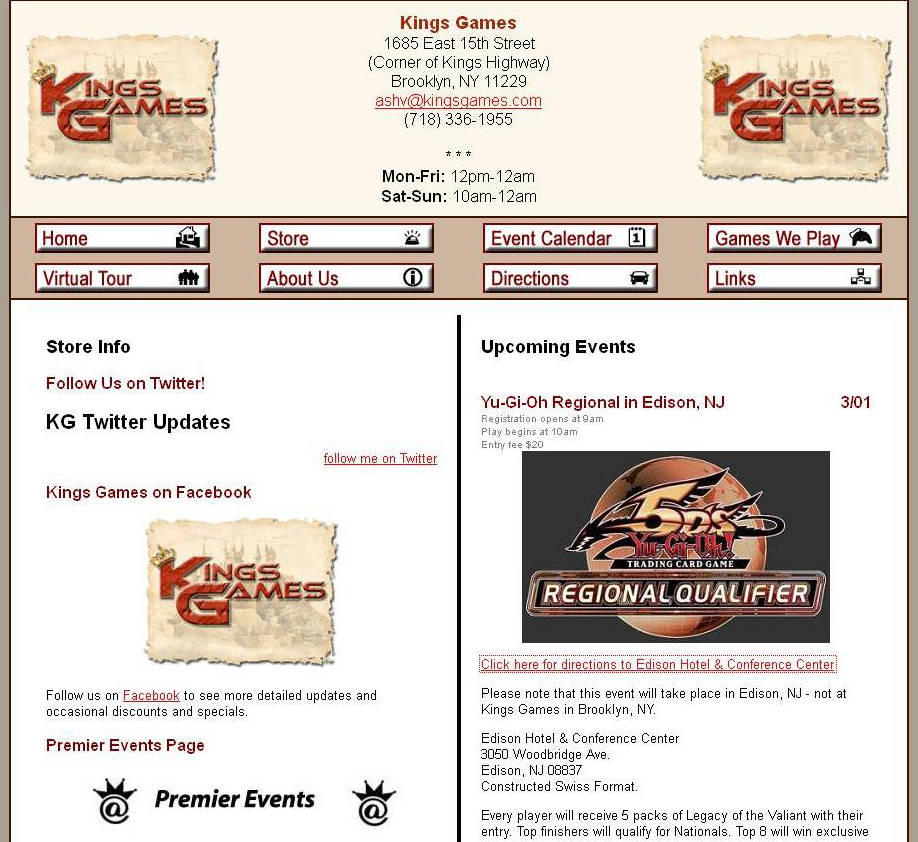
To this:
 You can also visit the live site, to see what I’m rambling about.
Another really important feature of a Wix site is that it’s very easy to integrate an Ecwid shopping cart into it. Which brings us to the second point:

An Ecwid shopping cart is another tool that can be set up by someone with zero programming experience.
There are many similarities between Wix and Ecwid in that both platforms are very customizable and offer an expert user great flexibility, but they are also simple and intuitive enough to allow a casual or new user to muddle through.
It’s very simple to create categories and add in products, and even link the same storefront through your Facebook page. Setting up shipping and tax tables is only slightly more complicated, but very doable. And if you want to adjust the look and feel of the site that’s a little bit more sophisticated, but still very achievable by a layperson.
One of my favorite features of the cart is coupon creation. You can set up very specific coupons and discounts, both by % of sale and a set $ value. You can have coupons be single-use or multiple use, and apply to specific items or categories. For example, right now I’m running a 20% off sale for all the UFO Publishing books listed on the site. The sale will last for only 48 hours, until end of day Tuesday, March 11. All you have to do is enter the coupon code UFO20 at checkout. (See how I snuck in an ad for my books there?)
And, of course, hooking in your PayPal account and setting up PayPal Express Checkout (which lets customers avoid the annoying process of creating Yet Another Account) is super easy!

Which brings us back to PayPal. After doing my research, I found them to be the only company to offer sufficient protection against chargebacks. As long as I follow a few simple instructions (ship the item to the address they provide via trackable means and with signature confirmation for orders over $250) they essentially insure the transaction, greatly reducing the risk for small businesses like mine.
Not to mention the fact that they masterminded this entire alliance to help me. You better believe I’ll be waving the PayPal card reader around at the upcoming conventions!
I’m enormously grateful to everyone at PayPal, Wix, and Ecwid who helped me. These very busy people took the time out of their schedules and worked together on this project. Representatives from three international corporations came together to help the little guy.
This update probably won’t get the kind of traction my original post did. It’s much easier to spread a story of being wronged by a company than a story of being helped by one (or three.) But I hope it does, because an act of kindness deserves at least as much recognition and praise as the attention given to an instance of poor customer service.
Comments Off on Moving Forward | Uncategorized | Tagged: e-commerce, Ecwid, PayPal, Square, Wix | Permalink
Posted by Alex Shvartsman

On the Internet, nobody knows you’re an underdog.
It has been a crazy 36 hours for me. I wrote a blog post about my poor experience with Square yesterday morning, and shared it on my Twitter and Facebook accounts. It got shared and retweeted a handful of times by my friends, and even a few strangers, which was pretty much the life cycle I expected of it. But then, it kept getting shared by more and more people, until my Twitter Interactions feed was updating literally every few seconds. The story got picked up by Hacker News, then reposted by Valleywag/Gawker. Since then it has also appeared in Business Insider and other media outlets. My inbox is inundated with requests for comment or permission-to-repost from various online media sites.
Tons of people wrote to me or posted in the comments. Their responses ranged from sharing their own bad experiences with the credit card processing industry at large, to suggesting services and credit card processors they are happy with, to great advice about steps my store can take to prevent fraudulent transactions in the future. In all, over 28,000 people read the original post so far, and that’s not counting the versions up on Valleywag and elsewhere.
As I tried to work while watching this thing explode on the Internet yesterday, I couldn’t help but wonder if it would prompt a direct response from Square. And it did.
Just before 5pm, a gentleman from Square Customer Support team called me at the store. We spoke for about ten minutes. The conversation did not go well.
First of all, he informed me that Square did, indeed, attempt to fight the chargebacks on my behalf, but that they lost those cases. I was told that they were going to inform me of this via e-mail “soon,” but since I expressed a strong desire to learn the fate of these transactions on Twitter, I was being given a more immediate update by phone.
Losing the chargebacks does suck, but I could accept that, if all the other parts of this scenario had played out differently. My real issue was with the lack of communication, which I expressed to him, and he acknowledged that they could have done better in that regard, and are working on improving that aspect of their business.
Then the conversation got around to the cancellation of the store’s account. He started off by explaining that collectibles are a high-risk sort of item with lots of fraud potential, and that they planned on disallowing the sale of this type of item via Square e-commerce portal in the future. Which is interesting, because how exactly do you define a collectible, and who is going to evaluate listings and enforce this policy? According to Wikipedia, the only type of items Square currently disallows to be sold using their service are firearms.
Then he offered to provide me with some “helpful information on how to detect/avoid fraudulent online transactions in the future”. Umm, OK.
Look, Square, if you possess such valuable and useful information then perhaps it might be a good idea to just make it available on your web site for all your merchants to peruse. You know, for the sake of humanity?
But it was the next thing he said that floored me. He told me that, while my store wouldn’t be able to continue to accept Square payments online, they would allow us to use the Square reader device in-store and for other in-person transactions.
Really, Square? Really? Isn’t it a little like breaking up with someone over text message, and then magnanimously suggesting that you’d be willing to still be friends with them?
I could have had a field day with this suggestion, but I didn’t. After all, it wasn’t this poor guy’s fault. He drew the short straw of delivering bad news to an already irate customer. He had no actual good news to offer me, and he knew it. So, instead of taking out my frustration on him, I explained as calmly as I could manage the ways in which their decision to cancel my account without notice screwed over my business, and how all of this could have been avoided with a simple “Hey, we’re sorry, but we aren’t comfortable processing your transactions. Why don’t you go ahead and take a week or two to set up a replacement, so you don’t lose a metric ton of business while the e-commerce site you’ve been advertising to all your customers for a year is suddenly taken down.”
Once again, he acknowledged that they could have handled all of this better. Then I thanked him for the call, and got off the phone.
Shortly after I got home form work, one of my employees called to let me know that someone else from Square had tried to reach me. This gentleman left a toll-free number and a twelve-digit pin code, and asked that I call him back. He said that he would also leave a note with an operator to forward my call, in case the pin didn’t work (I guess this happens often enough to warrant the backup plan.) I immediately tried to call him back, and, sure enough, the pin didn’t work.
Their toll-free number gives you three chances to input the pin. If you enter an invalid pin three times, it hangs up on you. I’ve tried pressing zero, and pound, and thinking positive thoughts at it, but there was no way to reach an operator.
Now that I had a name of the person who actually wanted to talk to me at Square, I wasn’t about to give up easily. I tweeted at their account, in case whoever was manning it would get the message across. I e-mailed them through the web form. I also Googled their company and, after a few minutes of searching, found their corporate phone number. When I called it, it asked me to enter the extension of the person I was trying to reach. Once again, I found no way to get to a live operator.
I was beginning to suspect that I was either trapped in an absurdist science fiction story, or these guys really didn’t like telemarketers. Or both.
My frustration was greatly tempered by an amazing outpouring of support from the online community. People kept spreading the story. They offered emotional support as well as information and advice on how to proceed. I spoke to several competent web designers about setting up a more traditional shopping cart. Several companies offered their services for processing online transactions. Shopify generously offered to waive six months worth of fees at their Unlimited account level (that’s almost $1000), if I wanted to try their service. I spoke to a very nice Market Development manager at PayPal in New York, who asked what they can do to help my business, and then set up an appointment to come to see my store in person the next day. And, being an eternal optimist, I still hoped that this second phone call from Square would eventually bring better news.
It felt like the entire Internet briefly forgot how to argue and troll, and just decided to be nice to me. I went to bed exhausted by the events of this day, but in a much better mood.
In the morning I woke up and checked my email. The subject of one of them read:
Square has sent you $2,280.78
Square has initiated a wire transfer to our bank account of, what I assume, is a full amount of disputed transactions less their standard 2.75% fee.
At this point, I don’t know if they managed to convince the credit card companies to cover these chargebacks after all, or if they decided to pay it out of their own pocket. I still haven’t managed to speak to that second person from Square (although I did finally get an e-mail from him late this evening, asking for a number where I can be reached tomorrow, so this conversation is likely going to take place.) The fact of the matter is that they did act to address this situation and help my store out of this jam.
There are lots of fascinating ethics problems here. As a self-interested individual, I’m obviously thrilled to have my money back. But is this resolution fair? Should I have expected far less, given how often merchants lose chargeback cases, out there in the real world? Should I have expected more, given the additional loss of business and the fact that our account is still cancelled, not because we did something wrong but due to the cold equations of risk management? And if Square covered the loss, is this fair to them? Or have I leveraged the power of social media to extort a favorable resolution?
My good fortune for the day didn’t end there. I met with a pair of very enthusiastic and kind folks from PayPal, who took the cab from the city all the way to South Brooklyn to visit my store and listen to my story, then set out to see what they could do to help on their end.
They offered to set up a PayPal-based shopping cart on our site at their cost (a service that would have set me back $500 had I hired a freelance programmer to do it, based on a quote I obtained yesterday), and to also set up a PayPal Here-enabled POS terminal for our in-store transactions. They were genuinely excited to be able to help us grow our business in partnership with them, even if our store is tiny compared to their volume of business. One of them will return next week, to help us set up this terminal and train our staff to use it.
The goal of this follow-up post isn’t to bash Square for their lack of transparency, nor it is to praise them for their quick and decisive action regarding the disputed funds. It isn’t even to shill for Shopify and PayPal, although their willingness to step in and help deserves to be recognized.
It’s to thank the online community.
If this conundrum happened before the age of social media; if dozens or even hundreds of people didn’t feel this story deserved being shared with their friends and co-workers, if blogs and aggregator sites and online reporters didn’t find my plight compelling enough to cover, I would have never achieved this outcome.
Internet isn’t just a vast repository of baby photos and cat memes. It’s an enormously powerful social engine that can, and often does, empower the little guy. On the Internet, nobody knows you’re an underdog, because with a few clicks of a mouse the netizens can make your voice heard as loudly as that of a major corporation.
So, from the bottom of my heart, thank you. I now return you to the regularly scheduled cat meme.
11 Comments | Uncategorized | Tagged: chargebacks, customer service, PayPal. Internet, Square | Permalink
Posted by Alex Shvartsman
You are currently browsing the archives for the Uncategorized category.




 Alex Shvartsman's Speculative Fiction