
Much like everything else about my life as a writer, attending cons is a fresh experience for me. Starting about two years ago I went to several regional cons as a civilian, and I loved it. As I leveled up within the SF/F fandom, I was afforded the opportunity to attend more cons, and to return to my original haunts as a panelist. I was beginning to have this convention thing figured out; I was beginning to grow comfortable. Then I went to my first WorldCon, in San Antonio, and it blew my mind.
WorldCon is the big time, the most important convention in all of science fiction fandom. It travels around the world – next year it’ll be in London – and attracts thousands of attendees. It is where the Hugo Awards, the most prestigious honors in speculative fiction, are handed out in an elaborate ceremony that is both very similar and very different to the Oscars, but more about that later.
LoneStarCon, the convention hosting this year’s WorldCon, was sprawled across two enormous downtown hotels, a huge convention center hall, and many conference rooms. It offered panels, meeting spaces, gaming, parties, a masquerade ball, and a con suite stocked with free snacks and drinks around the clock.
Amazingly, the entire affair was – and always is – ran by unpaid volunteers. And although I heard tales told of absolute behind-the-scenes chaos (at this con and most others), to this outsider’s view, everything was handled with near-military efficiency and precision. Senior con runners, called Secret Masters of Fandom (or SMOFs) dedicate enormous amounts of time and effort to put on conventions large and small, and although they do not receive or seek the sort of recognition the writers get (hence the “Secret” in SMOF), both writers and fans owe them a tremendous debt of gratitude.
The main hall hosted the vendors displaying rows upon rows of irresistible books, as well as some games, costuming supplies, and other fandom-related items. There was also a large area dedicated to displaying fantasy art. These two spaces are common features at writing cons. But, this being WorldCon, there was so much more.
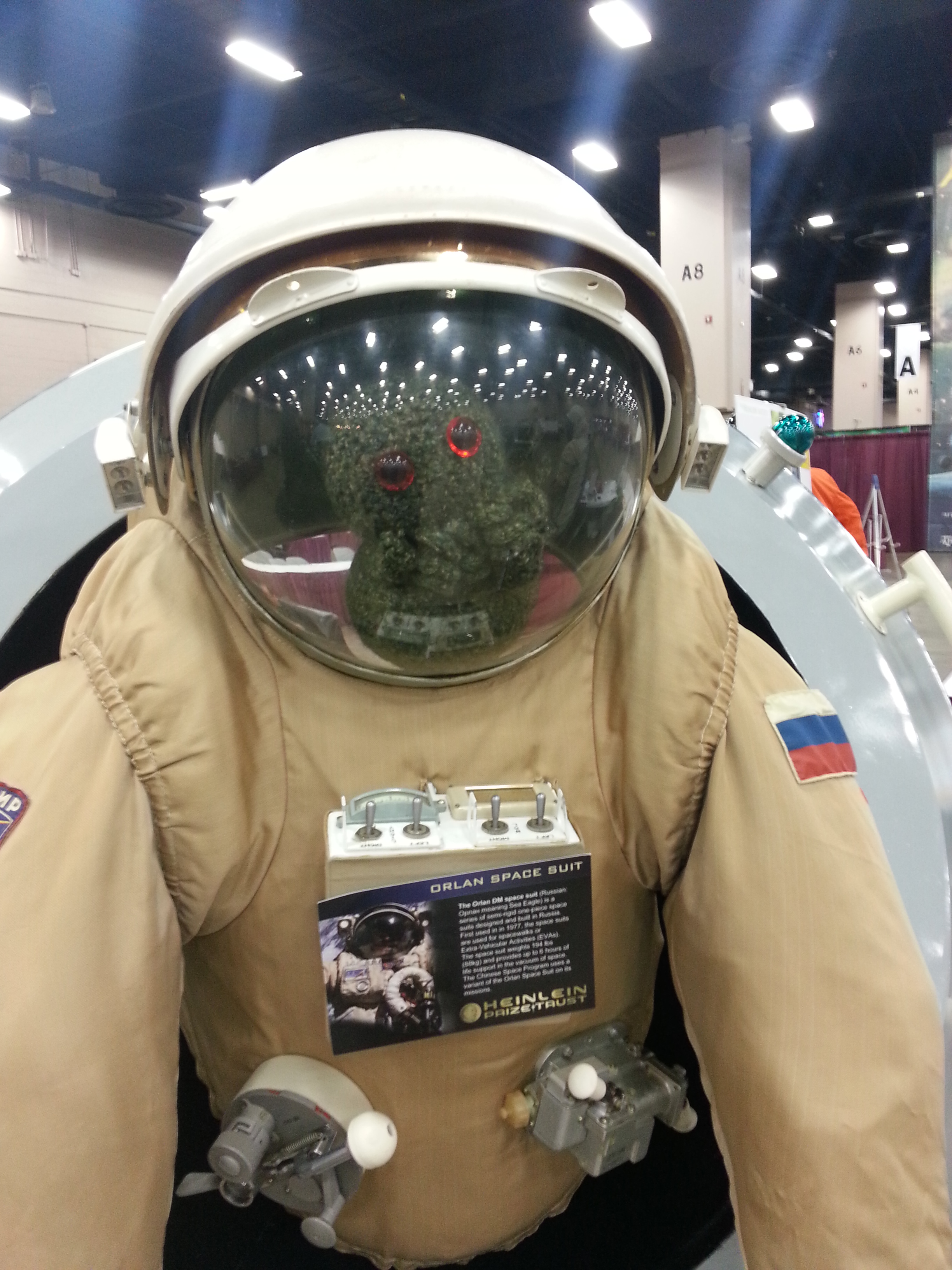
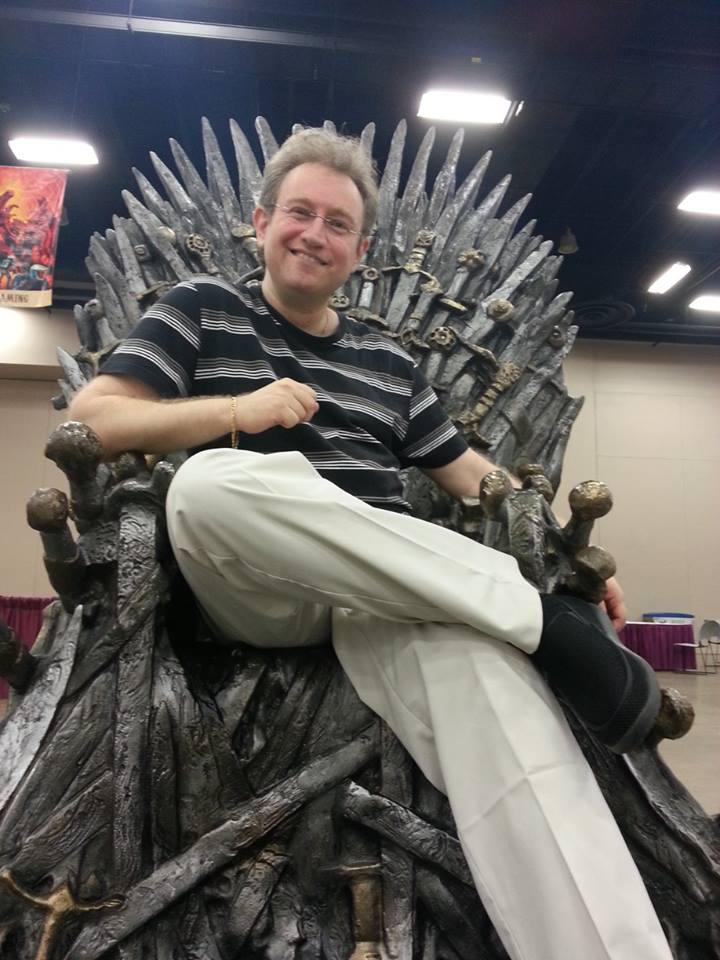
Replica of the Star Trek (original series) bridge stood side by side with an exhibit featuring Dr. Who’s TARDIS (also life-size, but possibly bigger on the inside), guarded by an array of Daleks and a moving, remote-controlled K-9. A real life Russian cosmonaut spacesuit was on display next to a partial suit, cut off so one could get their head into the helmet and hands into the gloved sleeves of the suit, and have their photo taken. And, towering above it all, was the Iron Throne from the HBO’s “Game of Thrones.”

The first rule of Game of Thrones is… Wait, wrong logline.
This may sound like WorldCon is some sort of Disneyland for geeks, but the props and the toys are a sideshow, mere distractions from the main focus the convention, which is the people. One attends in order to take in panels and listen to the wise and the experienced dispense genre wisdom, to meet their favorite authors and artists, but mainly to encounter fascinating, larger-than-life characters, and to talk, talk, talk.
To explain the sort of person one might run into at WorldCon I need go no further than to describe my three roommates, two of whom I never met prior to this convention:
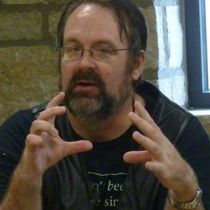
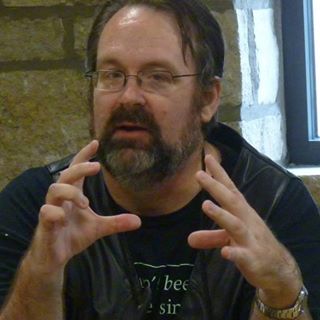
Bryan Thomas Schmidt
There was Bryan Thomas Schmidt – an anthology editor, novelist, and interviewer from Kansas City. Congenial and extroverted, he seemed to know literally everyone and was not shy about making introductions. Despite multiple setbacks, including losing his smartphone on the trip to San Antonio, Bryan remained positive and upbeat, and was every inch a tireless networker. He was the glue of the group: friends with each of the rest of us, he engineered our rooming arrangements. I bet Bryan was the only person to wear a sleeveless leather vest to the Hugo Awards.

Lou Antonelli
Lou Antonelli, who is a bit older than the rest of us, hails from Southern Texas. Although not a native Texan, he adopted the state many years ago, and his many, many published short stories are infused with the Texas sensibility. When dressed in his suit, Lou looked a picture of an old newspaper journalist that he Is (he runs his town’s paper), but then he’d add a medium-sized wind-up alarm clock on the chain around his neck and suddenly looked like a character out of some steampunk story or fairy tale. “An old journalist contributes nothing more than bad jokes and flatulence,” Lou said at one point. Delivering off-the-cuff lines like that to punch up an inexhaustible stream of anecdotes kept him constantly interesting.
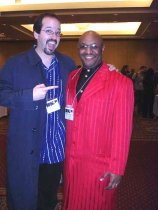
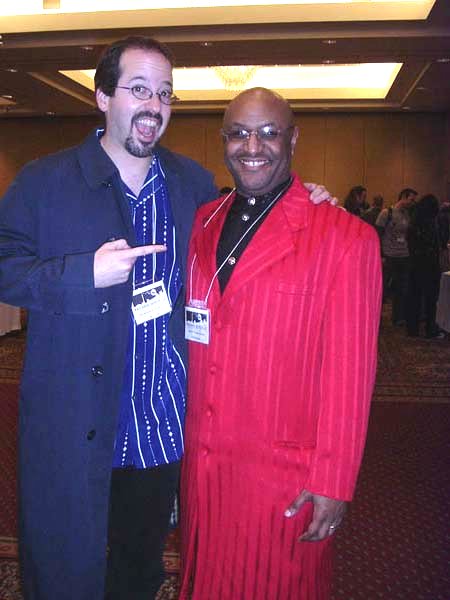
Maurice Broaddus (right)
Maurice Broaddus, an urban fantasy writer and anthology editor from Indianapolis, could easily give Bryan a run for his money when it comes to schmoozing. “I am going to keep vampire hours,” he warned us on the first day. True to his word, Maurice came and went (mostly went) at random intervals, and seemingly slept no more than three or four hours over the course of the entire weekend. You could almost always find him at the bar, talking with a different group of people each time. There is no private party Maurice couldn’t (or wouldn’t) crash. And it’s not like he was trying to be inconspicuous about it – much of the time he wore a bright red velvet suit.
The four of us arrived from different parts of the country, representing a range of different backgrounds, politics, philosophies, and personalities – but within minutes we were bantering and enjoying each other’s company like old friends. This Is the con experience: the love of speculative fiction brings people together in a way which trumps most differences.
In the age dominated by social media, you don’t merely go to a big convention like this to make new friends. More often you encounter acquaintances from Twitter or Facebook. Once again, the connection is instantaneous and deep. You are at ease with people you’ve never seen before in real life; it feels more like reconnecting with old friends.
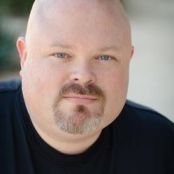
Seamus Bayne
Having registered for the convention and scoped out the main hall, I almost immediately ran into one such friend. Sean, who writes under the nom de guerre Seamus Bayne, is another Texas author. We chat on Facebook and were thrilled to meet in person. We hung out, on and off, throughout the con, but that Thursday we quickly found several Codexians – members of the online writing group I belong to – and held court in a set of armchairs strategically positioned on the crossroads of the con. We became somewhat of an impromptu cross between an information desk, lost and found, and a writers lounge.
Lesson learned: instead of running around and trying to meet people, it is often more efficient to sit down in the right place, and have them come to you.
Thursday culminated in a dinner with Sean and Trina Marie Phillips at Fogo de Chao, a fancy Brazilian all-you-can-eat steak house.
* * *
As Thursday closed with a memorable meal, Friday opened with one as well.

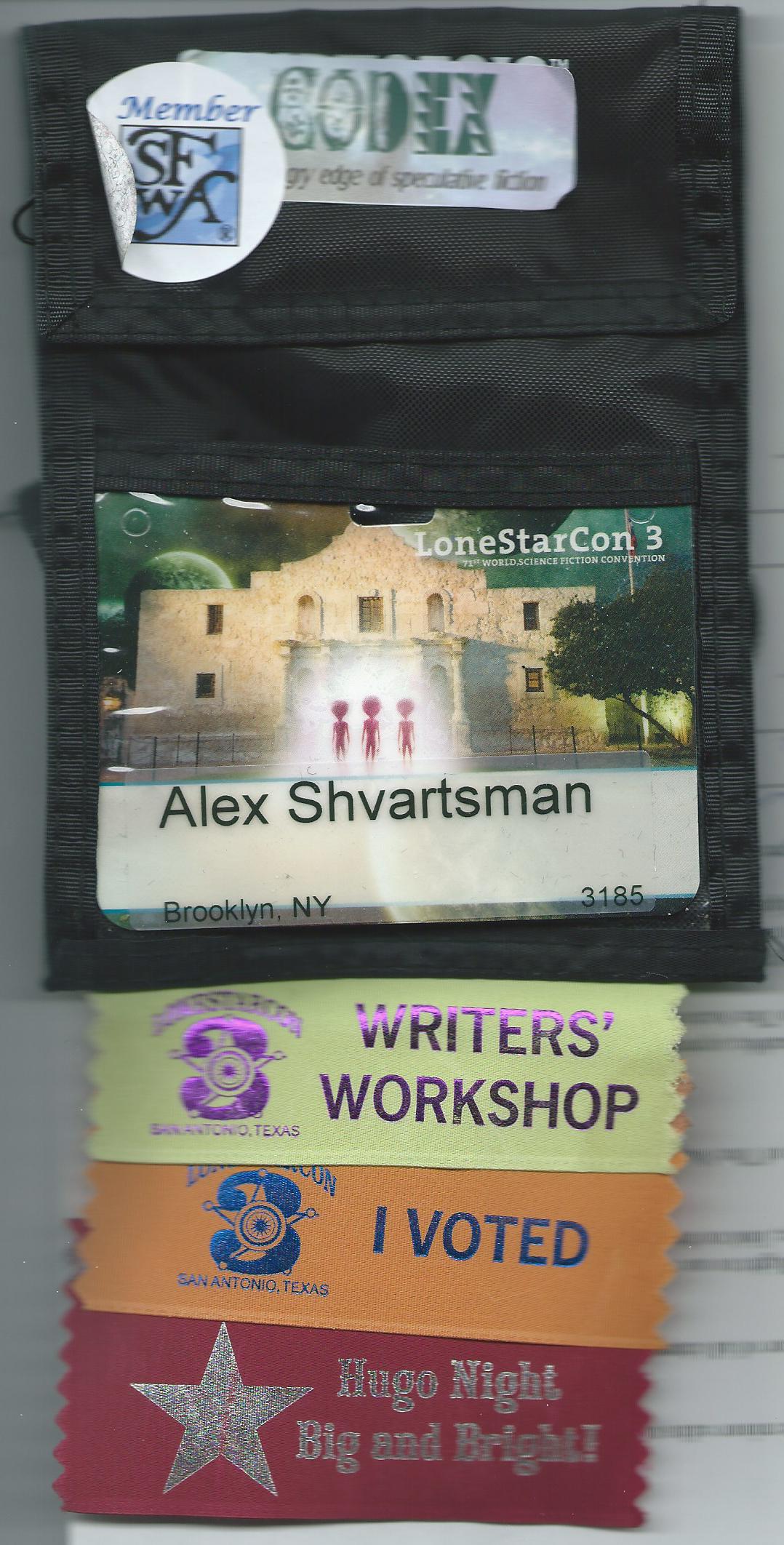
Lawrence M, Schoen, a Nebula nominee and one of the founding members of Codex, organized a special Codex breakfast, as he often does at large conventions. Between Codexians and their guests, there must’ve been nearly fifty people there, and while hotel restaurant food is both mediocre and ludicrously overpriced, the company more than made up for it. I got to meet so many people at once that it was difficult and overwhelming keeping track of them all. Thank God for convention badges!
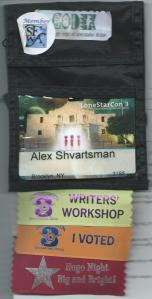
Everyone at the con wears a badge with their name listed in large, easy to read letters. “I used to be very self-conscious about staring at people’s badges,” confessed one convention veteran later that weekend, “but it’s almost impossible to keep track of people otherwise. Everyone glances at badges. It’s not a faux pas.” He’s right. I recall reading somewhere that an average person can’t maintain a social circle of more than 300 people. These numbers must be climbing significantly thanks to social media, but I must’ve met and interacted with 300+ people at this convention alone. And I stole glances at badges constantly.
Another lesson learned: Make sure to always wear the badge in a way that makes your name visible. Don’t make it difficult – or even somewhat embarrassing – for people you might encounter.
* * *
I didn’t get asked to participate on any panels at WorldCon – and given the sheer number of brilliant people in attendance, who can blame them? – but I did get to co-host a writer’s workshop.
An experienced writer (in this case, TOR novelist John A. Pitts) gets paired up with a neo-pro (in this case, me) and three “students.” Everyone gets the three manuscripts ahead of time and the instructors listen to the students critique each other, then add their own insights. The two-hour workshop was a lot of fun, the writers were highly intelligent and very open to feedback, and John was masterful in his comments, so much so that I would readily sign up for whatever workshop he might host in the future. After it was over, I hung out with two of the students for another hour or so as we grabbed lunch together. More friends made!
Lesson learned: Pay it forward. I was fortunate enough to attend the spectacular Viable Paradise workshop last year, and was able to apply the tools and techniques I learned there to help someone else. As is the case with con runners, there is never a shortage of volunteers willing to help and nurture newer writers.
Although I was fascinated and engaged by everything so far, I was feeling increasingly overwhelmed and also sleep-deprived. After lunch, I crashed and slept for several hours, missing out on whatever interesting things were going on out of sheer necessity. I woke up around nine p.m., just in time to attend the parties.

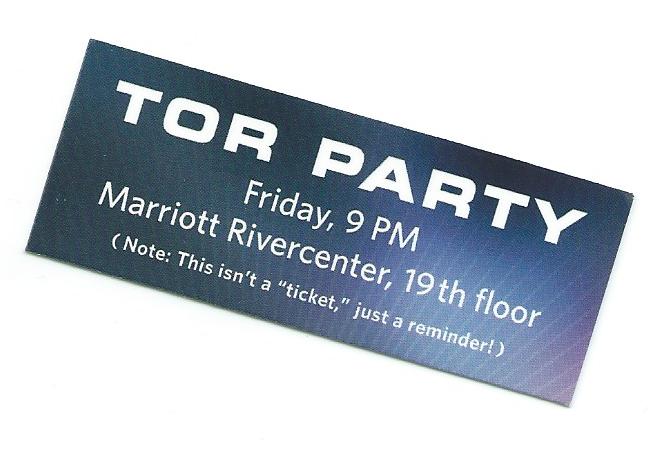
Parties are a very important part of every con. Naturally, WorldCon has the best parties. I wandered from the TOR.com party to the Dell Magazines party for Asimov’s and Analog.
I am not a party person. I don’t drink alcohol and I much prefer the quiet dinner conversation to trying to outshout the ambient noise of the crowd in a hot, crowded room. Even so, I found the WorldCon parties fascinating. People meet, mingle, and – of course – talk.
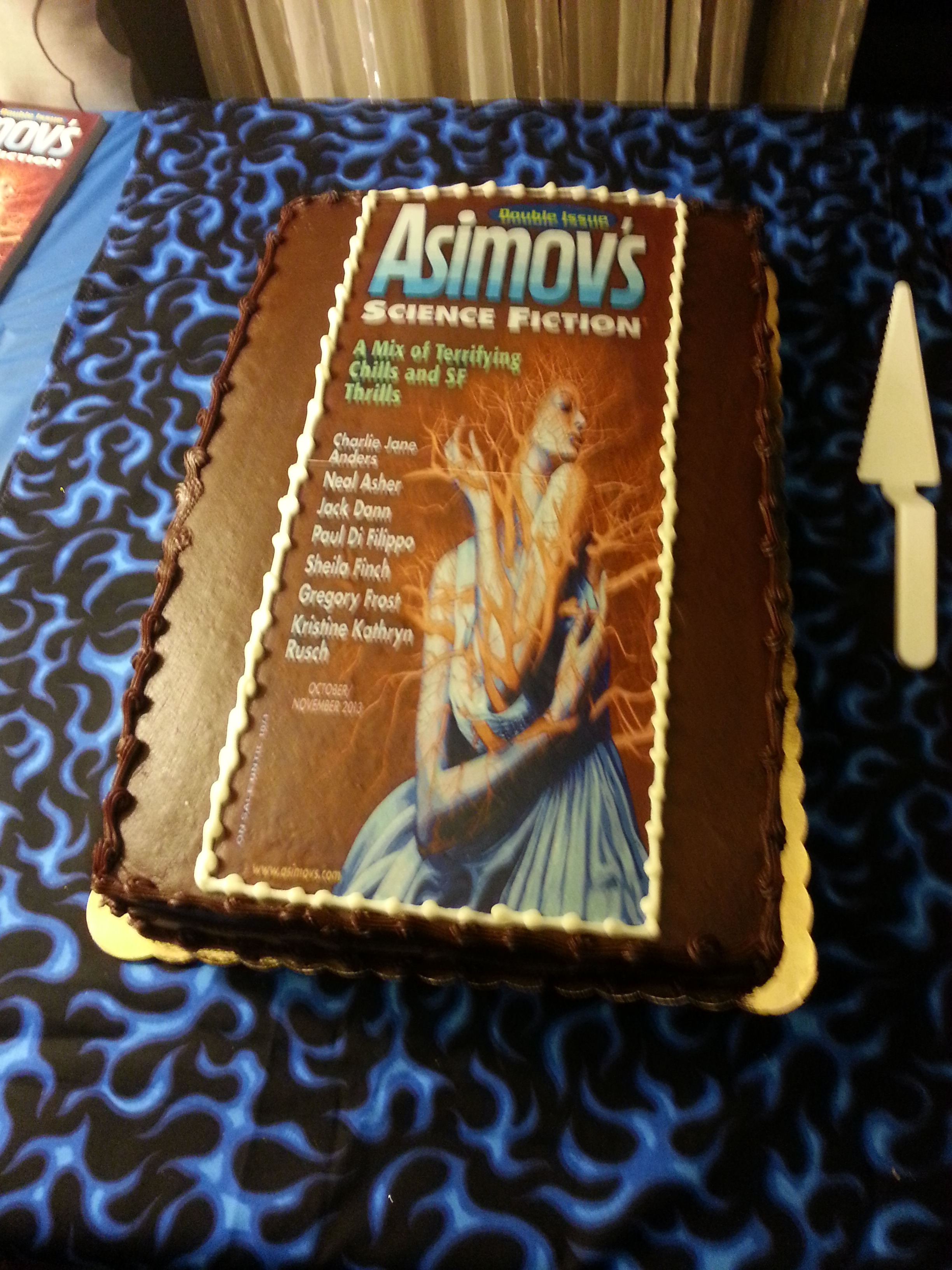
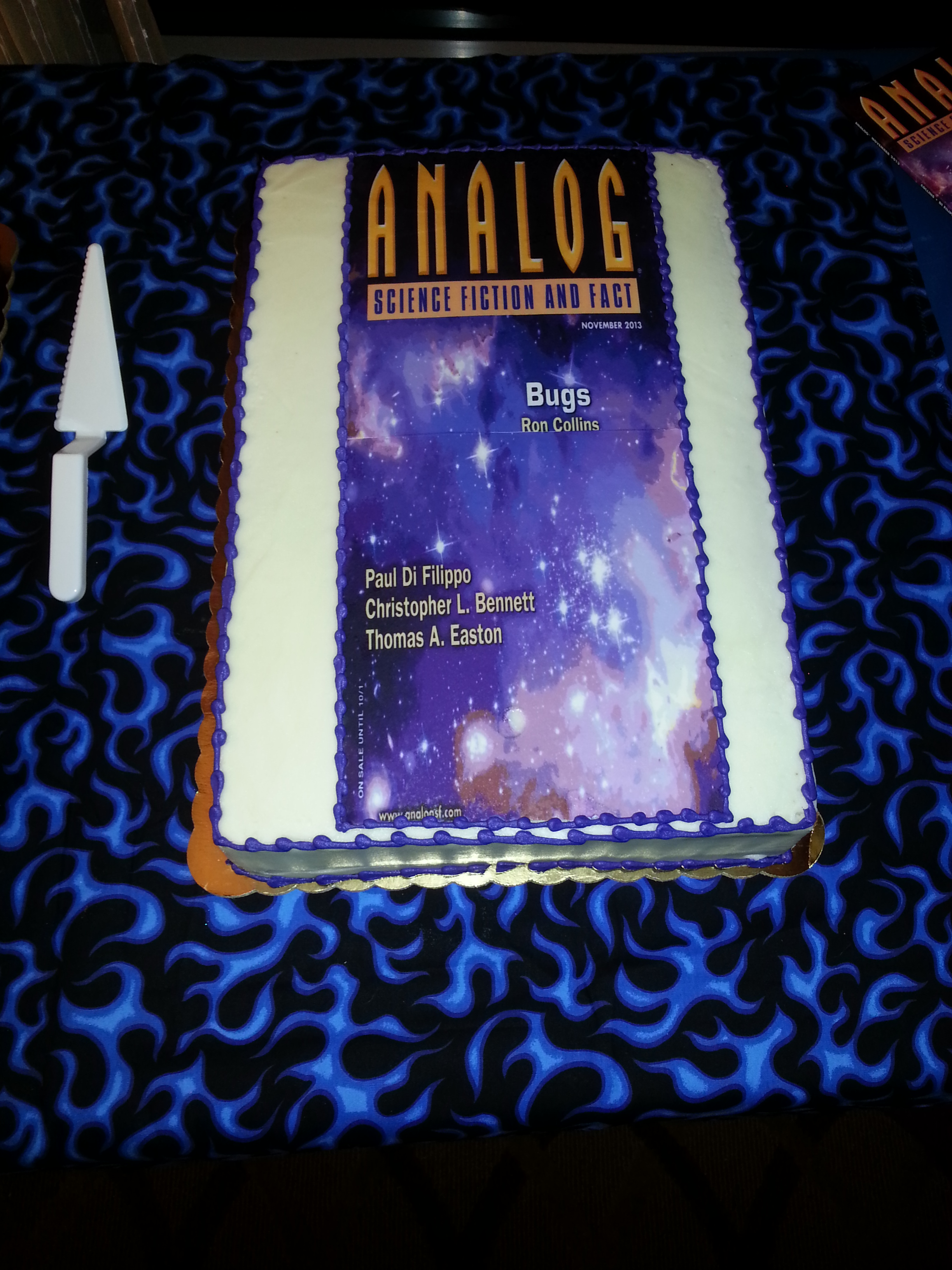
Publishers and con runners love to throw a great party. Mostly there are your typical chips and cookies and beer, but It’s not uncommon to find good scotch, expensive champagne, and decadent chocolate. Baen party (which I attended Saturday night) featured amazing velvet cake and gourmet chocolates. Dell Magazines party plied guests with free copies of Analog and Asimov’s, and in addition to all sorts of other food, two huge cakes depicting the covers of the current issues they were handing out.
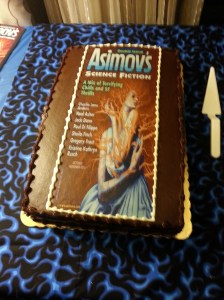
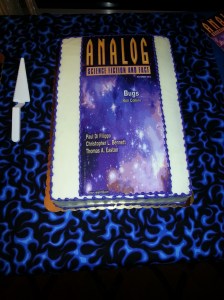
Analog vs. Asimov’s: The Cake-Off
The cakes looked so great, no one was willing to cut into them, until Sheila Williams (editor of Asimov’s) made the first cut. “I always make sure that Asimov’s gets the chocolate cake” she said in a bit of friendly rivalry. “Analog has to settle for whatever other kind of cake we get.” Of course, I had to sample both cakes. And although I somewhat prefer Asimov’s stories, I must admit to liking the Analog cake better this time. Sorry, Sheila.
* * *
Saturday was a free day for me, with nothing specific scheduled and little to do. I bummed around the con and – can you guess it yet? – talked to people. I also spent a fair amount of time in the SFWA suite.
Science Fiction Writers of America provides a private suite for its members where they can relax, get some food or drink, and mingle with other SFWA members. There’s a bouncer, referred to as the Door Dragon, who checks to make sure you’re a member before you can go in. You are allowed to bring a guest, too. Like everything else at the con, being a Door Dragon is a volunteer position. I took over for a friend, acting as a temporary Dragon for half an hour. I also put in a little time at the SFWA table at the dealers room. I had a great time hanging out with the other volunteers, and talking to legends like Robert Silverberg and Connie Willis, who walked the dealer room floor and were surprisingly approachable and willing to interact with mere mortals. #SFWAPro
Lesson learned: It’s OK to strike up a conversation with almost anybody at the con, no matter how famous they might be, as long as you aren’t interrupting the conversation they’re already in, and unless they look like they’re in a hurry to get somewhere. In most cases, pros are more than happy to talk to you as long as you are polite and don’t attempt to monopolize too much of their time; there are other fans who want to meet them as much as you do.
By the middle of the day on Saturday, I’d had too much. I am an introvert who can occasionally act extroverted, but generally around people I already know and am comfortable with. As awesome as this con experience was, its sheer size, the rapid succession of names and faces, and the mostly-self-imposed pressure to be social really got to me. A couple of times over the course of the con I had to go to the hotel room, shut the door, and be alone for a while. I don’t know what sort of interesting things I missed out on because of this, but those brief respites were necessary.
Lesson learned: Pace yourself. At the end of the day, being at the con isn’t a job. It’s important to enjoy the experience at whatever pace one finds comfortable.
I recharged well enough to attend a Baen party and called it an early night. I had a very full schedule for Sunday, my last day at the con. And it’s a good thing I rested up, because Sunday turned out to be the most interesting and memorable convention day of my writing/fandom life to date.
* * *

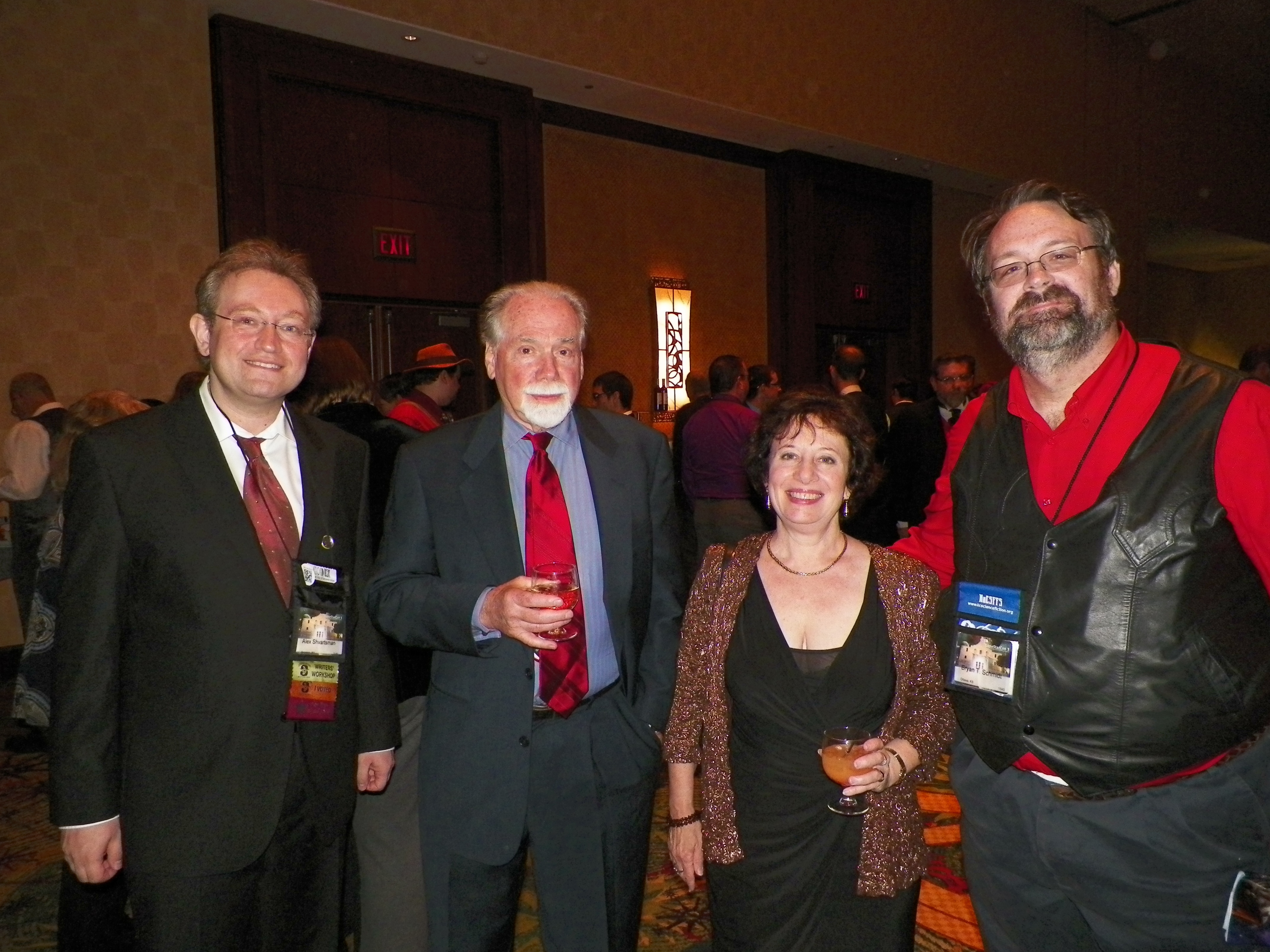
Alex Shvartsman, Robert Silverberg, Karen Haber, Bryan Thomas Schmidt (photo by Neil Clarke)
The day started on a high note, as I got to have breakfast with Robert Silverberg. His short stories were among the first science fiction yarns I read, in translation, back in the Soviet Union, at a tender age of ten. His writing, along with that of Robert Sheckley, had a tremendous formative influence on mine. It was a bucket-list sort of thing for me to have worked with Bob and to have published a story of his in UFO2, and I was thrilled to meet him in person – in fact, he was one of the first people I ran into on the first day of the con. When I learned, prior to attending, that my WorldCon roommate Bryan had a planned breakfast with him, I obviously had to ask if I could be invited along. And so I got to enjoy a long, interesting conversation with Bob, his lovely wife Karen, and Bryan. We didn’t even talk about writing, almost at all.
Much of the early afternoon was spent doing more of the same – saying hello to old friends and meeting new ones. Then it was time for the Hugo Awards.
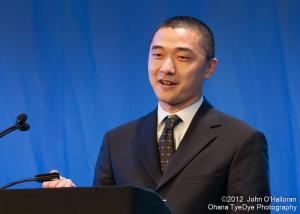
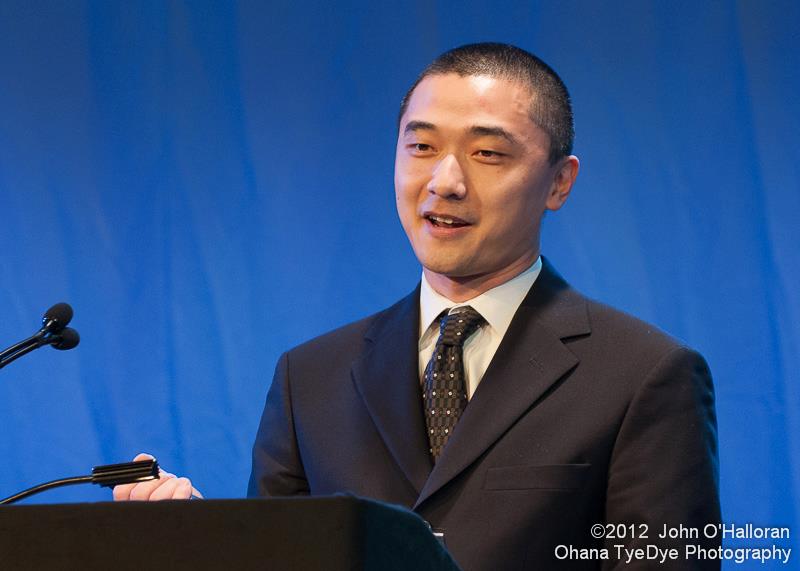
Ken Liu at the 2012 Hugo Awards in Chicago (photo by John O’Halloran)
When I first learned that I would be attending WorldCon after all, I e-mailed my friend Ken Liu to see if he wanted to room together. “I won’t be able to attend this year,” Ken replied. He was scheduled to attend a different event in Singapore on the same weekend. “But I was wondering if you could do me a small favor while you’re there.” And then he asked me to be his designated acceptor at the Hugo awards.
Being a designated acceptor means you get to stand in for the nominee who was unable to attend. You get to attend the pre-ceremony reception and the afterparty. You get to sit in the front rows during the ceremony, and you get to go up on stage, accept the Hugo, and deliver the speech, should the nominee you’re representing win.
So who was doing whom a favor, exactly? I was humbled, thrilled, and honored to stand in for Ken. I even bought a new suit to wear to the ceremony. Obviously, it had to be a Hugo Boss suit.
When the time came, I changed into the suit and dress shoes, put on a tie for, literally, the first time this century, and headed downstairs.
First up was the hour-long pre-ceremony reception for nominees and their guests. Everyone mingled, enjoyed complimentary drinks and cocktail-party food, but it was the guests and the designated acceptors like me who had the most fun. For the nominees, the pressure was on. “It doesn’t get any easier,” confessed one nominee who already has an impressive collection of awards on his mantle. “You’re still just as nervous.”
Free from such pressure – relatively speaking, of course – I had a blast mingling and rubbing shoulders with the best and brightest people in SF. Among the few people who might have had even more fun there than me was Christopher Kastensmidt, who was the designated acceptor for Aliette de Bodard.
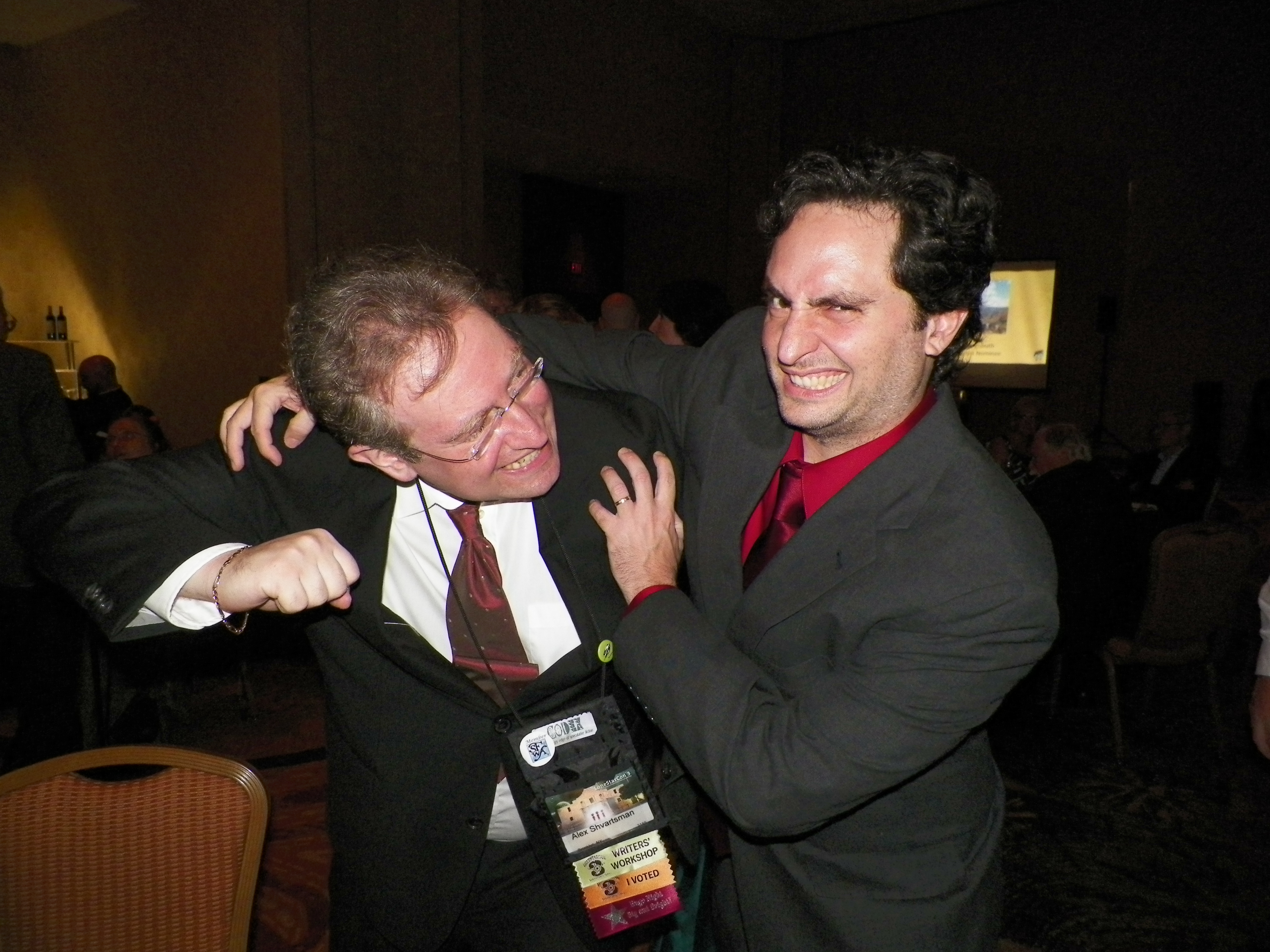
Ken, Aliette, and Kij Johnson were the only three authors nominated in the short story category this year. This meant Chris and I were in direct competition, and he immediately challenged me to a fight, whereas the winner would walk away with the Hugo. I countered with an offer of a Magic: The Gathering duel instead, but Chris had left his deck in Brazil. So we posed for fight pictures, amusing the passerby, and being totally oblivious to the fact that, if the Hugos were to be decided by combat, Kij Johnson would have probably mopped the floor with both of us.

Chris Kastensmidt and I go the extra mile on behalf of our respective nominees.
Finally it was time for the big show. The nominees piled into the hall, sitting down in the designated rows nearest to the stage. We snagged front row seats, dead center. Perhaps the only better spot to watch the ceremony was from the stage itself, where the hilarious British writer Paul Cornell hosted the ceremony.
Earlier, I mentioned that the Hugo Awards were both alike and different from the Oscars. It’s a big, professionally orchestrated gala, with awards and speeches and a significant budget. But it still felt more casual, more comfortable than awards I’ve seen on TV. Some nominees showed up in tuxedos, others in jeans. There was a sense of comfort and general good spirit from everyone involved. People genuinely rooted for, and were happy for each other. It’s hard for me to imagine that level of camaraderie at the Oscars but, of course, I don’t speak from experience. If anyone needs a designated acceptor for that particular event, I’d be happy to volunteer.
Jokes were told. Speeches were read. Awards were accepted. And I was on cloud nine. I clapped so hard, my hands were beginning to hurt. And, all too soon, the Short Fiction category came up, and the announced winner was “Mono no aware.”
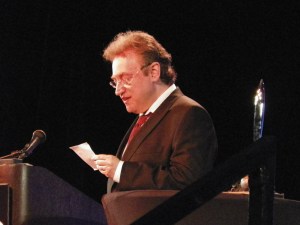
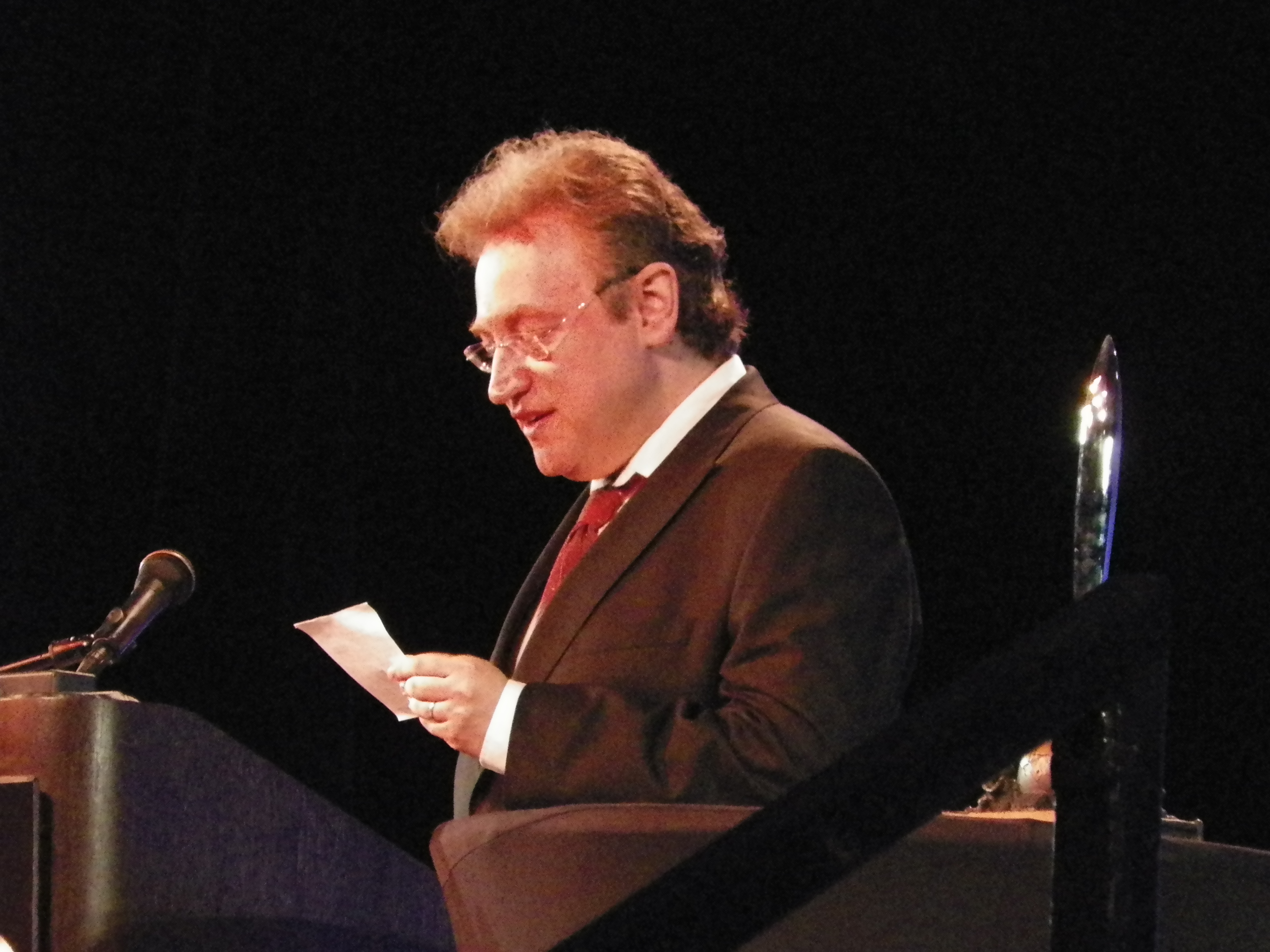
On stage, delivering Ken Liu’s speech.
The next few minutes were a blur. I remember jumping out of my seat and walking up onto the stage. I remember accepting Ken’s Hugo and holding it up for a few seconds as we were taught to do during the walk-through earlier in the day, facing the audience while completely blinded by stage lights, and then making my way to the podium. I delivered Ken’s speech. And although I was totally fine up until that point, for some reason I started getting really nervous mid-speech. I hope it didn’t show too much. Still waiting for the LoneStarCon team to post the video, so I can find out. Then I was ushered off stage and returned to my seat, clutching a Hugo rocket.
The first thing I did when I sat down was to send a tweet to Ken. I later found out that, at that exact moment, Ken was aboard his flight to Singapore. It wasn’t until he landed and turned on his phone that he learned about his win, via thousands of Tweets, text messages and emails pouring in and draining his international data plan. “I definitely recommend this way of finding out. It’s overwhelming and really, really energy-boosting when you’re jet-lagged J” Ken wrote.
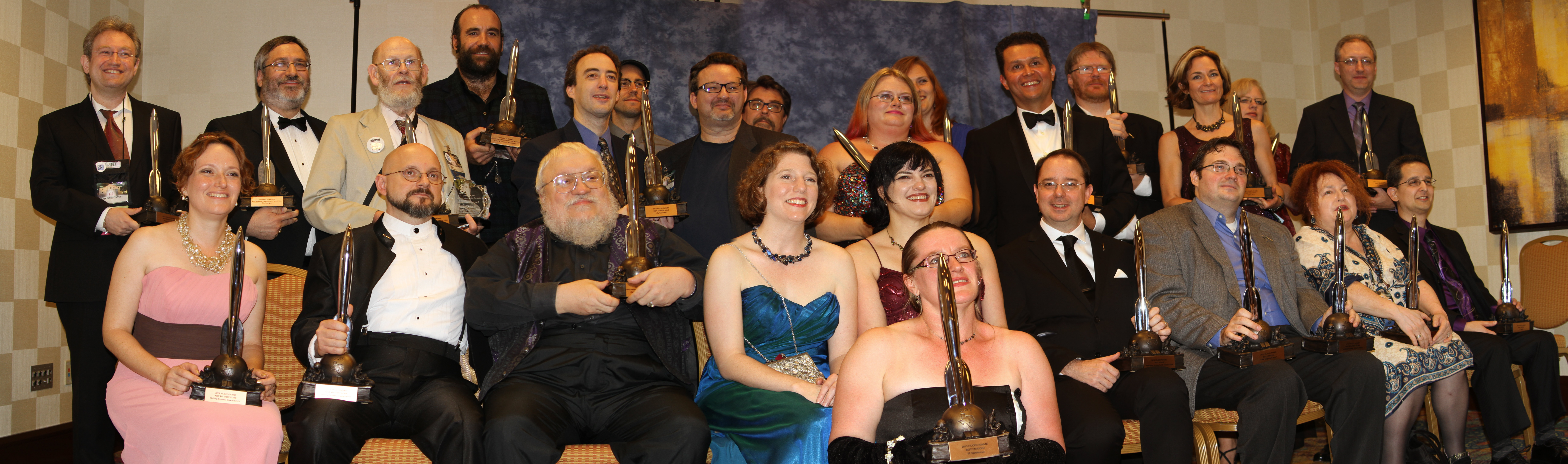
After the final award was announced, the winners (and us lowly acceptors) were whisked away for a round of photo-shoots. I loved every minute of it. When else am I going to get photographed standing next to a gaggle of insanely talented writers, editors, and the actor who plays The Hound on the Game of Thrones TV series?

2013 Hugo Award winners panoramic shot (photo by Andrew S. Williams)
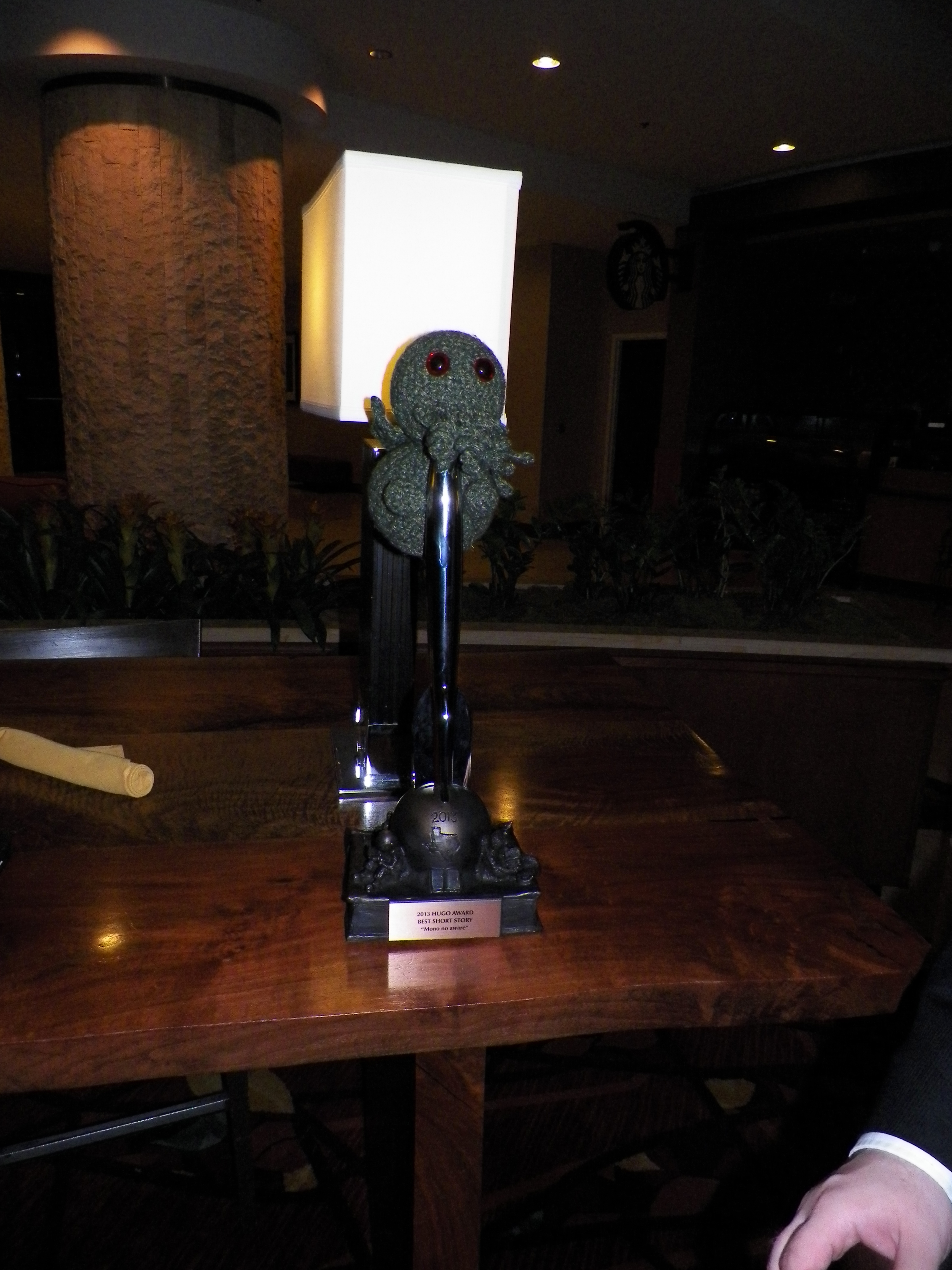
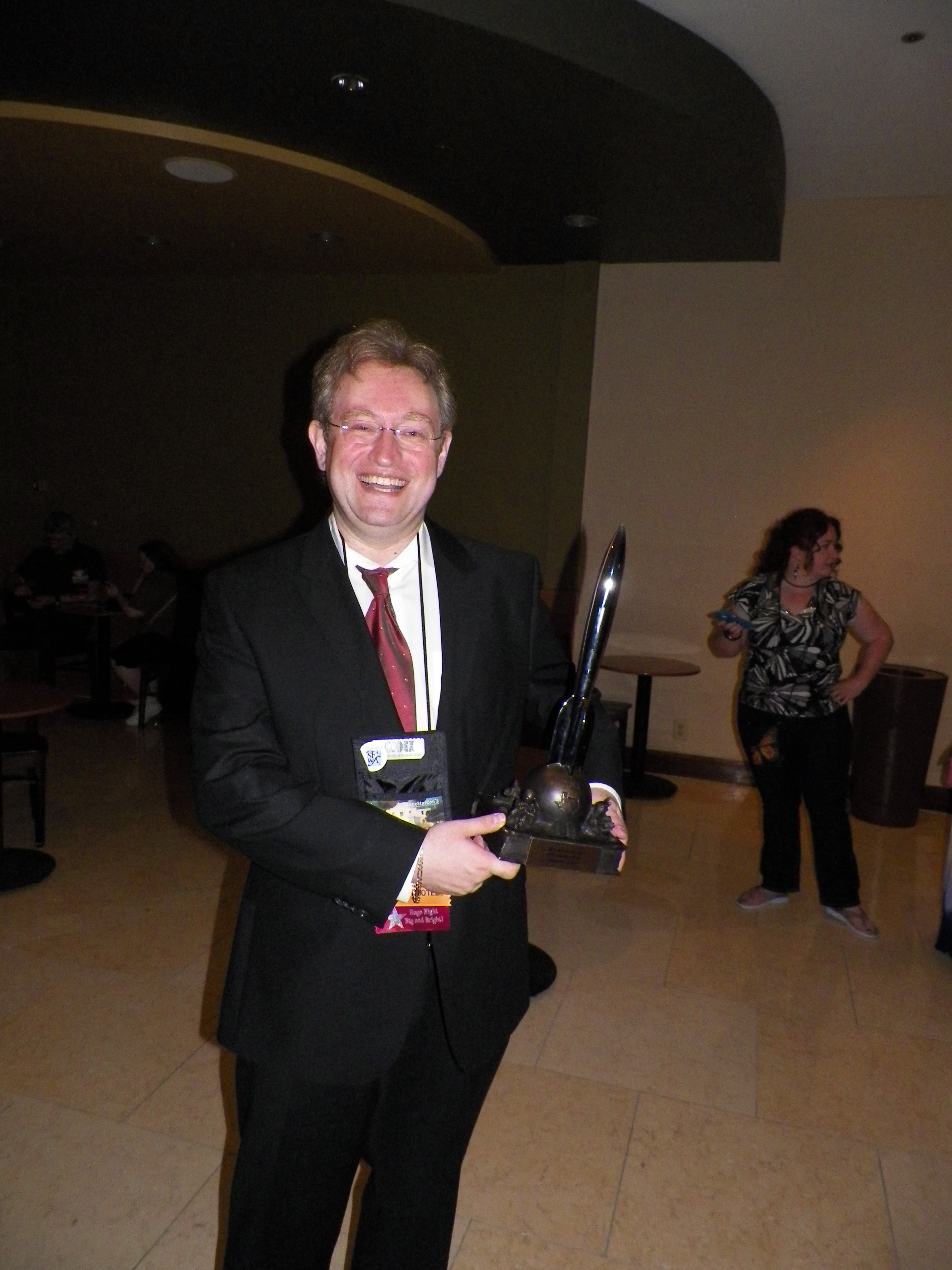
This isn’t so much a lesson learned as a bit of trivia: the Hugo trophy is heavy. It has a cast-Bronze base and a stainless steel rocket, adding up to a good few pounds. If you are ever interested in holding a Hugo, just follow someone who has one around. Invariably they will get tired and need somebody to carry it for them, for a spell.
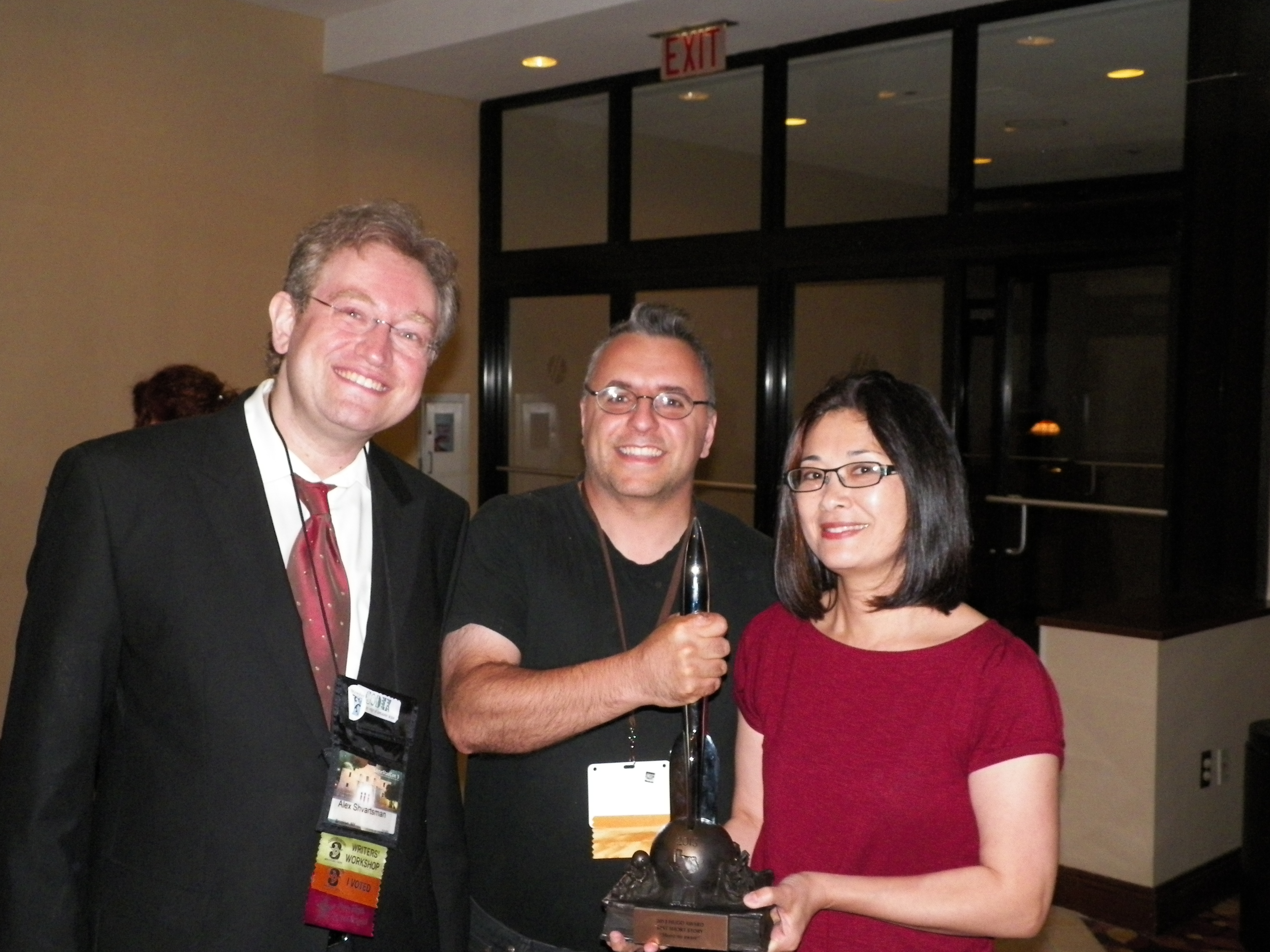
After the ceremony, Bryan and I whisked the trophy downstairs to the bar, so anthologists Nick Mamatas and Masumi Washington, who published Ken’s winning story in “The Future is Japanese,” could take some photos with it.

“The Future is Japanese” editors Nick Mamatas and Masumi Washington
If you ever really want to be the center of attention, walk through a WorldCon hotel lobby while carrying a Hugo. Everyone wanted to check out the trophy, touch it, and take a picture of it. And since I knew exactly how all of them felt, I let my friends and even complete strangers pose with the rocket ship.

It may not be my Hugo, but I still enjoyed carrying it around for the evening.

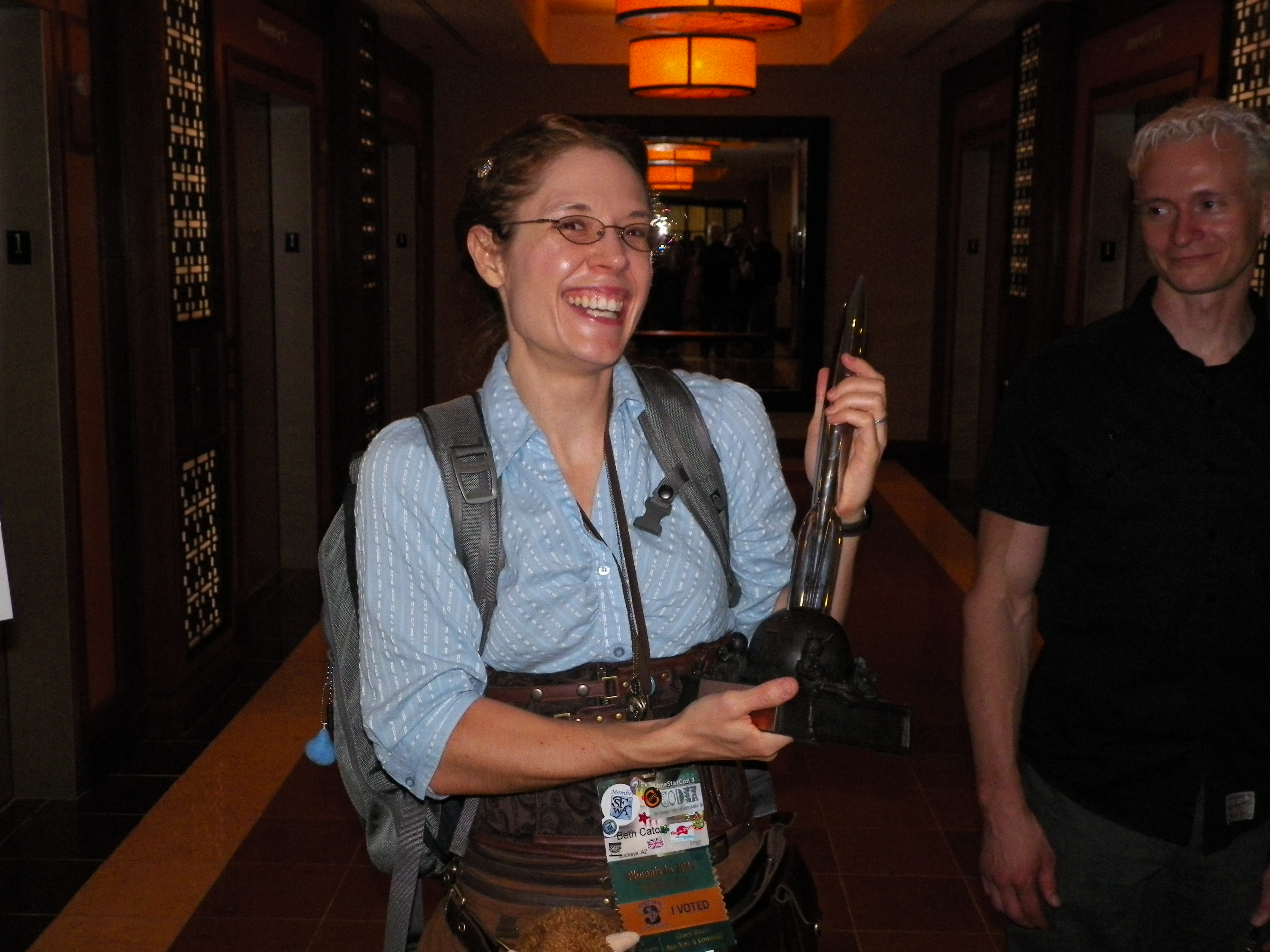
Beth Cato was one of many writers to practice their posing-wth-an-award skills that evening.
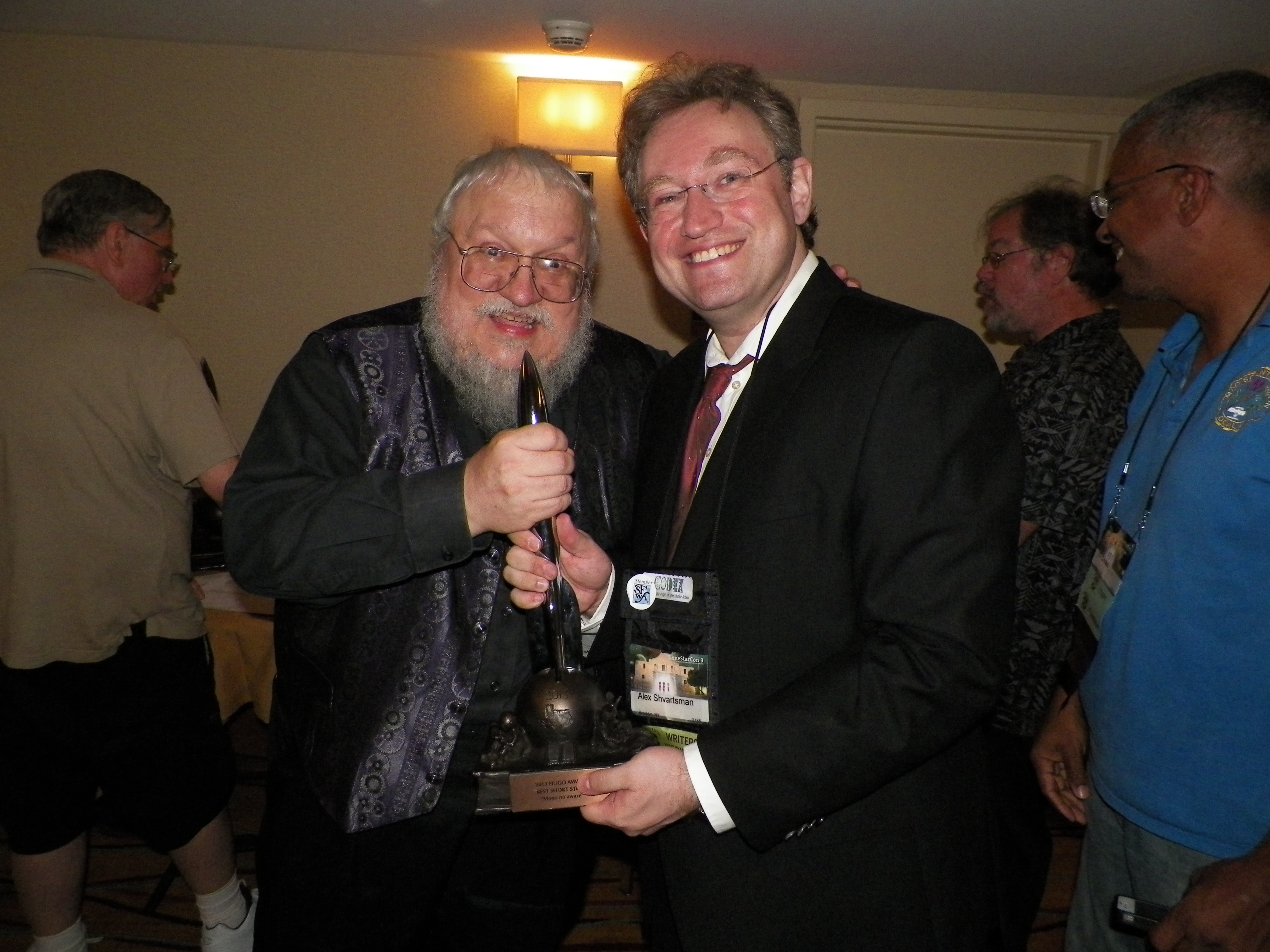
Then there was the after-party. I heard that there were supposed to be two – a Hugo Losers Party and a Hugo Winners Party. But, at least at this WorldCon, the two were combined. With the pressure of waiting for the verdicts over, everyone was able to relax and enjoy themselves. I socialized with more people, and even managed to get George R.R. Martin to bless Ken’s Hugo.
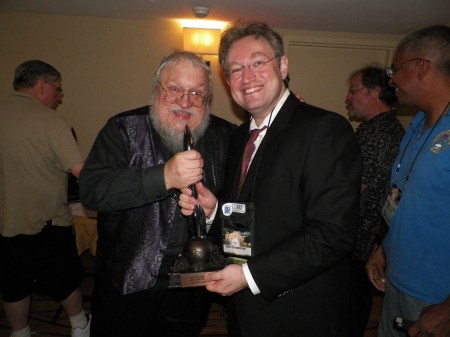
Ken’s Hugo receives the George R.R. Martin seal of approval.
It was well past midnight by then, and I had an 8 am plane to catch, so I reluctantly had to allow that wonderful day to draw to a close.
As I write these words, almost a week later, I still haven’t gotten over how amazing my experience at WorldCon was. This post is nearly 4000 words and I didn’t even cover recording a multi-author podcast for the Beyond the Sun anthology, having lunch and insightful conversation with Nick Mamatas and Maurice Broaddus, meeting legendary editors Ellen Datlow and Stan Schmidt… I could easily go on for another 4000 words. But I don’t need to because I think I have made my point: WorldCon is awesome.
Your first WorldCon experience might not be the same as mine. I can’t promise that you’ll get to hold a Hugo, or dine with celebrities. But you’ll almost certainly have your own amazing experiences, meet wonderful, quirky people, and create memories that will last a lifetime. So do yourself a favor and make plans to attend sometime. WorldCon is in London next year, and in Spokane, WA a year after that.
I hope to see you in London.


 Posted by Alex Shvartsman














 Alex Shvartsman's Speculative Fiction