The Hook: Barsk: The Elephants’ Graveyard by Lawrence M. Schoen

December 29, 2015

BarskCover

The Hook:

Rüsul traveled to meet his death. The current had carried him away from his home island as if it understood his purpose. He lost sight of the archipelago before dusk, as much a function of the falling rain as the southerly wind that pushed him onward. In the days since, the sun had risen and set unseen, a slightly brighter spot that eased itself across the overcast sky. Nor had it cleared at night to permit a glimpse of the heavens. The clouds changed color as the rain ebbed and flowed, and the wind drove him across the water of its own accord toward an unvisited destination. Rüsul didn’t care. He had no need to hurry. He could feel the increasing proximity in his bones and that was enough. More than enough. An aged Fant on a raft alone and at sea, the wind filling his makeshift sail and carrying him toward the last bit of land he would ever stand upon. His father and mother had each left in the same manner, and their parents before them. That’s how it had been, going back generation upon generation to the very founding of Barsk.

Lawrence M. Schoen writes:

Barsk is an anthropomorphic SF novel set in the far future. As an elevator pitch, think Dune meets The Sixth Sense, with elephants. Its themes explore prophecy, intolerance, friendship, conspiracy, loyalty, and a drug that allows one to speak with the dead.

As I originally wrote this book, this was the opening to chapter two. But wiser heads prevailed and even though Rüsul is not the book’s main character (not even close), he is a good place to start.

There’s a gravitas to that opening line. It’s perhaps the best hook I’ve ever written. It promises drama and emotion, destiny and agency, and then immediately slips away into building the scenario, laying down the groundwork for a story in which the weather is at least as important as life and death.

The character is resolved to an action, his death, but he’s not in any hurry. He’s set off to embrace it, and the journey will take as long as it takes. Establishing that as his motivation in the first paragraph, I was naturally obligated to thwart it, and do so with the rest of the chapter. All too quickly we discover that events have been set in motion with the express purpose of interfering with the time honored tradition of an old man (or at least, an old elephant) sailing away to his death. And if echoes of the myth of a place where all elephants go when it’s time to die are starting to stir in your mind, well, let’s just say that the book’s subtitle was no accident.

Much of the book is told from the point of view of a historian (who is also the protagonist), a chronicler with a specialty of studying the prophecies of a founder of the planet’s society. This allowed me to play with the frisson that results when exploring the past explicitly involves predictions of the future, as well as that classic physics problem of the effect observing a thing has on the thing itself. Along the way I had the opportunity to invent a new type of subatomic particle, define how memory really works, make an argument for a new type of immortality, play out some teachable father-son moments, play games with telepathy, obsession, righteousness, free will, and a really disturbing child who worked very hard to steal the entire novel away from me.

After more than twenty years writing and selling stories and novels, five published books from small presses, nominations for the Campbell, the Hugo, and the Nebula, Barsk is far and away the best thing I’ve ever written. I hope you enjoy it.

Buy Barsk on Amazon

About the author:

Lawrence M. Schoen holds a Ph.D. in cognitive psychology, has been nominated for the Campbell, Hugo, and Nebula awards, is a world authority on the Klingon language, operates the small press Paper Golem, and is a practicing hypnotherapist specializing in authors’ issues.

His previous science fiction includes many light and humorous adventures of a space-faring stage hypnotist and his alien animal companion. His most recent book, Barsk, takes a very different tone, exploring issues of prophecy, intolerance, friendship, conspiracy, and loyalty, and redefines the continua between life and death. He lives near Philadelphia, Pennsylvania with his wife and their dog.

###

#SFWAPro
If you’re an author with a book coming out soon and you wish to participate on The Hook, please read this.

FUNNY FANTASY Submissions Guidelines

December 28, 2015

FunnySciFi_cover

I’ll be publishing an anthology of reprint stories in the summer of 2016 titled FUNNY FANTASY. It will follow on the heels of FUNNY SCIENCE FICTION, my 2015 reprint anthology. For this book I’m seeking stories that are:

  • Funny.
  • Fantasy.
  • 500 – 7500 words in length
  • Were originally printed in the last ten years (2005-present)
  • Were printed in curated venues paying at least $0.01 per word – for this book please don’t send material from token and non-paying venues, self-published, posted on your blog, published in magazine/anthology you yourself edited, previously unpublished, etc. To reiterate, only material published in venues paying *all* contributors at least $0.01/word upfront will be considered.
  • Please do not send stories you previously submitted to any volume of Unidentified Funny Objects or Coffee anthologies.

Payment: $0.02 per word + contributor copy.

Rights sought: Non-exclusive print and electronic rights (aka I’d like to include your story in paper and e-book editions of FUNNY FANTASY and keep it in print for as long as I’d like. All other rights remain with the author.)

How to submit:

E-mail submissions as an RTF, DOC, or DOCX attachment to: ufoeditors @ gmail dot com

Format the subject line as follows: FF: <Story Title> by <Author> (Approx. Length)
Example: FF: Dreidel of Dread by Alex Shvartsman (800 words)

In the body of the email please specify where and when the story was originally published. If this info isn’t included I will assume the story breaks one of the guidelines above and send a form rejection.

Response times: I will try to reply within a week or two with either a rejection or a bump notice. Final decisions will be made in the Spring. Since these are reprints and I require no exclusivity, feel free to submit them elsewhere at the same time. Please send one story at a time. Once you receive a rejection or a bump-up notice you may send another.

Submission window: Now through February 29, 2016

If you’d like more insight into the kind of stories I like, I highly encourage you to pick up a copy of FUNNY SCIENCE FICTION or any of the UFO anthologies (linked to your right.)

I’m also looking to license an existing drawing for the cover. If you have something that might fit (once again, see existing covers as a point of reference) please e-mail me a link to the image.

#SFWAPro


Paying Back, 2015 Edition

December 18, 2015

Every year around the holidays I donate a few bucks to various online services and sites that I use heavily and that mostly offer their services for free. I also write this post in order to encourage others to donate also, if they can afford to. Here’s where I sent my hard-earned cash this time around:

Wikimedia Foundation

I use Wikipedia heavily whenever I need to look something up as it relates to my writing. I wouldn’t be surprised if I accessed close to 1000 listings on there in the course of 2015. Although not specifically a writing resource, most writers I know lean heavily on it as well.

Codex Writers

This is an invaluable resource and I spend a lot of my time at conventions and other writerly gatherings proselytizing fellow authors. Anyone who graduated a pro-level workshop like Clarion or Viable Paradise, or sold at least one short story to a SFWA-qualifying venue is eligible to join. Highly recommended!

The Submission Grinder

Free and easy-to-use tool to track your submissions, learn about new and active short story markets, and get estimates on how quickly editors at each venue are responding to submissions. The Grinder continues to grow and they’re 100% committed to providing their service free to all writers. They’re also publishing fiction at the Grinder’s parent site Diabolical Plots (full disclosure: a story of mine will appear there next year), as well as The Long List anthology of Hugo-nominated and near-miss stories from last year. David Steffen does a ton of work to benefit the community. In addition to a donation for his operating expenses, I’d encourage those of you nominating to consider his site for a Hugo nomination next year under Best Fanzine or Best Fan Writer categories.

Locus Magazine

This is not really a donation since I get the magazine in return for my money, but I subscribed mostly to support their efforts. Locus has been around for a long time and a ton of work goes into covering the SF/F publishing word the way they do. As an author and editor I truly have a vested interest in their success, and buying a subscription is one small way to ensure their continued existence.

Happy holidays!

#SFWAPro


Guest post: An Ode to Episodic, Serialized, and Anthologized Fiction by Emma Larkins

December 12, 2015

The following is an essay by Emma Larkins, written as part of her Mechalarum blog tour.

booktour

An Ode to Episodic, Serialized, and Anthologized Fiction

By Emma Larkins


“And specially from every shire’s end
Of England they to Canterbury wend,
The holy blessed martyr there to seek
Who helped them when they lay so ill and weak.”

-Geoffrey Chaucer, The Canterbury Tales

Ever since the dawn of language, humans have told stories. They used their tales to describe the location of food, to warn against danger, to strengthen bonds of community and friendship, or simply to pass the time.

Little physical evidence remains of these first stories, as writing didn’t exist until the Sumerians invented it around 2000 BC. Even then, oral traditions persisted: written works – and literacy – wouldn’t proliferate until the invention of the printing press a few millennia later.

Because of the oral nature of storytelling throughout much of history, stories were structured in a way that made them easily memorable. In part, storytellers accomplished this through the use of mnemonics (memory devices) such as rhyme and acronyms. Narrative structure also played an important part in memorization. For example, many similar stories were built around a particular character, like those detailing the exploits of Hercules. Other stories, like those making up Homer’s Odyssey, fit together in a particular order, building up over time to create an engaging narrative arc. Still others focused on a theme, such as the hubris of humans and how their lack of humility before the gods invariably lead to tragic consequences.

From Homer to Aesop to Chaucer, through the deft fingers of medieval bards to the bedsides of sleepy-eyed children, these stories passed from mouth to mind and back again. Over time, the words and meanings evolved until they were unrecognizable from their original form. The formats, however – episodic, serial, and collected around a theme – stuck around for good.

As literacy spread through the nineteenth and twentieth centuries, these formats started to fall to the wayside, with favor turning from the story to the novel. Readers grew accustomed to diving into the world of one author and one set of characters for an extended period of time. Literary fiction especially lent itself to the singular, long form story.

Today, these oral-tradition types of fiction are seeing a resurgence. Short form is a great way to dip into new and disruptive ideas. In this short-attention-span era, easy-to-consume is king. It makes financial sense, too – advances are dwindling (where they still exist at all), and many authors can’t afford to spend years on lengthy, detailed novels. Readers now well-accustomed to the episodic nature of most television shows easily transition to stories written in a similar form. Finally, the ever-growing interest in genre fiction lends itself particularly well to series and anthologies.

What differentiates these formats? How are they beneficial to writers? And to readers? Read on to find out!

Episodic Fiction

Episodic fiction follows a group of characters – usually in a recurring setting – as they experience life as it is revealed in the fictional universe. Alternately, the stories might revolve around a central device, such as an artifact or a location.

Episodic stories may or may not make use of continuity or story arcs. In the “snap back” trope, individual episodes act as silos: the storyline in one episode does not connect to that of the one before, and character situations and actions have no lasting consequences. In other cases, there may be some continuity between episodes.

Part of the rise in interest in episodic fiction is due to near-universal consumption of the format through television and movies. Another part is due to comic books and graphic novels gaining mainstream appeal (as demonstrated by the huge success of the Marvel movies and exploding interest in conventions like Comic Con). Audiences are more receptive than ever to one-off media experiences detailing the adventures of their favorite heroes that don’t tie together, even if those experiences directly contradict one another.

This flexibility is great for readers. They can enjoy unlimited narratives about their favorite characters and worlds without having to worry how it all fits together. They can pick up a comic book in a shop, read an issue digitally using apps like Comixology, or get a trade paperback which includes several comics in one compendium. They can jump into and out of universes at will, picking their favorite selections from a bountiful buffet.

Episodic fiction is also a boon for writers. More publications than ever before publish installments of short fiction – because readers might vary from day to day or from month to month, it’s beneficial when missing an episode doesn’t impact overall understanding and enjoyment. Writers can opt to self-publish and distribute episodic stories through their own websites, newsletters, and social media. Digital publishing platforms like Wattpad and Smashwords deliver stories to the masses in moments, with incremental funding through sites like Patreon providing authors with incentives to keep up the good work.

Serialized Fiction

Individually encapsulated episodes fill an important niche. However, often readers appreciate stories that tie together, with one or more ongoing story arcs continually fueling the hunger to discover “what happens next.”

The most well-known modern examples of book series are the trilogies, quadrilogies, septologies (and onwards) that swarm the shelves of bookstores and online retailers, often with ties to one or more popular genres.

Series can greatly benefit readers. When they find a character or universe that particularly appeals to them, they can relax knowing that their entertainment needs will be met for the foreseeable future, without the risk of diving into new works.

Many writers and publishers are fans of series as well. By their nature, series are easier to market and sell. Once you’ve got a reader hooked on one book, it’s a lot less work to get them to buy the next one than to convince them to try something new.

Series are nothing new, but we’re seeing innovations here as well. Or, more accurately, the re-emergence of trends popularized by the serialized fiction of Charles Dickens and others of his time.

Many writers now create worlds that can easily be expanded across formats and mediums. Instead of simply adding more novels to a series, they author supplementals, short stories, or novellas to fill in the gaps and enrichen their worlds. Savvy creators don’t ignore tie-in materials such as videos, games, art, graphic novels, and movies – they do whatever it takes to build an all-encompassing narrative.

Anthologized Fiction

Another way to take advantage of the modern interest in episodes and series is through anthologies – editor-curated collections of short stories that focus on a central element, such as genre (science fiction, fantasy, horror) or theme (summer romances, coming-of-age, humor). Anthologies gather together the works of many writers, giving readers the opportunity to enjoy a collection of voices, styles, and points-of-view all in one place.

Readers with hectic modern schedules appreciate the ability to dip into an an anthology for a few minutes, having completely forgotten the previous story. They can return to an anthology weeks or months after starting, without needing to remember the history of characters or storylines. Anthologies also offer an easy way to delve into the history and breadth of a genre. For example, there’s nothing quite like experiencing the what science fiction was like back in the 70’s or 80’s.

Writers enjoy great benefits from participating in anthologies. They often earn greater recognition than they might otherwise receive from publishing only their own stories. And they can experiment with new ideas and styles in a low-risk environment

Editors and publishers love collecting stories in this manner. Creating an anthology means having a whole host of authors (and their networks and platforms) to promote the work, instead of just one. Not only that – it’s a great way to build relationships with talented writers which can lead to fascinating collaborations in the future.

Episodes, series, and anthologies – fun fiction formats that are worth checking out, whether you read, write, or get paid to sell stories.

About Emma Larkins:

EmmaLarkins

Emma Larkins is a science fiction author and card game designer who loves puns. Her influences include Tamora Pierce, Piers Anthony, Douglas Adams, J.R.R. Tolkien and C.S. Lewis.

She writes accessible scifi that teases the edges of your imagination without making you feel like your brain has gone through a blender. Her characters face the world with wry humor, even as it comes crashing down around them. Her stories are filled with action and adventure. After all, what’s the point of a tall tale if it doesn’t make your heart race?

Stop by her Twitter or blog to learn more, or just say hi!

mechalarum

In the dystopian science fiction novel Mechalarum, sciencers toil in a last-ditch effort to defeat the offworld Losh, who have rained death from the skies for twenty years. They work to build and perfect Mechalarum flying suits for fearless pilots to infiltrate and destroy the Losh airships from within.

The most skilled of these pilots, Kiellen Corr, never wavers in her dedication to the cause until she is blindsided with betrayal after a fateful discovery. With her faithful sciencer friend Gage Turman by her side, she must fight to understand the true nature of the Mechalarum suits, the Losh, and herself.

#SFWAPro


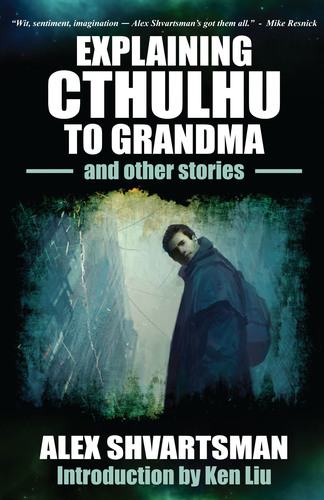
Explaining Cthulhu to Grandma at Moozvine

December 12, 2015

My award-winning humor fantasy story is now free to read at Moozvine! You can download it in e-book formats, PDF, or just read in the browser. Check out the cool cover they designed for it, too!

ectg-moozvine


Moozvine is an exciting new website that’s a bit of a mix between a free library and a crowdfunding platform. Some stories are released free for everyone to read (donations optional), while others are posted once a predetermined amount of funds has been raised. However, it’s not just the backers who get to enjoy the “funded” stories — once the story funds it is free to read and share for everyone!

Check out their library, featuring stories by Ken Liu, Nancy Kress and many other excellent authors. I should have a bit more news about Moozvine in a couple of weeks.

#SFWAPro


Dreidel of Dread: The Very Cthulhu Chanukah

December 7, 2015

I’m super glad to see Every Day Fiction return after taking the month of November off because of some technical issues. Their December stories are from authors and staff historically associated with the site. I’ve had a few stories published at EDF over the years, including my very first published piece of fiction, way back in 2010! So when they asked if I had a holiday themed story I was happy to offer them my favorite one. “Dreidel” originally appeared in Galaxy’s Edge but it wasn’t available online and I wanted to rectify that in time for Chanukah, so things worked out swimmingly.

Happy Chanukah and Merry Menorahs, everyone!

Read Dreidel of Dread: The Very Cthulhu Chanukah at EDF.

#SFWAPro


The Hook: The Worker Prince by Bryan Thomas Schmidt

November 30, 2015

TWP WFP front cover

The Hook:

Sol climbed to the top of the rise and stared up at the twin suns as they climbed into the sky. Yellows, reds, and oranges faded under the increasing blue of oncoming daylight, leaving a pinkish glow on the horizon, and the ever-present smell of chemicals and fuel filled his nostrils but he barely noticed.

For as long as he could remember, he’d started each day with an escape from the heavy, polluted air and the noise of people, factories, and traffic. The peaceful, quiet sunrises would usually calm him to face the day ahead, but today he had no sense of peace, and the silence of the city’s edge drowned beneath the clamor within him.

My precious son! My God, don’t forsake us now!

The wait had been interminable, punctured by endless prayers to God for a precious gift. Now they had to send him away—their Davi! Was there no justice in this universe?

He glanced at his chrono and sighed. Wouldn’t want to be late to serve the Borali Alliance! After one last look at the twin suns, he turned and hurried back along the path toward Iraja and the starport filling the horizon near the city’s edge below.

He labored more with each breath as heavy air filled his lungs. The depot occupied a strategic site at the center of the planet, ensuring easy access from all regions. Ignoring the droning soundtrack of the city awakening, Sol timed in on the chrono and greeted Aron, his co-worker and lifelong friend.

Bryan Thomas Schmidt writes:

The Worker Prince is a reimagining of the Moses story as a space opera. The basic premise, of course, is that a prince discovers he was born a slave and develops sympathy for his genetic family, bringing him into conflict with his adoptive ruling family. In Moses’ cases, God speaks to him, but instead, I chose to drop the Ten Commandments, burning bush, and miracle stuff, and instead focus on a hero’s journey and coming of age story. As Davi’s convictions cause him to question the status quo, he finds himself questioned by his friends and family, even as he seeks to investigate where he came from and who he is. As always with such journeys, Davi begins to transform as things he discovers match up with the liberal education his mother, Princess Miri, provided him in the Palace. Unlike most leaders in the Borali Alliance, he was taught to think for himself and question everything, an approach his Uncle Xalivar — presently High Lord Councilor and leader of the Borali Alliance — would never have allowed had he known. Soon, Davi’s convictions find him defending a slave girl from rape by a fellow officer and the officer dies at Davi’s hand. Now, Xalivar sends his special police to hunt Davi and Davi goes from prince to wanted fugitive. Events unfold that change his relationship with his once loving, doting uncle forever, and alter his whole life and sense of self.

I chose to open the book with a prologue set 20 years beforehand where Davi’s parents must send him away to save his life after Xalivar issues a decree that all first born must be slain. This accomplishes two things, establishes Xalivar and the parents early as important figures, allowing me to unfold the story and their roles more slowly, and sets up the loving family Davi was born into and their sacrificial love. Since he doesn’t discover their existence for 3 chapters, this helps us to feel an emotional connection with them and root him on in making the discovery. The book also pays tribute to the space operas I loved growing up, from Star Wars: A New Hope¸which I tried hard to capture the feel of (and am told I did), to Battlestar Galactica, Superman (Reeves), Buck Rogers, Star Trek and more. From little snippets of dialogue borrowed as a wink-wink to fellow fans, to a few plot elements, etc., I incorporated subtle pop culture references to these things while also trying hard to keep a good mix of action and humor. The story moves quickly and has a complicated plot that unfolds little by little with lots of political maneuvering, twists and turns, and more. It’s also an ode to old fashioned B-movie/golden age style stories but without the women depending on men aspect. I have women in various roles, and yes, Davi saves one from rape, but she and the others come into their own as strong women in various leadership roles, fully equal to the men. That was important to me in retelling this story for modern audiences and in representing my own experiences with strong women in my family growing up.

This book is the first in a trilogy, and sequels will follow next year, a few months apart. We redid the first one because everyone felt it deserved a bigger audience and the original micropress publisher closed down. Kevin J. Anderson and Peter Wacks expressed interest, so I revised and expanded The Worker Prince, am revising book 2, The Returning, and then we’ll release the brand new book 3, The Exodus, to finish the saga. They also designed a knock out new cover. Very excited to have the chance for more people to discover and enjoy this series. I dreamed it up when I was a teenager and it is a blast to see if become reality 30 years later.

The Worker Prince: Author’s Definitive Edition debuted November 4th in print, audio, and ebook.

Buy The Worker Prince on Amazon

Enter to win The Worker Prince on Goodreads

About the author:

Bryan Thomas Schmidt is an author and Hugo-nominated editor of adult and children’s speculative fiction. His debut novel, The Worker Prince received Honorable Mention on Barnes & Noble Book Club’s Year’s Best Science Fiction Releases. His short stories have appeared in magazines, anthologies and online. As book editor he is the main editor for Kevin J. Anderson and Rebecca Moesta’s WordFire Press where he has edited books by such luminaries as Alan Dean Foster, Tracy Hickman, Frank Herbert, Mike Resnick, Jean Rabe and more. He was also the first editor on Andy Weir’s bestseller The Martian. His anthologies as editor include Shattered Shields with co-editor Jennifer Brozek, Mission: Tomorrow, Galactic Games and Little Green Men–Attack! (forthcoming) all for Baen, Space Battles: Full Throttle Space Tales #6, Beyond The Sun and Raygun Chronicles: Space Opera For a New Age. He is also coediting anthologies with Larry Correia and Jonathan Maberry set in their New York Times Bestselling Monster Hunter and Joe Ledger universes. From December 2010 to June 2015, he hosted #sffwrtcht (Science Fiction & Fantasy Writer’s Chat) Wednesdays at 9 pm ET on Twitter as @SFFWRTCHT.

###

#SFWAPro
If you’re an author with a book coming out soon and you wish to participate on The Hook, please read this.


YA! 2015 Competition

November 25, 2015

Are you a YA author shopping around a novel? Authors.me is hosting a YA competition where you can win up to $750 in cash prizes and line edits for your manuscript. Furthermore, it’s an extra opportunity to get your book in front of potential agents and publishers.

Authors.me is a new service for both writers and publishers, something like Submittable with social media elements thrown in. They describe it as a “platform that connects writers, agents, and publishers to discover great manuscripts.”

Click here to learn more about the competition:

www.authors.me/ya2015

Disclaimer: I’m not affiliated with authors.me but I did meet with their representative this week to check out their platform, and they seem like good folks. This is how I learned about the contest.

#SFWAPro


Philcon 2015 Schedule

November 19, 2015

Today, I reached level 40.

That sounds way cooler than just saying “I turned forty years old,” you know. I celebrated with family and good friends. The best line of the evening, and I am not making this up, was “This is not a rabbi. It’s R2D2.” No context for you.

What better way to continue the celebration into the weekend than to attend a science fiction convention? I’ll be at Philcon starting tomorrow, and here’s where you can find me:

Fri 7:00 PM in Autograph Table (1 hour)
AUTOGRAPHS: JOSEPH BERENATO AND ALEX SHVARTSMAN (2361)

[Panelists: Joseph Berenato (mod), Alex Shvartsman]

Sat 1:00 PM in Plaza III (Three) (1 hour)
INCORPORATING NEW SCIENTIFIC DISCOVERIES INTO OUR WRITING (2138)

[Panelists: Alex Shvartsman (mod), Dr. H. Paul Shuch, David Walton,
Alexis Gilliland, Jon McGoran]

We now know modern humans have Neanderthal DNA. New planets are
being discovered almost on a daily basis. Technology is allowing us
to print organs. What recent discoveries are you putting into your
stories? And where will SF go now that the future is here

Sat 5:00 PM in Plaza II (Two) (1 hour)
THINGS YOU SHOULD READ (BUT DON’T KNOW ABOUT YET) (2226)

[Panelists: Fran Wilde (mod), Dena Heilik, Joseph Berenato, Alex
Shvartsman]

Not every amazing book is a best-seller. Whether it’s an unsung
classic or a recent author, come talk about the fiction you’ve found
that, strangely, nobody else seems to be talking about

Sun 11:00 AM in Crystal Ballroom Three (1 hour)
THE CHANGING FACE OF PUBLISHING (2123)

[Panelists: Sally Wiener Grotta (mod), Russ Colchamiro, Joseph
Berenato, Ian Randal Strock, Alex Shvartsman]

How is it moving away from the conventional New York publishing
scene? There are so many alternatives today (Crowd-sourcing, small
presses, independent publishers and non-print electronics) Will the
big publishers be left in the lurch

Sun 1:00 PM in Crystal Ballroom Three (1 hour)
HOW TO SELL YOUR FICTION (2122)

[Panelists: Neil Clarke (mod), Alex Shvartsman, Barbara A. Barnett,
Hildy Silverman, Danielle Ackley-McPhail, Robert E. Waters]

So you have a finally finished a story. What are the main markets?
Who do you want to avoid.

#SFWAPro


2015 Award Season Begins

November 15, 2015

Nebula award nominations opened today signaling the beginning of the 2015 award season. I’m going to be reading books and short stories for nomination this winter, but I also wanted to post the list of my publications this year, eligible in several categories, in case you might wish to consider any of them for nomination. Perhaps my strongest bit of writing to be published this year was “The Race for Arcadia” published in Mission: Tomorrow. This short story was already a finalist for the Canopus Award this year and I would love for everyone to read it. Fortunately it’s available as part of the preview for the anthology at Baen books so I’m linking it below.

If you’re reading for award consideration and would like a copy of any of the stories below, please let me know and I will do my best to provide them.

Short Stories

The Race for Arcadia — Mission: Tomorrow, Baen Books
Burying Treasure — Chicks and Balances, Baen Books
Die, Miles Cornbloom — Sherlock Holmes Mystery Magazine

Flash Fiction

Dreidel of Dread: The Very Cthulhu Chanukah — Galaxy’s Edge
Staff Meeting As Seen By the Spam Filter — Nature
He Who Watches — Fireside
Grains of Wheat — Nature
Invasive Species — Daily Science Fiction

Novelette

Islands in the Sargasso — Galaxy’s Edge

Novella

H. G. Wells, Secret Agent — UFO Publishing

#SFWAPro