Cover and TOC reveal: Funny Science Fiction

July 23, 2015

FunnySciFi_cover

Funny Science Fiction is a spin-off anthology from the Unidentified Funny Objects (UFO) annual anthology series of humorous SF/F. While UFO attempts to collect some of the best speculative humor being written today, Funny SF gathers seventeen from among the best funny science fiction stories published in the last decade.

Whereas UFO covers both genres, Funny SF collected science fiction stories specifically. There are tentative plans for a Funny Fantasy reprint anthology to follow in 2016.

Cover art is by the talented Flavio Greco Paglia. Cover design is by UFO’s amazing graphics specialist-in-residence and game designer Emerson Matsuuchi.

I’m indebted to the original publishers of these stories, who have done their share to publish and promote humor in SF/F. Special thanks to the editors and publishers of Crossed Genres and Galaxy’s Edge magazines who allowed me to include stories that are still under contract with them, because I wanted badly to make sure current short fiction is well-represented in this book.

Funny SF will be published on Amazon on September 1, 2015. It will become available on other e-book platforms in 2016.

Table of Contents:

Foreword by Alex Shvartsman

“Observation Post” by Mike Resnick (Beyond the Sun, Fairwood Press, 2013)

“Flying on My Hatred of My Neighbor’s Dog” by Shaenon Garrity (Drabblecast, 2013)

“Wikihistory” by Desmond Warzel (Abyss & Apex, 2007)

“Distant Gates of Eden Gleam” by Brian Trent (Crossed Genres, 2015)

“Half a Conversation, Overheard While Inside an Enormous Sentient Slug” by Oliver Buckram (F&SF, 2013)

“Hark! Listen to the Animals” by Ken Liu and Lisa Tang Liu (Galaxy’s Edge, 2014)

“Whaliens” by Lavie Tidhar (Analog, 2014)

“See Dangerous Earth-Possibles!” by Tina Connolly (Lightspeed Women Destroy Science Fiction, 2014)

“Kallakak’s Cousins” by Cat Rambo (Asimov’s, 2008)

“Kulturkampf” by Anatoly Belilovsky (Immersion Book of Steampunk, Immersion Press, 2011)

“Let Us Now Praise Awesome Dinosaurs” by Leonard Richardson (Strange Horizons, 2009)

“Miss Darcy’s First Intergalactic Ballet Class” by Dantzel Cherry (Galaxy’s Edge, 2015)

“Pidgin” by Lawrence M. Schoen (Aliens and A.I., Eggplant Literary Productions, 2005)

“Nothing, Ventured” by James Beamon (AE: The Canadian Science Fiction Review, 2013)

“Last Thursday at Supervillain Supply Depot” by Sarah Pinsker (Daily Science Fiction, 2015)

“Chicka-Chicka-Bow-Wow” by Mike Rimar (Cucurbital 2, Paper Golem Press, 2011)

“Troublesolver” by Tim Pratt (Subterranean Press, 2009)

#SFWAPro


The Art and Science of Anthology Editing

July 5, 2015

This post originally appeared at Locus Online, on February 1, 2015.

Now that I have five completed anthologies under my belt, the number of questions I get–from friends and strangers alike–about various aspects of anthology editing has turned from an occasional drip to a steady trickle. And while I would love to presume it’s because I’m such an awesome anthologist, the truth is, there’s fairly little information on the web regarding this niche topic. I thought it might be a good idea to collect some basic suggestions in one handy blog post. (Also, I’m incredibly lazy, and pointing people to a link is easier than cut/pasting chunks of this between e-mails!)

So, here goes:

Develop a Unique Concept

The optimal place to start is to develop a theme that is narrow yet appealing to a sizable readership, which your professional or life experience can somehow contribute to.

There are three primary reasons for a reader to pick up an anthology:

1)      It contains a story or stories by some of their favorite authors.

2)      They’re interested in the concept of the anthology.

3)      They trust the editor’s selections.

Unless you’re Gardner Dozois, Ellen Datlow, or anyone else who knows a lot more than I do about this subject (and therefore wouldn’t be reading this post), you probably won’t be able to capitalize on #3. And while we’ll cover headliners later, anthology concept is what you have the most control over.

There are plenty of space opera, zombie, steampunk, and Lovecraftian horror volumes edited by well-established anthologists. And while it’s possible to produce another quality entry into any of these sub-genres, you’re much better off exploring a narrow topic that will appeal to a large enough number of readers for the project to succeed.

My inaugural project as editor was Unidentified Funny Objects, an anthology of humorous science fiction and fantasy. I felt that there weren’t enough pro-paying venues that seek out humorous and lighthearted stories. I did some digging and discovered that no similar volumes exist or had existed in recent memory; most humor anthologies cover a specific theme (Deals with the Devil, Chicks in Chainmail, etc). As a reader, I would gladly buy an annual volume that collected wide-ranging humor stories. Happily, other readers agreed: I’m at work on the fourth annual volume. Similarly, Coffee: 14 Caffeinated Tales of the Fantastic tapped into a large, unexplored demographic; there haven’t been any coffee-themed speculative anthologies before. The book is easy to market as a present for anyone who enjoys both reading and coffee.

4books

When Neil Clarke, award-winning editor of Clarkesworld magazine, decided to launch his first anthology, he found a subject that was near and dear to his heart. Literally. A year before he announced Upgraded, an anthology of short stories about cyborgs, he survived a heart attack and had a defibrillator installed, effectively making him a self-proclaimed cyborg. Clarke wrote:

As I began looking into the possibility of a cyborg anthology, I quickly noticed that the cyborgs most people think of are villains (Cybermen, Darth Vader, the Borg, etc.). My people make excellent villains, but that only represents the tip of the iceberg. The more I thought about it, the more certain I became that this was the anthology project I had been looking for…  a cyborg-edited cyborg anthology. I don’t think that’s been done before. Besides, cyborgs are cool.

So, what unique idea do you have, and how can your life experience contribute to the project? An architect might collect tales of fantastic cities and structures. A real estate agent could gather urban fantasy and ghost stories involving houses for sale. (Plus, they’d be able to market these books to other architects and real estate agents, in addition to SF/F fans.)

Have a Plan, Have a Budget

What’s your strategy for producing an anthology? While it’s possible for a first-time anthologist to sell their project to an established publisher, this is perhaps even more difficult than selling a first novel.

Your agent could contact publishers and pitch them your idea. You will need a brief write-up of the concept and a list of headliners who are tentatively willing to contribute stories. The more appealing your headliners, the more likely you are to land a deal. There are a number of (mostly much smaller) publishers whom you can approach without an agent. Even so, it’s a long shot unless you have some sort of a pre-existing relationship or a resumé.

If a publisher accepts your proposal, they’ll pay you an advance against royalties (usually upon delivery of the manuscript) which you can use to pay your authors and cover some of your time and effort. The amount can vary greatly and is extremely unlikely to exceed $10,000.

Crowdfunding sites like Kickstarter are perhaps the best solution for such fledgling niche projects. Not only can you raise some or all of the funds needed to produce the book, but the level of interest during your funding period will be a good indicator of how well the book might sell upon release.

In recent years I’ve seen more and more “hybrid” projects, where an anthology would raise its initial funds on Kickstarter, then become picked up by a publisher who would handle subsequent sales and print distribution. For example, Bryan Thomas-Schmidt’s space exploration anthology Beyond the Sun was crowd-funded, then published by Fairwood Press.

Whatever your strategy, please be sure you are able to fairly reimburse your writers, cover artist, and everyone else involved in the project. Your contributors should be paid at least $0.05-0.06 per word, perhaps more for your headliners (some won’t write for that little). If you plan on including reprints, you can pay $0.01-0.02 per word for those. Always provide at least one contributor copy to each author.

“I can’t afford to pay much” is not only a common excuse I hear from token-market publishers, but also a terrible business strategy. Most of the accomplished authors will not submit their work to penny-pinching projects. In the end, you will have a much weaker pool of stories to select from, and the project will be far less likely to get noticed by readers and critics alike.

cover-hi-res#SFWAPro

Headliners

As I mentioned above, headliners are the top reason a reader might buy your anthology. Established authors will each have sizable fan bases who will gladly cough up a few bucks for their story alone; they might discover new authors as a bonus, which is an excellent reason to combine works from well-known authors and talented new writers alike.

Once you’ve established your anthology’s concept, think of popular authors who are especially good at writing the sort of stories you seek. Reach out to them directly. Send a polite query, including your pay rate, desired word count, and deadline.

If you plan to crowd-fund your project, be sure to mention that. Don’t ask them to begin working on the story until you’re certain you can afford to pay for it, but it’s okay to ask for tentative commitments. The same applies to anthologies you are shopping to publishers: so long as you don’t ask the author to begin the work, soliciting tentative interest so you can present your list of authors who are “on board” to the publisher is fine.

Keep in mind that popular authors are incredibly busy. Many won’t be able to commit to the project. Some will never respond to your e-mail. That’s okay–there are lots of great authors to approach, and some of them will say yes. If you’re having a hard time coming up with potential headliners for your project, you may not be quite well-read enough yet to edit an anthology.

Your e-mail should be brief, personal, and professional. Here’s a sample:

Dear Mr. Melville,

I’m in the process of putting together an anthology of short stories about whales. I greatly enjoyed Moby Dick and was hoping you might consider writing a short story for this project.

I’m seeking original stories of 2000-6000 words for Whales, Whales, Whales, and am able to offer $0.10/word for First Print and Electronic English language rights exclusive for 6 months after publication and non-exclusive rights afterward. Each contributor will also receive two paperback copies of the book and a lifetime supply of whale oil.

The submission deadline is December 31, 2015 and the publication date is August 1, 2016.

Thank you very much in advance for your consideration.

Sincerely,

Hopeful Editor

Other Contributors

Once you have a few solid headliners lined up, it’s time to fill out the rest of the book. There are two ways to go about this: you can open to submissions from the general public, or you can invite a bunch of authors directly. There are advantages and disadvantages to each approach.

Opening to submissions will likely allow you to find gems by little-known authors. Who knows, you could be the editor who discovers the next Octavia Butler or Robert Heinlein. Nothing about this process is more satisfying than nurturing and promoting brilliant new authors. However, this approach is extremely time-consuming. By posting the submission call on sites like The Grinder, Ralan, and Duotrope, you’ll likely receive hundreds of submissions. By the time you’re finished, you might sink enough hours into the project to earn less than minimum wage, but your anthology will be stronger for it.

The second approach is to identify and invite a number of authors whose work you’ve enjoyed to contribute directly. (Shameless Hint: I very much like getting invited to projects). These would mostly be neo-pros, not established best-selling authors.

The trick here is to catch people who are on their way up. Two years ago, any decent anthology could’ve gotten a story out of Ken Liu, who is one of the most brilliant short story authors writing today. By now, he’s too busy with bigger projects and has to turn down most anthology invitations. Be sure to approach authors whose work you already know and enjoy: they’re much more likely to write stories you’ll want to accept.

Cast your net wide: it’s important to solicit stories from a diverse group of authors. Let your potential contributors know that you welcome material from authors of all backgrounds, and actively seek out promising authors from traditionally disadvantaged groups. There is a ton of talent there, but even if you do an open submissions call, don’t just assume that you will get enough diverse submissions; be proactive about encouraging them. Also, I’m partial to encouraging the submission of translated stories, so English-speaking readers may be exposed to works from other countries and cultures.

Finally, it’s important to note that an invitation to submit is not a guarantee of acceptance. In fact, closed anthologies will generally invite more authors than they have room for, so that the editor can select and buy only the best of the available stories.

Selecting & Editing the Stories

If you do your job right, you will end up with more great stories than you can use. This is a good thing. An anthology isn’t just a random collection of tales united by theme: it is a work of art. The interplay of voices, styles, and plots should fit together like a symphony performed by an orchestra with you as the conductor.

To this end, most editors will whittle the submissions down slowly and only send out acceptances at the end of the process. They’re looking for material that isn’t just good, but fits well with the rest of the accepted stories.

Once the stories are in, don’t just spell-check them and throw the ones you like into the book. A good editor will work with an author to polish their story like a gemstone. In many ways, this process is similar to beta-reading and critiquing stories for fellow authors, except your opinion has more weight and you must be more careful to help rather than hinder the story. In addition to selecting the best stories, this is where your own skill and talent will matter most to the quality of the project.

Finally, there’s the devilishly difficult task of assembling the table of contents (TOC). There are many schools of thought on the subject. Some editors subscribe to “open strong, close long”–they place their one or two strongest stories at the beginning and close with a longer piece. Others prefer to mix up lengths and close on a light note, with their one humorous story at the end of the book.

This process is more art than science and no two editors will build the TOC in exactly the same way. Ultimately, it will come down to the interplay between stories, as described above.

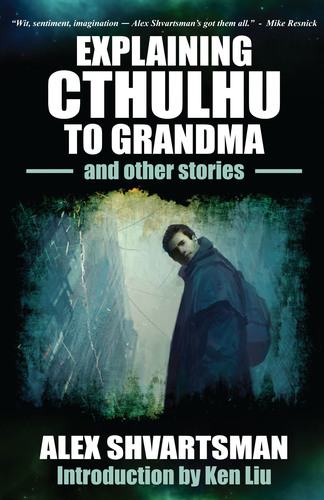
I recently had the pleasure of designing the TOC for my own short story collection, Explaining Cthulhu to Grandma and Other Stories. This is generally a bad idea, because authors are famously poor at judging the quality of their own work. Fortunately, most of the stories in this collection are reprints from pro venues, which means they were vetted by other editors. For this TOC, I took a rollercoaster approach: hopping from humorous to dark, from space opera to urban fantasy, in an effort to emphasize fun and enhance the sense of wonder for the reader. Did I succeed? Can you deduce my reasons for story placement? In a shameless act of self-promotion, I invite you to pick up a copy and find out.

Funny Science Fiction Update #2

June 29, 2015
Funny Science Fiction

Funny Science Fiction

I’ve read a LOT of funny science fiction stories so far, and have a good number in my “maybe” pile, but this is an update on the stories that have made it into the book already:

“Observation Post” by Mike Resnick (Beyond the Sun, Fairwood Press, 2013)

“Flying on My Hatred of My Neighbor’s Dog” by Shaenon Garrity (Drabblecast, 2013)

“Whaliens” by Lavie Tidhar (Analog, 2014)

“Half a Conversation, Overheard Inside an Enormous Sentient Slug” by Oliver Buckram (F&SF, 2013)

“Wikihistory” by Desmond Warzel (Abyss & Apex, 2007)

“See Dangerous Earth-Possibles!” by Tina Connolly (Lightspeed Women Destroy Science Fiction, 2014)

“Kulturkampf” by Anatoly Belilovsky (Immersion Book of Steampunk, Immersion Press, 2011)

“HARK! Listen to the Animals” by Ken Liu and Lisa Tang Liu (Galaxy’s Edge, 2014)

“Let Us Now Praise Awesome Dinosaurs” by Leonard Richardson (Strange Horizons, 2009)

“Miss Darcy’s First Intergalactic Ballet Class” by Dantzel Cherry (Galaxy’s Edge, 2015)

“Pidgin” by Lawrence M. Schoen (Aliens and A.I., Eggplant Literary Productions, 2005)

“Nothing, Ventured” by James Beamon (AE: The Canadian Science Fiction Review, 2013)

“Troublesolver” by Tim Pratt (Subterranean Press, 2009)


If you plan on sending a suggestion, please do so in the next day or two at the latest. I hope to finalize the TOC in the next week.

#SFWAPro


H. G. Wells, Secret Agent humor steampunk novella, coming in July 2015

June 12, 2015

I’m happy to share the cover of my upcoming humor novella, designed by the very talented Jay O’Connell:

HGWellsCover

Blurb:

H. G. Wells is a Victorian-era James Bond who must defend England and the world against time travelers, alien incursions and interdimensional threats (if he can learn quickly on the job, and survive the human foes he encounters, that is!)

During his missions, Wells will alternately team up with Anton Chekhov to foil an assassination plot against Prince Nicholas Romanov of Russia, oversee the construction of the giant antenna designed to detect alien invasion fleets (or, as we know it, the Eiffel Tower), rub shoulders with the likes of Arthur Conan Doyle, Marie Curie, Jules Verne and Annie Oakley, and risk everything to encourage cooperation amongst the world’s most powerful intelligence agencies.

This humorous steampunk novella is filled with Easter eggs and British pop-culture references, from The Beatles and Ian Fleming to Douglas Adams and Dr. Who.

What makes this story different:

Every single named character, from the titular Herbert Wells to the lowest gate guard, is based on a real historical personage who could have conceivably been found at the time and place of the story (which spans from 1887 to 1889.) Although the individuals the characters are based on happen to be real, the story is riddled with intentional anachronisms.

Wells, who is the newest agent of a Torchwood-like organization, wears a Babel Fish translator device, travels in the yellow submarine, and rubs shoulders with some of the most iconic individuals from the late nineteenth century.

Here’s a brief sample. Wells is at a party at the Hermitage Palace in St. Petersburg.

Sample:

Back in the Armorial Hall, Wells sought to soothe his bruised ego with strong spirits. He approached one of several bars set up for the guests. He waited for the bartender to finish serving a glass of sparkling wine to an attractive blonde.

“Have you got any gin?” Wells asked.

The bartender shook his head. “Vodka,” he said curtly. “Seven different flavors.”

“Obviously,” said Wells. “Very well. I’ll have a vodka mixed with a shot of the Kina Lillet you’ve got over there.” Out of the corner of his eye he noticed the blonde watching him with interest. Perhaps this day wasn’t entirely ruined yet. “This mixture is my own invention; I’m going to patent it when I think of a good name. Make sure it’s stirred, not shaken. Wouldn’t want the drink to be weak.”

He turned toward the blonde and flashed his best smile. “My name is Wells. Herbert Wells.”

The blonde giggled and walked off, carrying her glass. Wells sighed as he watched her go. Things really weren’t working out in the way he had imagined. He waited for his drink, composing excuses for Ministra MacLean in his head. His first mission for the Ministry was shaping up to be his last.

Wells took a swig of the proffered cocktail and coughed violently. The drink turned out to be far more potent than he had anticipated.

“You should have added lemon to that. I take a slice whenever I have to drink Cognac. Makes the vile stuff taste almost tolerable.”

Wells looked up at the man advising him, and swallowed the biting remark he was about to make. Standing in front of him was the heir to the Russian throne.

Annotations:

Readers familiar with Ian Fleming’s work may note that Wells is trying to pull a James Bond here. I couldn’t have him order a Martini because this drink hadn’t been invented yet in 1887, but Fleming was very helpful in that he wrote the line, which I steal wholesale, where Bond orders what becomes known as a Vesper Martini.

There are lots of Easter egg moments in the story where dialog or exposition are a nod to some pop culture or historical reference. For those interested in seeing if they caught them all, I’m providing a complete list of annotations after the story, which will also include some relevant images as well.

#SFWAPro

H. G. Wells, Secret Agent is slated for the release as an e-book in July.


Funny Science Fiction update

June 10, 2015
Funny Science Fiction

Funny Science Fiction

Thank you for sending your suggestions, recommendations, and your own stories for Funny Science Fiction. Please keep sending more! The anthology is coming along nicely, and I figured I would update the list of stories that are already contracted to be included, so far:

“Observation Post” by Mike Resnick (Beyond the Sun, Fairwood Press, 2013)

“Flying on My Hatred of My Neighbor’s Dog” by Shaenon Garrity (Drabblecast, 2013)

“Whaliens” by Lavie Tidhar (Analog, 2014)

“Half a Conversation, Overheard Inside an Enormous Sentient Slug” by Oliver Buckram (F&SF, 2013)

“Wikihistory” by Desmond Warzel (Abyss & Apex, 2007)

“See Dangerous Earth-Possibles!” by Tina Connolly (Lightspeed Women Destroy Science Fiction, 2014)

“Kulturkampf” by Anatoly Belilovsky (Immersion Book of Steampunk, Immersion Press, 2011)

“HARK! Listen to the Animals” by Ken Liu and Lisa Tang Liu (Galaxy’s Edge, 2014)


I will continue reading through at least the end of this month, so please send me more stuff!

#SFWAPro


Announcing the FUNNY SCIENCE FICTION Reprint Anthology

June 8, 2015
Funny Science Fiction

Funny Science Fiction

I will be editing another anthology of science fiction humor over the summer.

Tentatively titled FUNNY SCIENCE FICTION (Hey, it gets the point across, okay?), I envision it as being “just like the Unidentified Funny Objects anthologies, except it will all be reprints.” There are lots of funny stories out there that I love, and would have published in UFO without hesitation, except other editors got to them first. Still, it’s virtually impossible for anyone to read all the magazines and anthologies out there, and so I’m confident the anthology will feel fresh to the fans of the UFO series. You can expect the same variety of voices, styles and lengths, and the same wacky and occasionally difficult-to-peg down sense of humor.

The awesome picture displayed above is by Argentine artist Flavio Greco Paglia will be the cover art for this book.

Those are some of the similarities to UFO, but lots of things are different, too.

For one thing, this will be an e-book only release, at least for now. UFO books sell way better as e-books than in paper (partly because UFO Publishing is a tiny company with limited distribution). Also, e-books are way cheaper to produce. I can afford to do this on a shoestring budget and without a Kickstarter campaign or causing undue emotional harm to my wallet.

In case the book is super successful, I’m optioning the Print rights from authors. (As in, I will pay them a bit more money and be able to release the book in a print version.) Authors will be paid $0.01 per word for non-exclusive electronic rights outright, and another $0.01 per word if and when I want to exercise the print option. It’s not a lot, but unfortunately $0.01-$0.02 per word is pretty standard as reprint rates go. Ultimately I do not expect to make a ton of money from this project, but to use it as a way to promote the UFO series.

The second difference is that this book will include science fiction stories only. No fantasy. However, if it proves to be successful, the FUNNY FANTASY volume won’t be far behind! I have a fairly broad definition of science fiction, which includes superheroes, steampunk that doesn’t include magic, etc.

Also, there will be no submission window for this project as such. About half the stories will be solicited by me directly — they’re stories I’ve already read, I already love, and I will definitely include in the book if the authors let me. For the rest, I’m asking readers (and authors themselves) to recommend reading material to me.  I’m looking for stories of 500-7500 words that are SF and that are funny. Please feel free t0 e-mail me, or simply post  your favorites in the comments of this post. If you’re an author, it’s OK to recommend a few of your own stories. I’ll do my best to read everything that’s suggested, and may reach out to some authors directly and ask them to see their stories if they weren’t published online.

I’m looking to mostly include stories that were published in the last few years. (Original publication date of 2010 – present.) I may go back a few years more for my absolute favorites, but will include nothing from the 20th century. The idea is to showcase some of the best humor SF being written today. Go far enough back and the book will become filled with time-tested classics by Brown and Asimov and Sheckley, leaving little room for modern stories.

I began the process of reaching out to authors about their stories yesterday and already have three tales under contract:

“Observation Post” by Mike Resnick (Beyond the Sun anthology, Fairwood Press, 2013)

“Flying on My Hatred of My Neighbor’s Dog” by Shaenon Garrity (Drabblecast, 2013)

“Whaliens” by Lavie Tidhar (Analog, 2014)

I’m super excited to share these stories (and several others I’ve already solicited and am waiting on responses and/or contracts) with my readers.

I’ll be reading and slowly acquiring stories for this project over the course of the next month or so. Again, if you have a (recent) favorite, please let me know about it in the comments, on Twitter, Facebook, by carrier pigeon, or at a convention. Thanks!

#SFWAPro


UFO Publishing at BookCon 2015

May 29, 2015

UFO Publishing will have a booth at BookCon in NYC this weekend. I’ll be on hand to sign (and, of course, sell) books. And if you ask nicely, I might even show you the draft/preview of my next book’s cover.

So stop on by. We’ll be in booth # 3175.

#SFWAPro


UFO4 cover and table of contents

May 22, 2015

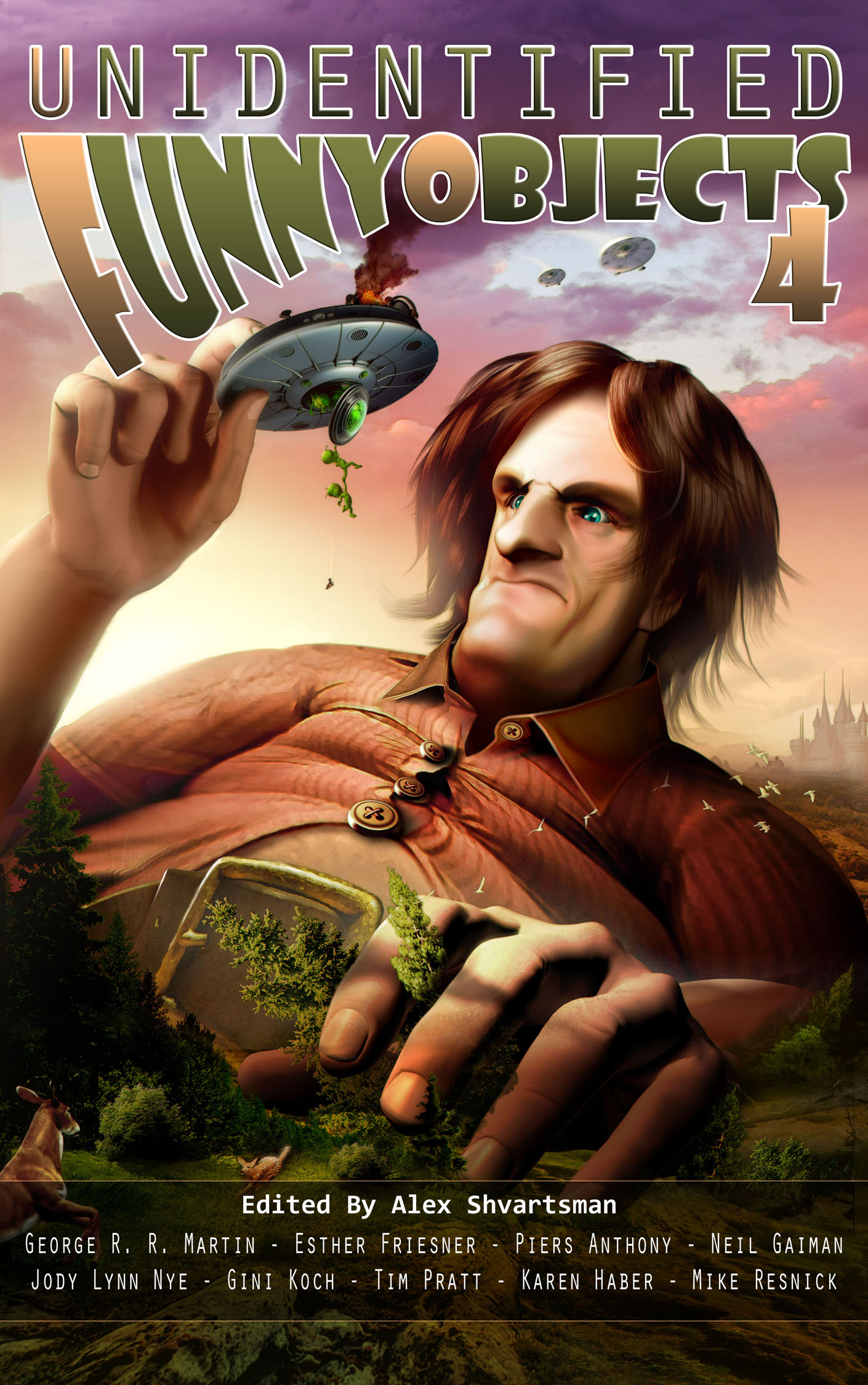
The fourth annual Unidentified Funny Objects anthology will contain 23 stories totaling approximately 86,000 words. Cover art by Tomasz Maronski. Interior illustrations by Barry Munden.

image description

Unidentified Funny Objects 4


“We Can Get Them for You Wholesale” by Neil Gaiman

“The Time-Traveling Ghost Machine of Professor Jaime Peligrosa” by Andrew Kaye

“Please Approve the Dissertation Research of Angtor” by Caroline M. Yoachim

“Match Game” by Esther Friesner

“The Transformation of Prince Humphrey” by Brent C. Smith

“In the End, You Get Clarity” by Laura Pearlman

“Project Disaster” by Tim Pratt

“Hello Hotel” by Piers Anthony

“Bob’s No Kill Monster Shelter” by Ian Creasey

“Board Meeting Minutes” by Oliver Buckram

“Armed for You” by Anaea Lay

“The Unfortunate Problem of Grandma’s Head” by Karen Haber

“My Mother Loves Her Robot More than Me and I Feel Bad” by Eric Kaplan

“The Worm that Turned” by Jody Lynn Nye

“Department of Death Predictions, Final Notice” by Tina Gower

“Champions of Breakfast” by Zach Shephard

“Keeping Ahead” by Mike Resnick

“So You’ve Metamorphosed into a Giant Insect. Now What?” by James Aquilone

“Confessions of an Interplanetary Art Fraud” by Michael J. Martinez

“Texts from My Mother about an Alien Invasion” by Tina Connolly

“Support Your Local Alien” by Gini Koch

“Topics to Avoid on a First Date with Yourself” by Jonathan Ems

“The Monkey Treatment” by George R. R. Martin

#SFWAPro


Get a free copy of Dark Expanse: Surviving the Collapse anthology

May 14, 2015

Dark Expanse cover

Dark Expanse: Surviving the Collapse is FREE at Amazon for the next few days. Grab your copy!

And speaking of anthologies, all acceptances and rejections for UFO4 have gone out. I’m waiting on one rewrite request, and on all the contracts to come in, but I expect to announce the TOC early next week!

#SFWAPro


UFO4 Slush Update

April 10, 2015

First, I’d like to thank our Kickstarter backers. UFO4 raised nearly $8500 during its campaign, enough to buy full slate of stories. interior illustration, and some exciting initiatives to be announced soon.

To date we’ve received nearly 200 submissions. Approximately 150 of them have already been responded to.  We’re still considering a handful of stories from the first week of submissions and several have been advanced into the hold pile, to be decided on at the end of the submissions window. I post fairly regular updates on Twitter as to the status of the slush pile, so folks could query if the response has gone awry. Most authors should hear within 1-3 days.

If you haven’t submitted yet, please keep sending your stories! Don’t wait til the last minute. We always see a huge upswell of submissions in the last day and that’s fine, but consider this: if a story is pretty close but needs a rewrite, we’re more likely to ask for one if there’s time for the author to deliver. If we’re at the very end of the reading period and are on the fence about the story, there may not be enough time to ask for a rewrite. Of course, if a story truly wins us over, that won’t be an issue at all — but submitting earlier is good strategy in this case.

#SFWAPro