The Hook: Children of Arkadia by Darusha Wehm

April 28, 2015
Children-of-Arkadia-cover-1000

The Hook

Raj Patel pressed his face against the porthole, his fingers locked tight around the nearby handhold. His stomach lurched and rolled, only partly because he was still unused to weightlessness. Mostly it was the emotional stew created by the sight of the massive planet appearing before him, its almost inconceivable bulk entirely obscuring the four wheel-shaped habitats he knew were there, orbiting Jupiter. Sat Yuga, Fiddler’s Green, Eden and Arkadia.

He rolled the word around in his mind. Arkadia. His new home.

Darusha Wehm writes:

Children of Arkadia is high-tech science fiction (space stations! artificial general intelligences! smart drugs!) with a pastoral, agrarian sensibility (farming! water wheels! goats!). Arkadia is built by a group of political dissidents, economic refugees and disgruntled AIs fleeing a war-torn Earth to create a new society in space. But creating a new world, with new systems — both political and technological — is challenging, even when everyone is working toward a common goal. After all, just because I treat you the way I want to be treated, there’s no reason to believe that you’re being treated the way you want.

Originally the story opened on Earth, setting the scene for why the characters leave in the first place. But this isn’t a story about Earth and what happens there. It’s a story about making something new, about leaving behind preconceptions and prejudices (or not), and how to build something better.

I realized that I wanted the reader to have that same sense of excitement and trepidation the characters had when the full understanding of what a one way trip to space entails came to them. I wanted to capture that sense of wonder I feel every time I see visions of the cosmos, the desperate desire to be out there and see it for myself, right along with the terror of making an irreversible decision.

Raj is uncomfortable, physically but also emotionally. He’s leaving behind everything he knows to do something that, on the face of it, is absolutely crazy. There’s no going back and that’s terrifying, even if the place he’s going to is meant to become a paradise. The story is all about transition from one kind of society to another, a home of birth to a home of intention. Change is frightening, even when it’s a change for the better. Opening with a visual marker of change not only sets the tone for the whole novel, but also clues the readers to some of the upcoming struggles the characters will face.

Besides, if you have the opportunity to open with the image of Jupiter heaving into view from the port of a spaceship, why would you not do that?

Buy Children of Arkadia on Amazon

About the author:

Darusha Wehm is the three-time Parsec Award shortlisted author of the novels Beautiful Red, Self Made, Act of Will and The Beauty of Our Weapons. Her next novel, Children of Arkadia (Bundoran Press), will be released on April 28, 2015. Her short fiction has appeared in many venues, including Andromeda Spaceways Inflight Magazine, Toasted Cake and Escape Pod. She is the editor of the crime and mystery magazine Plan B.

She is from Canada, but currently lives in Wellington, New Zealand after spending the past several years traveling at sea on her sailboat. For more information, visit http://darusha.ca.

###

#SFWAPro
If you’re an author with a book coming out soon and you wish to participate on The Hook, please read this.


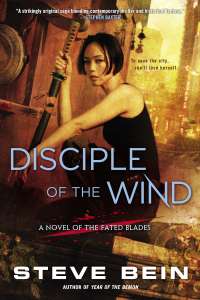
The Hook: Disciple of the Wind by Steve Bein

April 17, 2015

disciple

The Hook:

Mariko would never forget where she was when she heard the news.

Steve Bein writes:

There are those events in life that make such a deep impression that you’ll never forget where you were when they happened. Some are personal (my memory of the moment I learned about my first published story is nearly perfect, all the way down to how cloudy it was and how much sunlight was in the room), while some are so large that they define the experience of a generation.

It’s too bad that those generation-shaping moments are often tragic. Everyone of my parents’ generation can tell you exactly where they were when they heard about the assassination of JFK. Everyone of my generation can tell you where they were when the Challenger exploded. Everyone older than ten can tell you where they were on 9/11.

The first sentence of Disciple of the Wind was born out of a conversation I had with my brother the day after 9/11. I was living in Honolulu at the time, so because of the time difference, by the time I got out of bed all four planes had crashed. I’d gone to sleep in a nation at peace and I woke up in a nation under attack. My brother was living in Chicago, and heard all the events unfold one by one. There was a terrible aviation accident in Manhattan. No, not an accident; another plane went down. Then a third. Then a fourth. No one knew how many more there would be.

What my brother and I talked about was whose experience was worse? I don’t know that we ever came to an answer; the two experiences were so different. Reflecting on it now, I find it strange that I can remember the conversation so clearly, yet I can’t remember what conclusion we came to. But the fact that it stuck with me all these years is what inspired the opening pages of Disciple of the Wind.

No spoiler here: right from the first chapter, Tokyo is under assault. One explosion could have been an accident; the second one makes it a pattern. Mariko Oshiro, the only female detective in Tokyo’s top police unit, knows exactly who carried out the attack. She’s arrested him before: Jōko Daishi, leader of the Divine Wind. His cult has attempted terrorist attacks before; this time, Mariko failed to stop them.

She knows more about Jōko Daishi than any other cop in the city, but she’s never been able to watch her tongue. When she pisses off her commanding officer, she loses her badge. Now she faces an awful choice: her surest bet for stopping the Divine Wind is to abandon all the values she holds dear, join forces with a criminal syndicate, and become a killer herself.

From there I’ll just say things get a lot worse for her—and for Tokyo—before they get better. If you like police thrillers, I think this book is for you. If you like to see characters push the boundaries of their own morality, and venture into gray areas where you might be able to keep track of right and wrong, then this book is definitely for you.

Buy Disciple of the Wind on Amazon

About the author:

Steve Bein (pronounced “Bine”) is a philosopher, photographer, traveler, translator, martial artist, and award-winning author of science fiction and fantasy. His short fiction has appeared in Asimov’sInterzoneWriters of the Future, and in international translation. His first novel, Daughter of the Sword, was met with critical acclaim, and his second novel, Year of the Demon, was named one of the top five fantasy novels of 2013 by Library Journal. Steve’s newest book, Disciple of the Wind is in stores now, and his new novella, Streaming Dawn, is available now for your e-reader. You can find his work at Powell’s, Barnes & Noble, Amazon, and Audible.

Steve lives in Austin, Texas. Please keep up with him on Facebook at facebook/philosofiction and on Twitter @AllBeinMyself. Appearances, publishing news, photos, links, and more can all be found at http://www.philosofiction.com.

###

#SFWAPro
If you’re an author with a book coming out soon and you wish to participate on The Hook, please read this.


The Hook: Superposition by David Walton

April 10, 2015

Superposition cover

The Hook:

I should have known better than to let him in.  Brian Vanderhall showed up on my doorstep in the falling snow wearing flip-flops, track shorts, and an old MIT T-shirt, the breath steaming from his mouth in little white gusts.  It would have saved me a lot of trouble if I had slammed the door in his face, never mind the cold.  Instead, like a fool, I stepped aside.

David Walton writes:

Some stories start with a bang: an explosion, a death, a fire, or an arrest.  Others start more subtly, perhaps even with an event the character himself doesn’t realize will be momentous.  Either way, a story almost always begins with the moment everything changes for the main character.  It’s the spark that kicks off all the action and danger in the rest of the book.  The point when, whether the characters recognize it or not, their problems begin, and there’s no going back.

In Superposition, it’s the moment Jacob Kelley opens the door.  Before an hour is past, the man he lets in will have demonstrated an unsettling new technology and fired a gun at Jacob’s wife.  But although he doesn’t know it, it’s the moment he opens the door and steps aside that turns his life upside-down forever.

That’s why I think this first paragraph works as a hook, despite its relative simplicity.  A man comes to the house; his friend lets him in.  Not much to it, on the surface.  But there are clues to the reader that something more sinister is afoot.  For example, Vanderhall is badly dressed for the weather, as if he ran out into the snow with no time to throw on shoes or a coat.  Why?  Was he afraid?  Of what?  Also, the narrator says that he regrets letting him in (“like a fool, I stepped aside”), implying that there is trouble coming.  There’s also the suggestion that Vanderhall has been trouble in the past (“I should have known better”).

These clues work together to give the reader a sense of unease, of unsolved mystery, of trouble to come.  That trouble won’t take long to materialize–before the day is over, Vanderhall turns up dead and Jacob is arrested for his murder, and a relentless quantum intelligence attacks Jacob’s family.  I hope you’ll consider picking up a copy, and reading what happens next!

Buy Superposition on Amazon

About the author:

David Walton is the author of the newly released novel Superposition, a quantum physics murder mystery with the same mind-bending, breathless action as films like Inception and Minority Report.  His other works include the Philip K. Dick Award-winning Terminal Mind, the historical fantasy Quintessence (Tor, 2013) and its sequel, Quintessence Sky.  You can read about his books and life at http://www.davidwaltonfiction.com/.

###

#SFWAPro
If you’re an author with a book coming out soon and you wish to participate on The Hook, please read this.


The Hook: The Grace of Kings by Ken Liu

April 6, 2015

GraceofKings

The Hook:

A white bird hung still in the clear western sky and flapped its wings sporadically.

Perhaps it was a raptor that had left its nest on one of the soaring peaks of the Er-Mé Mountains a few miles away in search of prey. But this was not a good day for hunting—a raptor’s usual domain, this sun-parched section of the Porin Plains, had been taken over by people.

Thousands of spectators lined both sides of the wide road out of Zudi; they paid the bird no attention. They were here for the Imperial Procession.

They had gasped in awe as a fleet of giant Imperial airships passed overhead, shifting gracefully from one elegant formation to another. They had gawped in respectful silence as the heavy battle-carts rolled before them, thick bundles of ox sinew draping from the stone-throwing arms. They had praised the emperor’s foresight and generosity as his engineers sprayed the crowd with perfumed water from ice wagons, cool and refreshing in the hot sun and dusty air of northern Cocru. They had clapped and cheered the best dancers the six conquered Tiro states had to offer …

Ken Liu says:

The Grace of Kings is a silkpunk epic fantasy that re-imagines the rise of the Han Dynasty in a secondary world archipelago setting.

It’s the story of two unlikely friends, a bandit and a duke, who join together to overthrow tyranny only to find themselves on opposite sides of a deadly rivalry about how to construct a more just society.

The novel features a melding of classical Western epic narrative techniques with tropes taken from Chinese historical romances and wuxia fantasies. The “silkpunk” aesthetic employs many elements inspired by Chinese and East Asian traditions that I’ve always wanted to see in contemporary English fiction: silk-draped airships, soaring battle kites, honor-infused duels that are as much dance as warfare, magical tomes that describe our desires better than we know them ourselves, gods who regret the deeds done in their names, women who plot and fight alongside men, princesses and maids who form lifelong friendships, and, of course, sea beasts that bring about tsunamis and storms but also guide soldiers safely to shores.

The opening scene does two things: introducing the setting and establishing the narrative voice.

The Grace of Kings tells an epic-scaled story through individual characters that readers can empathize with and care about: a street urchin who rises to command tens of thousands under her banner, a ne’er-do-well who discovers his talent for crime as well as politics, a princess who navigates a maze of expectations to preserve the lives of her people, an actress who finds the parallels between kingship and theatre, an aristocratic scholar who is forced into inventing machines of death and plotting warfare … but one of the most important characters of them all is the setting.

The silkpunk aesthetic shares with steampunk a fascination with technology roads not taken, but what distinguishes it is a visual style inspired by Chinese block prints and an emphasis on materials primarily of historic significance to East Asia—silk, bamboo, ox sinew, paper, writing brushes—as well as other organic building materials available to seafaring peoples like coconut, whalebone, fish scales, coral, etc. The result is a technology vocabulary that feels more organic and more inspired by biomechanics. For instance, the bamboo-and-silk airships compress and expand their gasbags to change the amount of lift and are powered by feathered oars. When illuminated at night, they pulsate and move like jellyfish through an empyrean sea. Similarly, artificial limbs described in the book draw their inspiration from the “wooden ox” of Zhuge Liang in Romance of the Three Kingdoms, being constructed from intricate wooden mechanisms powered by flexible ox sinew.

The opening scene introduces the reader to this aesthetic gradually: in the following paragraphs, readers will discover that the approaching raptor is really a stringless battle kite, establishing the connection between the organic and the technological. As well, readers are given a preview of a few of the silkpunk wonders that will make more detailed appearance later on in the book.

The narrative voice of The Grace of Kings is also something where I had a lot of fun. It is a deliberate melding of narrative conventions taken from two very different traditions. There are wuxia-style flashback character introductions as well as Anglo-Saxon-style kennings, poems based on Tang Dynasty models as well as songs imitating Middle English lyrics, rhetorical devices taken from Greek and Latin epics as well as formal descriptions reminiscent of Ming Dynasty novels. The opening scene features an extended series of parallel sentences with repetitive structure to form a catalog, something familiar in old oral epics but not often seen in modern works. I wanted to cue the reader to expect something different from what they may be used to, something that should, after an initial period of adjustment, prove the right fit for the story I wanted to tell.

That’s the hook, and I hope you enjoy reading the rest of the novel.

Buy The Grace of Kings on Amazon

B&NPowell’sIndieBoundSimon & Schuster

Link to the novel excerpt at Tor.com

About the author:

Ken Liu is an author and translator of speculative fiction, as well as a lawyer and programmer. A winner of the Nebula, Hugo, and World Fantasy Awards, he has been published in The Magazine of Fantasy & Science Fiction, Asimov’s, Analog, Clarkesworld, Lightspeed, and Strange Horizons, among other places. He lives with his family near Boston, Massachusetts.

Besides Ken’s debut novel, The Grace of Kings, Saga Press will also publish a collection of his short stories, The Paper Menagerie and Other Stories, later in the year.

Visit his website or find him on Twitter or Facebook.

###

#SFWAPro

If you’re an author with a book coming out soon and you wish to participate on The Hook, please read this.


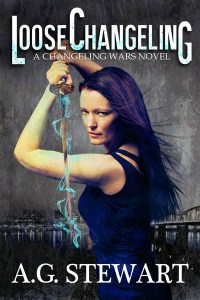
The Hook: Loose Changeling by Andrea Stewart

April 1, 2015

Loose-Changeling

The Hook:

Ever have your life turn upside down in the span of a few days? And not upside down in the just-had-a-baby or just-bought-a-house or even the my-brother-joined-the-circus-and-just-got-arrested-for-being-a-little-too-close-to-the-zebras sort of way.

I mean the sort of way where you find out you’re not actually human.

The mysteriously missing staple remover should have been my first clue that my week was about to get much, much worse. My mom liked to say that trouble didn’t just come in threes—it began with something small, almost unnoticeable, and then snowballed from there unless you did something to stop it. In her case, that meant drawing a circle on the ground to keep out unwanted spirits.

I just wasn’t that superstitious. Living in the real world does that to you.

I cradled my phone between shoulder and ear, swiveling from side to side in my cubicle, a packet of papers in my hand. “It’s not happening, Owen,” I said into the phone. I scanned my desk again. Stacks of papers sat in labeled piles, my color-coded calendar was pinned to one wall, and my scissors, staplers, and pens lay lined up by my computer, perfectly parallel to one another.

A.G. Stewart says:

Loose Changeling is a tongue-in-cheek urban fantasy, where the fairies are assholes and the two hundred year-old men come with two hundred years’ worth of baggage.

Nicole always thought she was regular-issue human…until she turns her husband’s mistress into a mouse. The next day, Kailen, Fae-for-hire, shows up on her doorstep and drops this bomb: she’s a Changeling, a Fae raised among mortals. Oh, and did he mention her existence is illegal? Now she’s on the run from Fae factions who want to kill her, while dealing with others who believe she can save the world. And there’s the pesky matter of her soon-to-be ex, without whom she can’t seem to do any magic at all…

The beginning above was actually the second beginning I wrote; during revisions, I scrapped the original beginning and replaced it with this one.

I wanted to establish a couple things in the first paragraph. Nicole addresses the reader directly for brief periods throughout. I didn’t want that to come out of left field. Second, I wanted a bit of her perky, humorous attitude to shine through, to show her personality and help the reader connect with her.

The second paragraph was my hook.

The first two paragraphs for me were about establishing tone, while at the same time leading into some conflict and setting up the premise of the book.

The third paragraph was an elaboration on the promise of conflict in the second paragraph. The missing staple remover is a lead-in to something much larger. It also gave me the chance to bring in Nicole’s mother, and to foreshadow her relationship with her family, something that becomes important much later on in the book.

In the last paragraph, we dive into the story. I wanted to show Nicole at work—the place she has always felt most comfortable—while her life was in the process of being overturned.

Another thing I wanted to establish in the opening was to set some sort of anchoring point, something I could later refer back to. One of the things I think that makes a story feel complete is the sense of having come full circle at the end. As such, I like the ending to contain some echo of the beginning, and the beginning to hold something that can later be echoed. It reminds the reader how far the character has come and what has changed. It’s like having a story about a character climbing a mountain. They begin at a gnarled oak tree at the base, and then look back at that oak tree once they’ve reached the top.

In the last paragraph, Nicole is on the phone with her husband, who is asking to get a dog. Her answer, as seen here, is an adamant “no.”

As for the ending?

Let’s just say that many things in Nicole’s life have changed, and this may be one of them—though not in the way you might expect!

Buy Loose Changeling on Amazon

About the author:

Andrea G. Stewart lives in Northern California and gardens year-round in her tiny backyard, an activity that allows for copious daydreams of distant lands and planets.  Her fiction has appeared in Writers of the Future Volume 29Beneath Ceaseless SkiesDaily Science Fiction, Galaxy’s Edge, and Orson Scott Card’s Intergalactic Medicine Show.  When she’s not writing, working her day job, or chasing chickens out of her vegetables, she hangs around the house with her trusty dog, her loud cat, and her endlessly patient husband. You can find out more about her urban fantasy series at http://www.changelingwars.com

###

#SFWAPro

If you’re an author with a book coming out soon and you wish to participate on The Hook, please read this.


The Hook: Death Marked by Leah Cypess

March 13, 2015

DeathMarked HC cThe Hook:

The mirror shattered into a hundred pieces, a sudden explosion followed by a cascade of jagged shards. Ileni whirled, throwing her hands up in front of her face, but nothing hit her: no sharp pieces of glass, no sting of cut flesh. After a moment, she lowered her arms and crossed them over her chest.

The broken fragments of glass hovered in the air, glimmering with rainbow colors. Then they faded back into the mirror, smoothing into a shiny, unbroken oval.

“Impressive,” Ileni said. She had no idea who she was talking to, but it wasn’t difficult to sound unafraid. After six weeks in the Assassins’ Caves and three days as a prisoner of imperial sorcerers, false courage was second nature to her. “But since I’m the only one here, it seems a waste of effort.”

Leah Cypess writes:

This is the sequel to Death Sworn, a novel in which a naive ex-sorceress is entombed in a cave full of assassins in training — and discovers that her entire life was built on a lie. In Death Marked, Ileni is determined to find the truth for herself. But the answers she is seeking lie in the Imperial Academy of Sorcery, a place where danger and temptation sit side by side. If her true purpose is discovered, she won’t escape alive. But once she discovers what the imperial sorcerers can offer her, she may not want to leave at all.

Except this place has its secrets, too.

The truth is never purely evil or purely good. And Ileni no longer knows whose side she is on.

Most of my critique partners expected me to start Death Marked right where Death Sworn ended. Instead, I jumped ahead 3 days so I could start with a bang (literally), and begin with Ileni situated exactly where her struggles and conflicts throughout the book would take place. She’s a prisoner in a strange new place, and discovering the secrets of this place will form the heart of the novel.

My decision made the beginning a bit less straightforward to write. I still had to explain what happened in those three days, not to mention what happened in the first book. This required me to violate the no-flashbacks-in-the-first-chapter rule, though fortunately that’s a rule I’ve never been that fond of. The trick was explaining the past in short bursts that wouldn’t slow down the forward action of the new story, while still making the sequence of events easy to understand. Beginnings are usually easy for me, but I reworked this one at least ten times. Maybe that’s typical for sequels — I guess I’ll find out when I find the fortitude to write another one!

Buy Death Marked on Amazon

About the author:

Leah Cypess is the author of several young adult fantasy novels published by HarperCollins. Her latest book, Death Marked, is the second in a duology about a sorceress forced to serve as magic tutor to a secret sect of assassins. She has also published several pieces of short fiction, including the Nebula-nominated “Nanny’s Day” (Asimov’s Science Fiction, March 2012). She lives in the D.C. area with her family. You can find out more about her at www.leahcypess.com, or connect with her on Facebook or Twitter (@LeahCypess).

###

#SFWAPro

If you’re an author with a book coming out soon and you wish to participate on The Hook, please read this.


The Hook: Sing Me Your Scars by Damien Angelica Walters

March 9, 2015


SMYS_large

The Hook:

This is not my body.

Yes, there are the expected parts—arms, legs, hips, breasts—each in its proper place and of the proper shape.

Is he a monster, a madman, a misguided fool? I don’t know. I don’t want to know. But this is not my body.

#

The rot begins, as always, around the stitches. This time, the spots of greyish-green appear on the left wrist, and there is an accompanying ache, but not in the expected way. It feels as though there is a great disconnect between mind and flesh, a gap that yearns to close but cannot. I say nothing, but there is no need; Lillian’s weeping says it with more truth than words.

The hands are hers.

“Please don’t show him yet. Please,” she whispers. “I’m not ready.”

“I must,” I say. “You will be fine.”

“Please, please, wait until after the party.”

I ignore her. I have learned the hard way that hiding the rot is not acceptable, and while the flesh may be hers, the pain is mine and mine alone. I remember hearing him offer an explanation, but the words, the theories, were too complex for me to understand. I suspect that was his intention.

Lillian will still be with us; she is simply grasping for an excuse, any excuse at all. I understand her fear, but the rot could destroy us all.

Damien Angelica Walters writes:

With respect to openings, the same rules apply to both novels and short fiction. You want to grab a reader’s attention, draw them in, and give them reasons to care and to keep reading. In my short fiction collection, “Sing Me Your Scars” is both the title story and the first story to appear.

My goal for the opening was to offer a bit of mystery, a peek at the main character’s sense of physical dislocation, and a hint that this was not a result of her own doing.

From there, I move to the rot and the stitches, which hopefully ups the stakes and also gives the reader an indication that this story owes much to Mary Shelley. But the true hook to me is “the hands are hers.” That’s the sentence that provides the connection between the rot, the main character, and Lillian and makes it clear that this creation is not just a Shelley pastiche, but something new.

All told, it’s one hundred and twenty-two words. The next one hundred and nine up the stakes even more by revealing that the rot could destroy them all. So not only is the rot something the main character can’t take lightly, but it shows that she and Lillian are not the only occupants of this body. Also included in this section is another reference to the as yet unseen “him,” the true monster in the story.

All this information is conveyed on the first page.

It was a risk opening with a period piece, as most of the stories are set in contemporary times, but I think the story sets the tone well for the rest of the collection. A hint of darkness, a pinch of grim, and stories set a little off the expected path.

Buy Sing Me Your Scars on Amazon

About the author:

Damien Angelica Walters’ short fiction has appeared in various magazines and anthologies, including Year’s Best Weird Fiction Volume One, The Best of Electric Velocipede, Strange Horizons, Nightmare, Lightspeed, Shimmer, and Apex. “The Floating Girls: A Documentary,” originally published in Jamais Vu and reprinted in the Chinese literary journal ZUI Found, is on the 2014 Bram Stoker Award ballot for Superior Achievement in Short Fiction.

Sing Me Your Scars, a collection of her short fiction, is set for a March 10th release from Apex Publications, and Paper Tigers, a novel, is forthcoming later in the year from Dark House Press.

You can find her on Twitter @DamienAWalters or online at http://damienangelicawalters.com.

###

#SFWAPro

If you’re an author with a book coming out soon and you wish to participate on The Hook, please read this.


The Hook: Flex by Ferrett Steinmetz

March 5, 2015


Flex-144dpi

The Hook:

Julian knew the exact price of everyone’s pants in this nightclub. His own pants were a shabby APO Jeans knockoff ($17), purchased in a muddy alley from a toothless Chinese man, that Julian had hand-stitched with needle and thread ($2) until they’d pass casual inspection.

On any other night, Julian would feel like a fraud in this glamorous world of $275 jackets and $180 jeans – fake it ’til you make it – but he’d smile like he was a rich businessman’s kid, not the son of an $18,000-a-year drycleaner who was dealing coke to pay his tuition ($38,439 per semester). Any other night, he’d be discreetly swapping out his water ($6 a bottle, plus a splashy-generous tip) with a smuggled flask of Popov vodka ($16.99 per gallon), drinking to muffle this horrid idea that maybe – just maybe – being rich was something in the blood, and you could never ever buy success no matter how many deals you cut.

But tonight, he’d snorted Flex. And Julian saw numbers everywhere.

Hot lights flickered over bodybuilders draped in velvet, each flexing into new hypermasculine poses at set intervals – an experimental art exhibit he and Anathema had stumbled into, lured by tumbling streams of statistics. The gallery patrons plucked toothpicked pieces of brie ($1.50 apiece) off of silver trays ($49.95 from Williams-Sonoma). Each tray had wasplike blurs of probabilities hovering over them – the secret knots that tied the future together.

Magic. He had snorted crystallized magic.

Ferrett Steinmetz writes:

The truth is, I hate prologues.

But the structure of my book demanded one, alas. The magic system in Flex is a fairly complex one, and the whole thing that drives the first half of the book is that my protagonist Paul doesn’t understand magic very well. Alas, I needed an introductory sequence that showed how magic works, and more importantly how magical drugs work, to some ordinary schmuck who – spoilers! – does not survive his encounter with them.

Yet if I had to make a prologue, I reasoned, then I would make it the hookiest damn opening I could. You can’t see it here on this web page, but I rigged the manuscript I sent out to agents so that “Magic. He had snorted crystallized magic” was the last line on the first page.

The last line? Aren’t hooks supposed to come up-front?

Well, up-front-ish.

Trick is, like any good fisherman, you have to set the hook deep so they don’t wriggle away.

See, when I started writing, I would have thought a starter sentence like “Magic. He had snorted crystallized magic” would have been a strong start. But it isn’t. It grabs your attention, sure, but it’s a candy attention, a quick rush of sugar that fades too fast. The nourishing meat and vegetables of any novel consists of a heaping tray of who is snorting this crystallized magic, why they’re doing it, and what unwise decisions they are about to make as a result of this inciting incident.

But a fatal prologue makes that introduction more complicated, giving you an intrinsic struggle: You want to make the first person your reader meets sympathetic, but so obviously flawed that there’s a subliminal undertone of don’t stick around too long. The danger here is in getting your reader so attached to the first person they see that they lose interest once you kill them off, and hence put the book down.

So what I needed was to convey the desperation of a kid who was in a fix, and out of his depth. I knew he was in a fancy nightclub. I knew he was miserable. So what would make you experience this club as Julian saw it?

When I’m trying to get into character, I put a character in a situation and then ask: what thing about this setting is something nobody else but this character could possibly notice? That detail is not only a significant window into how a character thinks, but it’s also often a good initial hook – as when a character fixates on an odd detail, the reader tends to go along with them.

In this case, I realized that a poor kid fronting his ass off in a rich nightclub would know money. Nobody knows costs better than poor people trying to pass above their paygrade. And so the opening sentence of “Julian knew the exact price of everybody’s pants in this nightclub” was born.

The trick of putting the prices in was a really low-weight way of adding detail. It’s almost subliminal, as your eyes tend to skip over prices, but it’s also a way of mirroring Julian’s thoughts. Early readers (particularly E. Catherine Tobler, a fine writer in her own right) wanted me to emphasize the dollars, adding more of them for every proper noun, which worked.

So that was, uh, the first paragraph.

The second paragraph was where I had to build sympathy quickly. One of the things any fiction writer has to answer, and answer quickly, is “Why should I care?” Sure, Julian sees prices in everything, but unless we root that in some good reason for people to have sympathy for him, then that becomes a meaningless quirk. So I churned out some backstory quickly, to establish why he’s poor and desperate, and a pretty poor coke dealer. And right at the end of the second paragraph comes that cue that little Julian isn’t going to end so well – he’s convinced that maybe he’ll never be happy, and in fact he’s absolutely correct.

And from there, I could do a bit of descriptive scenework as the bridge to that more important punch.

Five paragraphs. The hook’s at the end of the fifth, and every good writing book will tell you to start off with the strongest start you can.

But the trick is not getting the reader’s attention. It’s getting them to care, as quickly as possible. And once you’ve maneuvered your poor reader into place long enough that they have stakes in who this person is and what they’re doing…

then you reel them in.

Buy Flex on Amazon

About the author:

Ferrett Steinmetz’s debut urban fantasy FLEX, described as “A desperate father will do anything to heal his daughter in a novel where Breaking Bad meets Jim Butcher’s The Dresden Files,” is out in bookstores. It features a bureaucracy-obsessed magician who is in love with the DMV, a goth videogamemancer who tries not to go all Grand Theft Auto on people, and one of the weirder magic systems yet devised. Ferrett, a prolific short story writer, has been as nominated for the Nebula and the WSFA, Tweeters at @ferretthimself, and blogs entirely too much about puns, politics, and polyamory at www.theferrett.com.

###

#SFWAPro

If you’re an author with a book coming out soon and you wish to participate on The Hook, please read this.


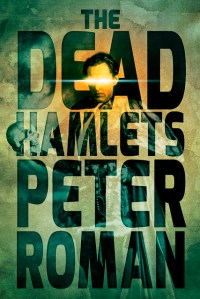
The Hook: The Dead Hamlets by Peter Roman

February 25, 2015
 
The Dead Hamlets
The Hook:

I lost the angel Baal in Berlin during a rainstorm of biblical scale. Some might say the weather was a sign of things to come, or maybe a sign of things past. But if there was one thing I’d learned over the ages, it was that the weather was usually just the weather. Usually. So instead of killing Baal and getting drunk on his heavenly grace, I found a bar on a quiet street and got drunk on regular spirits instead. It wasn’t the same, but I’d learned to make do. 

Make that drunker. I hadn’t been sober in months, not since the Barcelona Incident. The less said about that, the better. Let’s just say if I didn’t have a reason to kill angels before, I had one now.

Peter Roman writes:
The first few paragraphs of a novel are always the most important ones to me as a reader. They’re what’ll hook me or lose me. They tell me what I need to know about the style of the book, the writing level of the author, the genre coordinates — basically the whole works.
That means the first few paragraphs of a novel are also the most important ones to me as a writer. So how did I begin my new novel, The Dead Hamlets? By using the ol’ dark and stormy night intro.

It’s a dangerous game opening a book like that. But it’s the perfect start for a tale that is so strongly connected to the theatre world. The Dead Hamlets is a ghost story of sorts, where the immortal Cross must solve the mystery of who or what is killing the members of the faerie queen’s court. As it turns out, Cross’s search leads him to an ancient and startling secret about the Shakespeare play Hamlet. There’s a long tradition of dark and stormy nights in the theatre — lots of blackouts and thunder sound effects. The first stage directions of Macbeth, for instance, are “Thunder and lightning.” So I was hinting at the subject matter of my book in its opening lines. Shortly after that initial scene, I have Cross stumble into a theatre full of the dead — at which point things really get dark and stormy!

There’s a bit of the noir to this opening, too. Cross often treads the same moral ground as Raymond Chandler’s Philip Marlowe, and he operates in the shadows just as many hard-boiled detective characters do. Cross has seen it all and done it all, thanks to his immortality.

Then there’s the angel Baal, who is mentioned in that first line. Opening with Cross hunting the angel immediately sets the tone for the book and tells us a bit about his character. This is a dark and gritty urban fantasy, populated with dangerous and sometimes unpleasant people. Readers of the first book in the series, The Mona Lisa Sacrifice, will see immediately that Cross is in a grim place mentally as he’s back to hunting angels for their heavenly grace, which he needs to power his supernatural abilities. He loses Baal and then gets drunk (and later beat up), which tells us that he’s still making a mess of his life. Some things never change for Cross.

Plus, there’s that word “Baal.” The very sound of it is dark and foreboding. This is a book where nothing good is going to happen if characters have names like that.Introducing an angel in the very first sentence of the novel also sets up the supernatural nature of this book. Readers won’t be surprised when other crazy creatures show up, such as the real Witches of Macbeth, the eerie Alice from the Alice in Wonderland tales, a demon, a god of the dead — and a very supernatural and very nasty Shakespeare. If you’re down with the angel, then you’ll be fine with everybody else that arrives with weapons drawn.

As for Berlin? It sets the international scope of this book and reinforces the moodiness of the story. Berlin’s not exactly a place with a lot of happy memories and pleasant associations, after all. And I admit it’s a very subtle nod to the Wim Wenders film Wings of Desire, which featured angels hiding out in Berlin. Nick Cave, who has a cameo in the film, would probably feel at home in The Dead Hamlets.The last hook I put in the opening of The Dead Hamlets was the mention of The Barcelona Incident. This kind of lets readers know Cross has a back story and sets up where the book is in the series overall — The Mona Lisa Sacrifice opens and ends on two very different Barcelona incidents, so it’s a rich reference.

There you have it. In a couple of paragraphs I tried to set up the mood and plot of The Dead Hamlets, give an insight into Cross’s state of mind, and describe how the book relates to the first one in the series. Did all these hooks succeed? I suppose the true test of that is if you keep on reading the story. I certainly hope you do, as I’ve got a lot of tales to tell about Cross and his crazy group of friends.
About the author:
Peter Roman is the alter ego of Peter Darbyshire, a Canadian writer. Roman is the author of The Mona Lisa Sacrifice and The Dead Hamlets, while Darbyshire has written the novels The Warhol Gang and Please, which won Canada’s national ReLit Award for best novel. Both of them share an office in Vancouver, where there are no angels. You can follow their adventures at peterdarbyshire.com
#SFWAPro
###
If you’re an author with a book coming out soon and you wish to participate on The Hook, please read this.

Introducing: The Hook

February 25, 2015

The Hook is a guest post feature on this blog that will help promote other authors’ latest science fiction and fantasy books. Optimally each of these will be posted on the book’s release date.

Each post will open with a very short (up to 200 words) quote form the opening of the novel, followed by the author’s brief post consisting of two parts:

1) Elevator pitch — A paragraph or so talking about the book; what is it about, why is it awesome, etc.

2) The Hook — The author will explain why you they chose that specific scene/those specific lines as the opener. What makes it a great hook that will stick with the readers, and what makes it the right place to begin their story?

It is my belief that such posts will be both interesting to the readers and instructive to fellow writers.

I already have a number of authors lined up and will reach out directly to others on my radar whose books I’d like to bring to attention of this blog’s readers.  If you are an author who would like to participate, please have your publicist contact me. Self-published books will occasionally be featured, but those slots will be available by invitation only.

#SFWAPro