Publication: “The Field Trip” in Nowa Fantastyka

January 29, 2013

NowaFantastyka0113


My short story “The Field Trip,” was was originally published in the In Situ anthology from Dagan Books, appears in the February issue of Nowa Fantastyka, Poland’s premier SF magazine.  This is the first time one of my stories has been translated and published in another language, and the magazine looks spectacular. Plus, I get to share the TOC with Tad Williams. How cool is that?


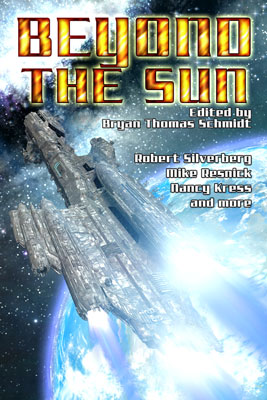
“The Far Side of the Wilderness” accepted at Beyond the Sun

January 28, 2013

BTS-Cover-400x267

I first heard about “Beyond the Sun” when editor Bryan Thomas Schmidt launching a crowdfunding campaign for it on Kickstarter. I love space opera, and was intrigued by the concept as well as by the stellar list of potential contributors. So I summoned up the courage and reached out to Bryan, asking if he would consider a submission from me.  He graciously allowed me to submit something, and a few weeks later I e-mailed him a space opera story with lots of alien races, intergalactic conflict, and other cool stuff that I was certain would win Bryan over.

It was rejected within a week.

Bryan was a class act though. Despite the fact that he knew he wasn’t going to pick up the story, he returned the file with extensive copy-edits and suggestions, many of which I adopted before submitting it elsewhere. I thanked him, and asked if I could try something else. Bryan told me that he’d let me know, but in all fairness, he wanted to get submissions from all the other writers he invited first. Which made perfect sense.

Fast forward to two weeks ago. I was down with a nasty case of the flu which was just beginning work me over. I wake up on a Wednesday morning to an email from Bryan, letting me know that I can submit something else, but I’d have to get it to him by the weekend. At this point I have no space opera story in my inventory, or even a developed idea for one. And I’m enjoying the flu.

So I sit down to brainstorm on Wednesday morning and write half a story. On Thursday morning I write the other half, and send it off to beta readers. I edit based on their suggestions and submit it by late Thursday evening, and after some very minor edits, Bryan accepts it on the following week.

This is, without a doubt, the fastest concept-to-submission-to-sale turnaround I’ve had on a story that isn’t flash-length.

Bryan announced the TOC today. It includes stories from Robert Silverberg, Mike Resnick, Nancy Kress, and many other writers I like and admire. My own story will appear between tales by Jason Sanford and Cat Rambo! Behold the complete table of contents.

Beyond the Sun will be releasing later in 2013.


Publication: Life at the Lake’s Shore in FISH

January 27, 2013

fish cover_FINAL sm (1)

At long last, the FISH anthology from Dagan Books is out!

Edited by Carrie Cuinn and KV Taylor, FISH is a collection of strange and wonderful stories of piscine nature.  My own story in this collection is “Life at the Lake’s Shore,” a magical realism retelling of the “Fisherman and the Fish” fairy tale set in Soviet Russia. The story was inspired by the Pushkin’s retelling of the fairy tale, and although it was written back in 2011, it remains one of the strongest short stories I’ve written to date. And if that doesn’t entice you, the TOC is full of stories by awesome people such as Ken Liu, Cat Rambo, Amanda Davis, and many, many more. I just got my contributor copy and can’t wait to start reading!

The e-book is available now, with a paperback copy soon to follow.

As a fledgling small publisher, I know all too well how much of a difference it makes to the publisher’s bottom line when readers choose to buy the e-book directly from the m. So don’t wait to pick it up on Amazon or elsewhere; support Dagan Books by purchasing a copy of MOBI or EPUB e-books from them!


Notable Links – January 2013 Edition

January 22, 2013

Here are some of the interesting writing- and SF-related things happening around the Internet:

raygun


Bryan Thomas Schmidt launched a Kickstarter campaign for his next anthology yesterday. This book is called Raygun Chronicles and collects space opera short stories from the now-defunct Raygun Revival magazine as well as a number of original stories.  Raygun Revival was most recently owned by Every Day Publications (which produces the excellent Every Day Fiction magazine) so you get to support both Bryan and EDF in one shot. Click here to pre-order your copy via Kickstarter.


amazingstories


Amazing Stories is back! It’s relaunching this week at amazingstoriesmag.com

Steve Davidson rescued the world’s oldest science fiction magazine when the previous owners allowed its trademark to lapse. Davidson registered the trademark and spent several years working behind the scenes to resurrect the storied brand.

There is no original fiction – yet. But there are several dozen bloggers who will be covering various topics of interest to SF fandom, including some very familiar names. If all goes according to plan, new fiction is soon to follow.

This isn’t the first time Amazing Stories has been brought back to life. It remained in print for nearly 70 years, finally closing its doors in 1995. Two different publishers attempted to engineer its comeback, but neither attempt succeeded. Let’s hope that third time is the charm and that Amazing Stories will be here to stay.


3-Logo

While Duotrope is doing whatever it is doing behind a pay wall and Submitomancy is still in the process of raising the funds necessary to code their site, Diabolical Plots masterminds Anthony Sullivan and David Steffen created a basic, effective, and free-to-use Wiki tool to track and report submissions called The Submission Grinder.

Although the site is fairly basic and there are still some bugs, it is improving rapidly and moving in the right direction. Anthony and David are committed to always keeping the service free to its users (though there’s a handy Donate button if you’d like to thank them for their hard work!).

But no matter how great a job the two of them do, Wiki sites are always only as good as their data. I encourage the readers of this blog to create accounts and upload their submission results. In my estimation, if we can get over a thousand active users on the site (its at just over 250 as of today), we can turn an already useful tracking tool into a useful and reasonably accurate snapshot of what’s happening at speculative markets.


Publication: A Brief Respite from Eternity at Toasted Cake Podcast

January 21, 2013

Tina Connolly did a great job reading my flash story “A Brief Respite from Eternity” at the Toasted Cake podcast.

This is a space opera about love, eternity, and the heat death of the universe. It was originally published in Stupefying Stories in April of 2012.

Also, Bogi Takacs reviews two of my religion-inspired SF stories on her blog. Spoiler alert: she likes one of them 🙂


Schrodinger’s Story

January 12, 2013


I enjoy every aspect of creating a new story, but one.

I like the brainstorm part, where an idea settles in, usually over the course of multiple days, before I ever type the first word.

The first draft is especially cool. Often the story runs amok and I discover things about the characters and the world of the story that I never originally intended. This is where, when I’m lucky, I write my best lines.

Revisions are cool, too. I go over the feedback from my crit partners and beta readers to nip and tuck at the story and give it the best possible face lift. Sometimes merely the act of letting the story sit for a few days and approaching it with a fresh eye will allow me to identify weak spots in the writing and fix them.

I enjoy sending the stories out on submission, and the thrill of making it past the slush readers and of an occasional sale. Rejections are OK, too. They’re part of the game.

Editorial revisions and copy-edits are fun; a competent editor will always make the story better and make me look smarter in the process.

And, of course, there’s nothing like the feeling you get when a story is published and I get to share something I created with thousands (hundreds? tens?) of readers out there.

There’s only one part of the process I really hate: the time spent waiting on feedback after the story has been polished enough to show to friends and critique partners, but before they get the chance to respond.

At this stage I call them “Schrodinger stories” because I don’t yet know if the story is alive or stillborn. It’s very difficult for any writer to evaluate the quality of their own work. Some of the pieces I think turned out brilliant get their heads bashed in during this round of feedback. There are clear problems, gaping holes in the plot, or trouble conveying what I want to convey to the reader.  Such stories may need lots more work, or even to end up in the “Come back to this one day later. Much later” pile.  On the other hand, there are stories I don’t have as much confidence in that sometimes come back with better reviews than I expected. Arguably my two strongest flash fiction stories published to date are “Spidersong” and “Nuclear Family” — both were written in one sitting, and both were stories I felt somewhat skeptical about upon finishing them.

The smart thing to do would be to move on to the next project, but I find it difficult to do so until I finalize the current work-in-progress and get it out on submission. So I usually find other things to do — editing, critiquing, and writing blog posts, to while away the time.

Can you guess what stage my latest story is in, presently? 🙂


Win a copy of Unidentified Funny Objects!

January 8, 2013

There’s a giveaway on GoodReads that’s beginning tomorrow. Click to enter!

Goodreads Book Giveaway

Unidentified Funny Objects by Alex Shvartsman

Unidentified Funny Objects

by Alex Shvartsman

Giveaway ends January 23, 2013.

See the giveaway details
at Goodreads.

Enter to win

And if you don’t want to wait for a chance at a freebie, you can buy a copy on Amazon, B&N, Kobo or directly from UFO Publishing.


Submitomancy Premium Features Explained – A Guest Post by Sylvia Spruck Wrigley

January 4, 2013

submitomancy

Ever since Sylvia Spruck Wrigley announced the project she’s spearheading to create an advanced submission tracking web site, the most common question I’ve seen was: “If I’m not willing to pay for Duotrope service, why should I give money to this?”

So I asked Sylvia to explain the premium Submitomancy features in some more detail. Also, it’s very important to note that all basic functions of the site will be available for everyone to use for free.

Sylvia’s post, below:

The core of the Submitomancy service will be free. This allows writers to record their manuscripts and track their submissions. But the really fun stuff, in my opinion, is in the pay-for service.

Here’s an example of the process that a subscriber to the pay-for service might follow. This is all optional, of course! Subscribers will obviously choose the options that they find most useful and although I am focused on short stories for this example, we’ll be supporting poetry as well. Here’s my own personal vision of what I would do having completed a new story.

First I enter my manuscript details. The manuscript database is part of the core service but as a subscriber, I’ll get a secondary page of data that I can track (I’ll be refining down the details of this with the early access users). I’ll also have the option to share the title of my latest masterpiece with my friends. In the future, I might be able to submit it directly to my personal critique partners (who are of course, also using the site and loving it) but for now, let’s assume my story is shiny and perfect.

For a free search, I would get a basic list of markets that I can then read through to make a decision.

But as a subscriber, I get power searches, which have a lot more granularity. My preferences are saved as a part of my profile. For example, a user might set his default to show pro- and semi-pro markets who have sent personal responses in the past, sorted by acceptance rates. My personal default might only show me SFWA qualifying markets, unless there are fewer than three matches, in which case I want to see all matching pro-markets. The point is that, once I’ve set this up, I’ll see the key markets for my manuscript with a single press, with the ability to expand the possibilities at search time. Markets that I have marked as favorites will be highlighted.

Once I have my list, I can re-sort on the fly and click through to look at a market profile.

Everyone can see general market information along with the average response time and average acceptance rate. As a subscriber, I’ll get extra information, including the recent responses and the average response rate for that market over the past 6 weeks. I’ll get a break-down of the acceptance rate with, if we can get the data, percentages by author gender and story word count. This personalised market listing will also show my history with that market: my submissions, response times and type of response. This means if I am an “outlier”, I have my past data on the page for reference. If the market has sent me personal comments in the past and I entered those comments into the system, they will show up for me here.

As a subscriber, I will also see a button on the market page to generate a cover letter. If I press this button, the system takes four pieces of information:

* My manuscript details,
* My most recent three sales (which I can override with my three favorite sales),
* The market details,
* The market guidelines (if cover letters are mentioned).

With this information, the system will create a cover letter for me to use. I can copy the text (and edit it if I like, for example if I am on a first-name basis with the editor) and then paste it into my submission, whether it’s postal, form-based or an email.

Once I’ve done the submission, I can send an update to my friends so that they can cheer me on. Now the waiting begins.

Quite honestly, I spend too much time watching market pages so an important aspect of the pay-for service for me is the notification service. This is a process which watches my submissions for me and maps them against the recent responses. When specific conditions are met, I’ll receive a private message which could also be sent to my email or Twitter account to alert me.

An obvious alert is when a market responds to a manuscript that has been out for the same number of days as my story has been with them. That function alone will seriously help my pointless refreshing problem. But there will be a number of options which I plan to refine with the early access users.

Some examples: I might notice a market has been silent for a month and ask for a notification to show me when a response has been reported. I can see Analog recent responses are a lot longer than they have been traditionally and sign up for an alert when their response rate drops below 60 days. And for every submission, I’d like to be notified if a response is past due so I can consider querying. That query letter can be generated with the manuscript title and date of submission, along with the correct procedure for querying at that market.

Once I get the acceptance (this is my fantasy system, so of course every response is an acceptance), I enter it into my personal database with the pay rate, the exclusivity period and any personal comments. I can update it when I receive the contract, when I receive payment and when the story has been published.

Now I can set up a new notification to alert me when the exclusivity period is finished. I will have a search available to show me reprint markets. This might get a bit complicated: there are so many different rights and contracts vary, so I suspect that for every story, the writer will have to go through the markets and see what works. Eventually, I’d like to be able to search for audio publications and foreign language markets, if I still have those rights available. Certainly, I’d love to be prompted to offer my story to a wider market.

That’s my dream. I can’t guarantee that every aspect of that process will be available at launch but I hope that most of it will be in place. Especially that 100% acceptance rate on my account.

When Submitomancy goes live, the premium service will cost $20 per year, not $50 Duotrope is now charging.
You can donate to the Submitomancy crowdfunding campaign on IndieGoGo.

Publication: The Miracle on Tau Prime

January 3, 2013

dsf

The Miracle on Tau Prime” went live on the Daily Science Fiction web site today. So if you haven’t subscribed to free DSF e-mails (and shame on you if you haven’t!), you can now read it online. This is the story about the Vatican miracle investigators… in space!

I had many fine stories published this year, but this may be the strongest story I wrote and had published in 2012. Do check it out.

In other news, Rebecca Roland interviewed me on her blog today.  I tried my best to be entertaining. Head over to her blog, read the interview, and let me know how I did 🙂

And finally, a completely unrelated but absolutely awesome bit, about William Shatner’s Twitter exchange with a real-life astronaut.


2012 Year In Review

December 31, 2012

w1s1-2013

In 2010 I began writing fiction and managed two token sales.

In 2011 I made my first professional sale and began building a bibliography.

And 2012 has been the best year yet.  Here are some of the highlights for me this year:

* Qualified for full SFWA membership.
* Was accepted to and attended the Viable Paradise workshop.
* Edited and published my first anthology project.
* Attended my first SF convention as a guest/panelist.

And although I’m proud of each and every one of those accomplishments, perhaps the most important achievement for me is this:

* I now believe that I can sell what I write.

This sounds less impressive than it actually is. But the truth is, confidence is hugely important. The ability to write fiction without second-guessing myself, without wondering if the latest story I’m working on is at all viable, is liberating and something I’m only recently able to do. The “pretender” syndrome of “I’m-n0t-a-real-writer-I’ve-just-been-lucky-with-a-few-short-stories” is more difficult to shake than you might expect. But statistics are on my side, showing that most of what I write consistently sells, at least at semipro level.

In 2012 I completed a total of 24 short stories, totaling almost exactly 50,000 words. Of those 24, I felt that 20 were good enough to submit (and may yet revisit the remaining four and fix them up).  I already sold ten of them (7 to pro-paying markets). I also sold almost every story I’ve been submitting since 2011.

Part of this success is due to submitting very aggressively. I spent time researching new markets, tried to make sure I never had too many stories hanging out on my hard drive without being out for consideration somewhere, and was perfectly willing to have the story debut in a smaller market rather than remain unpublished.

Write1Sub1 challenge (which I will continue in 2013) had helped. Also, my goal of hitting a total of 200 submissions kept me going as well. Sending out 200 submissions in a year is *hard*. I barely managed it, shipping off a few stories this past week just so I can reach that number. Here are my statistics for the year:

Submitted: 203

Currently out on submission: 13

Lost / never responded: 1

Rejected 159

Accepted: 30

There were also a number of stories accepted in 2012 which I submitted in 2011. A total of 35 stories (including reprints) were accepted in 2012. Of these 35 stories:

10 sold at pro pay (5c+ per word)

16 sold at semi-pro (1-4c)

3 sold to token markets (2 to Every Day Fiction and 1 to Toasted Cake. I donated the payment back to those markets)

6 reprints were donated without pay (5 to podcasts, one to a charity anthology).

And the stories that are still circulating? Although there are a few oldies I really like and can’t quite let go off, most are recent work, from late 2012, and I have every confidence that they will find quality homes soon!

So what’s the plan for 2013?

I actually expect LESS sales next year. Because I want to spend more of my time on writing novel(s), editing, and translating. So with that in mind, my 2013 goals are:

* Complete at least one novel and begin shopping it around to agents/publishers

* Continue to participate in the Write1Sub1 initiative and write at least one new short story per month.

* Translate into English at least two SF/F short stories by Russian authors

* Attend at least one major SF con (something like WorldCon or World Fantasy) and a few smaller ones

I wish everyone the best of luck with setting and accomplishing their own 2013 goals. Happy New Year!